Teaching for Sustainability — integration or transformation?
Yesterday, I participated in a workshop by the Swedish Education for Sustainable Development working group, and it sparked a lot of thoughts. The workshop was one of those formats where the agenda is set at the beginning of a meeting, based on what topics participants bring. In my breakout group, we discussed whether it is enough to integrate sustainability in teaching, or whether we need a radical transformation of the whole system, given the urgency and that the system is pretty broken anyway.
This is a topic that I have thought about a lot previously and don’t really know where I stand.
On the one hand, I think that we will need to transform the system.
On the other hand, I don’t know how. As they say, you cannot dismantle the Master’s house with the Master’s tools. But the Master’s tools are the only tools I have — I have spent basically my whole adult life in academia and it is very difficult to imagine a radically different system from the inside (although we are trying to imagine different futures, and are trying to find inspiration for example in our Teaching for Sustainability journal club, reading for example “Stories of Hope“, and the “Everyday Changemaker” book to create a shared vision in our community).
On yet another hand, I feel very reluctant to move too quickly and radically. Yes, there is urgency. But education is also a wicked problem, so we know that there is no perfect solution (and even if there was, we don’t know what it is). It then seems like good advice to carefully feel our way forward step by step, monitoring closely for intended and unintended consequences, and making sure to adjust the course. That is the paradox of sustainability: While working for sustainability, we need to understand sustainability as emergent. We cannot define it, instead we need to invite everybody into the process to figure out what it can be. The process is the point, and we need to do the process in a way that aligns with the desired outcome, and we need to do it together.
So what to do?
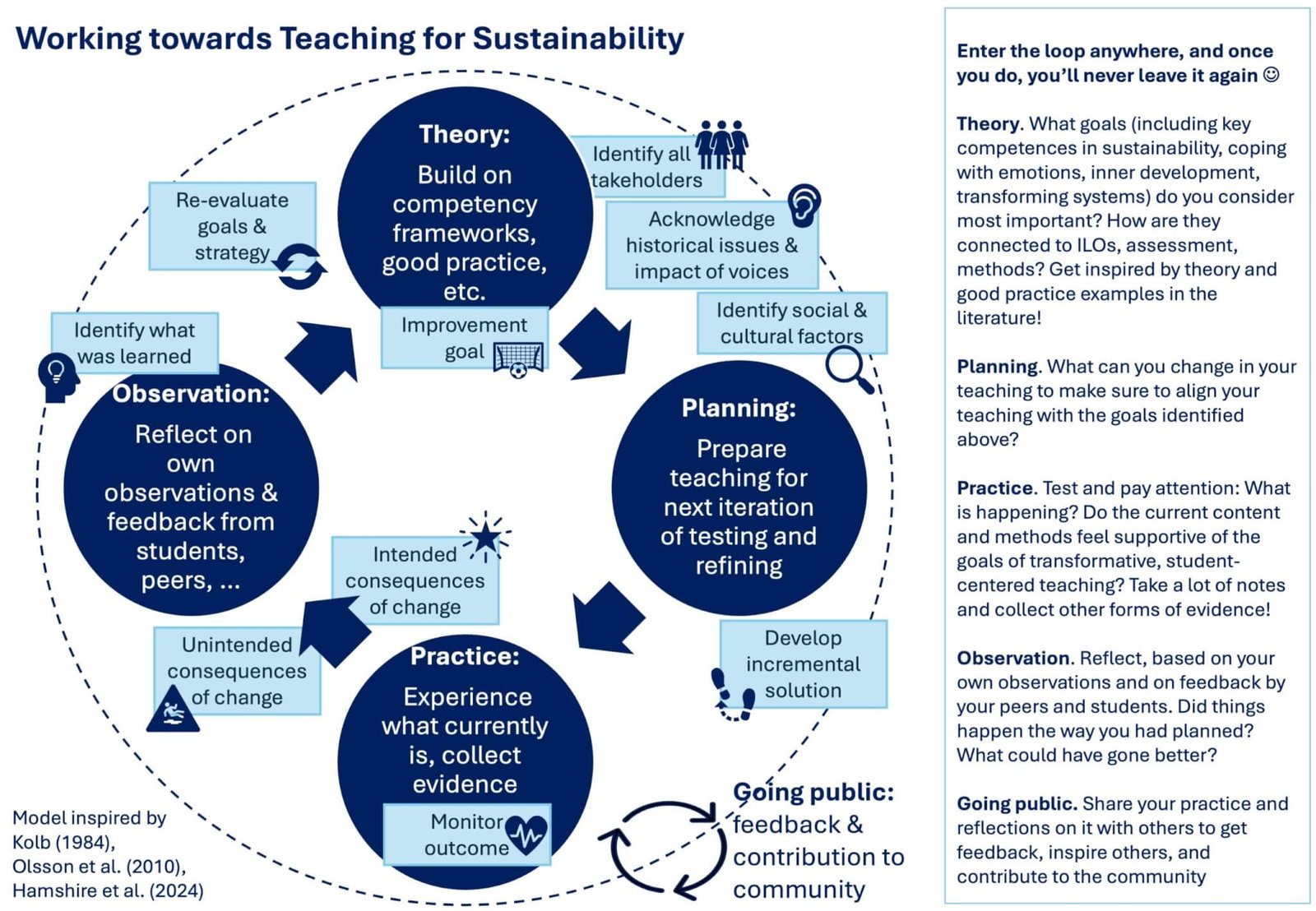
I think for now, I am going to stick with the baby steps. At Lund University, we work a lot with the Lund model of pedagogical competence by Olsson et al. (2010), which is basically based on Kolb’s (1984) experiential learning cycle: Have an experience of something, reflect on it, draw in theory to make more sense of it, plan the next experience, and start over. And, in the model for pedagogical competence, share your experiences and reasoning SoTL-style so a) you can get feedback, and b) the community can learn from you. If we combine this model with a wicked problem approach (read more about that in Hamshire et al. 2024), we get to something like the image above (dark blue circles are Kolb/Olsson, light blue rectangles are Hamshire).
What do you think? This is only a quick first draft and Kolb/Olsson and Hamshire are just added in the same slide rather than actually integrated, but would such a visualization of a process be useful to guide thinking about changing teaching for sustainability? Or does it lead us away from what we actually want? Would love some feedback!


Quick recap of the “Sustainability Research and Teaching in a time of polycrisis” symposium at Södertörn University - Adventures in Oceanography and Teaching says:
[…] two days was about whether we can dismantle the Master’s house with the Master’s tools, which I wrote about before. In sustainability teaching, we want transformation, at the same time, we need to treat it as a […]