Tag: GenAI


Currently reading Hingle & Johri (2026) on “A guided inquiry approach to students co-designing generative AI course policies”
In their study, Hingle & Johri (2026) describe a 4-week module in a course on a related topic, in which students first learn about how GenAI works both technically and in society.

Currently reading Bryant (2026) on “Rebuilding a Culture of Trust in Teaching and Learning in an Era of Generative Distrust”
Bryant (2026) starts from the premise that “the decline of trust in institutions is the real existential threat for teaching and learning“. Trust in institutions, they say, has been declining for a while, but this has intensified with the availability of GenAI, and the imperfect way in which both teachers, students, and institutions react to […]

Currently reading: Corbin et al. (2026) “On AI glasses and wearable AI in assessment”
One of the seemingly most promising responses to GenAI being misused in assessment situations has been to (try to) physically exclude technology by creating assessment situations where the assessor observes what the student is doing (like in face-to-face oral or proctored assessments). But what if accessing GenAI does not require a computer or phone, but […]

Reading about GenAI tutoring
In Kestin et al. (2025), discussed in yesterday’s iEarth journal club (pity I missed the discussion!), an “AI-powered tutor” is compared against an active learning class, and they find that “students learn significantly more in less time when using the AI tutor, compared with the in-class active learning. They also feel more engaged and more motivated“. […]

Currently reading Bearman et al. (2026) “Time, emotions and moral judgements: how university students position GenAI within their study”
What caught my eye about this article was that Bearman et al. (2026) write that “students prioritise their developing values and moral positions over institutional messaging“. Sounds intriguing, and somehow inspires hope in the future, doesn’t it?

Currently reading Hershock et al. (2026) on “Unpacking SoTL “Failure”: Lessons from a Fellowship Program Investigating Generative AI’s Impacts”
We use SoTL projects a lot in our academic development work, and from an appreciative inquiry approach: hyping up and building on the good practice we see and carefully addressing the rest when we feel that can be done without harming relationships. We typically talk about the very good and interesting projects we see, but […]

Currently reading Nguyen-Trung & Friese (2026) “Towards a methodologically congruent framework for GenAI use in nonpositivist qualitative research”
I’ve written repeatedly about how using GenAI for qualitative analyses is a bad idea. In this paper, Nguyen-Trung & Friese (2026) present a different, very interesting and nuanced perspective. My summary below.

Currently reading Paxton et al. (2026) on “The Affective Impact of Generative Artificial Intelligence on Instructors of First-Year Writing Courses”
Even though this study is on writing instruction — which is probably the subject that is affected most by the presence of GenAI — I think it is relevant far beyond: What does the presence of GenAI do to teacher emotions?

Currently reading “the WONKHE report” by Dickinson & Marshall (2026)
I’ve seen lots of summaries and references to the “WONKHE report” on AI, so I had to check it out. It is based on focus group interviews and a survey with responses from more than 1k UK students, and it is a bit difficult to read because it is not always clear what results are […]

Currently reading Laidlaw (2026): “When faculty ask, ‘what’s the point of teaching?’: GenAI as identity crisis, not skills gap”
Another article that I read just now and that really resonated with me is Laidlaw (2026), where they explore teachers’ reactions to GenAI as an identity crisis, not a skills gap.

Currently reading Kotz et al. (2026) on “Conversational AI shifts beliefs and policy support among skeptics across contested societal issues”
The central question in Kotz et al. (2026)’s preprint is about “understanding how to increase evidence-consistent beliefs and support for empirically grounded policy responses” on contested societal issues. They investigate whether conversations with LLMs can change peoples’ minds, and if so for what types of audiences it works best. They build on other research that […]

Currently reading Rettberg (2026): “AI-generated podcasts: Synthetic intimacy and cultural mistranslation in audio overviews from Google’s NotebookLM”
When LLMs were new, a participant in the Inclusive LU course I was teaching did a project where they explored using AI to generate podcasts about scientific articles to make them more accessible to the students. They generated a couple of podcasts on different articles and discussed the quality in terms of correctness but also […]

Currently reading Yüce et al. (2026) on “ChatGPT vs teachers vs students: Large-scale analysis of generative AI discourse in education communities on Reddit”
I always like studies that use authentic data from out in the wild. I think it is so elegant to look at what is happening in real life rather than trying to generate data and then having people not respond leading to too small sample sizes, people misunderstanding the question (which might also have been […]


On teaching issues as controversial vs as settled
Related to whether we teach in a fact-based, normative or pluralistic way, there is also the issue with teaching about topics that might be controversial (hello again, sustainability, and my post earlier on conflicts and resistance), and how to deal with that. After recently having heard his work on “teaching controversial issues” summarized as “don’t […]

Currently reading Jowsey et al. (2025): “We reject the use of generative artificial intelligence for reflexive qualitative research”
Loved reading this short piece in which 419 qualitative researchers from 32 countries write very directly that they reject GenAI in reflexive qualitative research because 1. GenAI is incapable of meaning-making; 2. Qualitative research needs to be done by humans; and 3. GenAI is too harmful to the environment and to the human workers who […]

Currently reading Morris & Maes (2026) on “Same Feedback, Different Source: How AI vs. Human Feedback Shapes Learner Engagement”
There is a “study out of MIT” that somehow absolutely dominated my LinkedIn feed a couple of weeks ago (the source really typically given as “study out of MIT” or very similar, so I had to do some digging to find it! But maybe the clue should have been in the missing citation already…). Anyway, […]


Currently reading Shen & Tamkin (2026) on “How AI impacts skill formation”
In the preprint “How AI impacts skill formation” by Shen & Tamkin (2026), study participants are learning a new Python library either in a control condition or with an “AI assistant”, and researchers observe how the participants prompt AI during learning and measure completion times and quiz scores after learning. They find that “AI-enhanced productivity […]

Currently reading Most & Clout (2026) on “Education As The Lighting Of A Fire: Personal Connection Strikes The Match”
I see statistics on social media every day about 1 in 3 young people who say that there are topics they talk about with an AI but not with another human. And almost all our students report that they use AI for learning, because they aren’t being judged, they don’t feel like they are bothering […]

Playing with simulations of dyslexia, colorblindness, and more
We want new engaging web content for the Inclusive LU project, and I wanted to try how easy it really is to use AI for coding (turns out: very!), so I have built a page that — at first glance — looks exactly like this post, but when you hover different sections, things start happening. […]
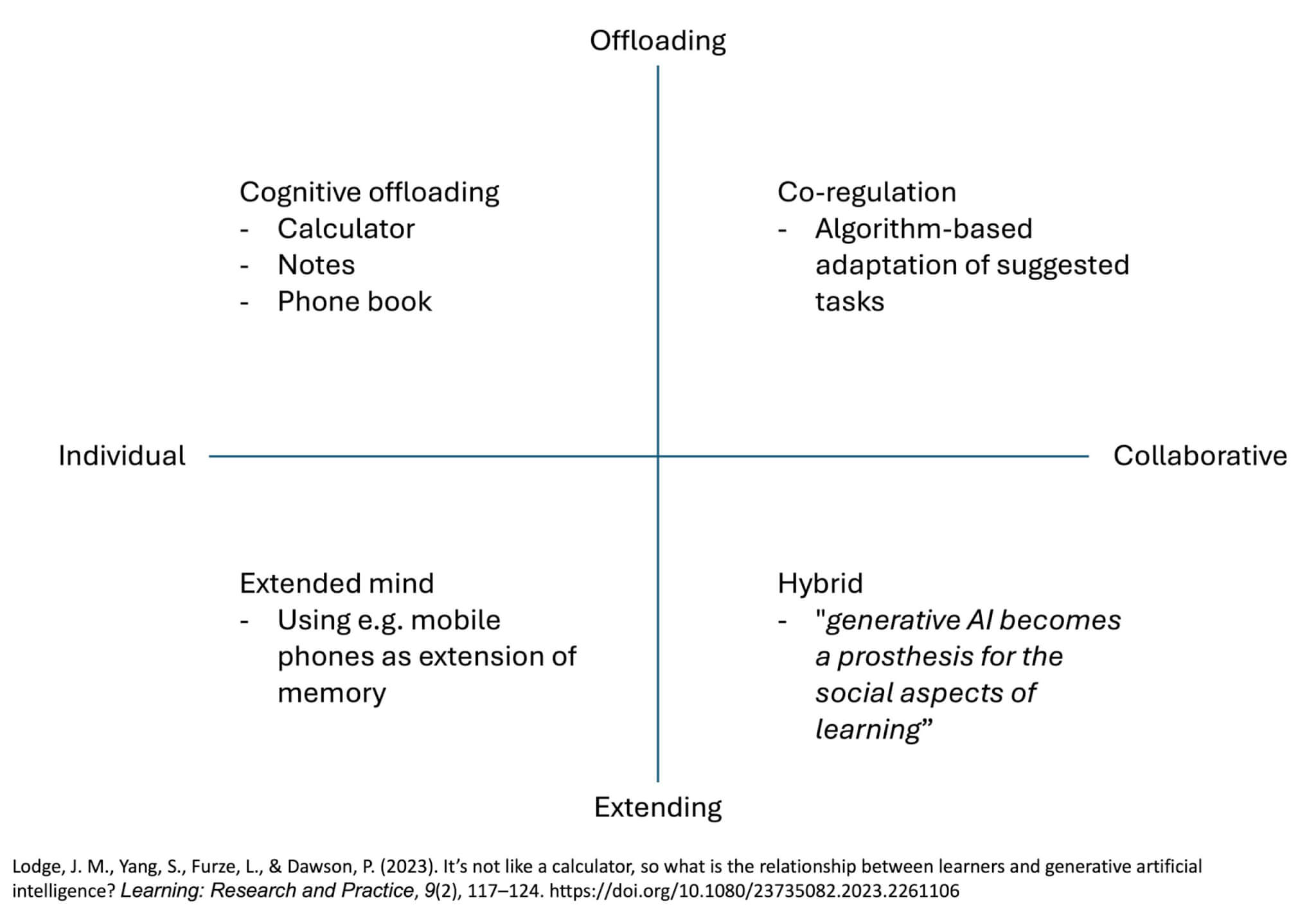
Currently reading Lodge et al. (2023) on “It’s not like a calculator, so what is the relationship between learners and generative artificial intelligence?”
Intriguing title! Lodge et al. (2023) discuss a “quadrant typology of human and machine interactions for education” with the two axes individual-to-collaborative and extending-to-offloading. Calculators fall into “cognitive offloading“, meaning it’s individual and offloading.

Thinking about AI resistance
I keep coming back to Karen Costa’s question “What if the critical #AI skill for our era is not how to use it, but how to resist it?” In the Poulidis et al. (2025) chess study, 40% of those who learned with AI and could press a button to get help said that in hypothetical […]

Currently reading Poulidis et al. (2025) on how “Self-Regulated AI Use Hinders Long-Term Learning”
Usually we like to think that self-regulation in feedback seeking and learning is a good thing: When students get stuck, they can ask for support that helps them overcome the difficulty and continue learning. This can become problematic, though, when students ask for hints too early and often, get used to that behaviour, and then […]
Currently reading Inie et al. (2026) on “De-anthropomorphizing “AI”: From wishful mnemonics to accurate nomenclature”
The other day I wrote about a paper on “sycophantic AI” and its implications on human interactions, and I am reminded of that daily when I hear kids on the bus mention how they talk to “chattis” (which seems to be a common nickname for ChatGPT around here) about all kinds of topics (which is […]

Currently reading Bassett et al. (2026) on “Heads we win, tails you lose: AI detectors in education”
AI detection products cannot produce output to reliably distinguish between an AI generated text and one written by a human, and they reflect biases (for example more often flagging non-native speaker texts — see also my recent post about the “GenAI writes like me” post). We’ve known that for a while now, so why summarize […]

Currently reading Magnani & Clindaniel (2025) on “Artificial Intelligence and the Interpretation of the Past”
No matter how sick I am of GenAI, this is a cool paper! Magnani & Clindaniel (2025) look at lots and lots of GenAI generated texts and images — both generated with a generic prompt and with one specifically asking for scientifically correct representations — depicting Neanderthal behavior and compare it to what science actually […]

Currently reading Forsyth et al. (2025) on “The impact of AI on inclusive learning communities”
While some people see big potential in GenAI to make learning and teaching more inclusive — by leveling the playing field through providing people with personalized instruction and support that they might otherwise not get — it is of course not as easy as that. GenAI is only as good as the data it is […]


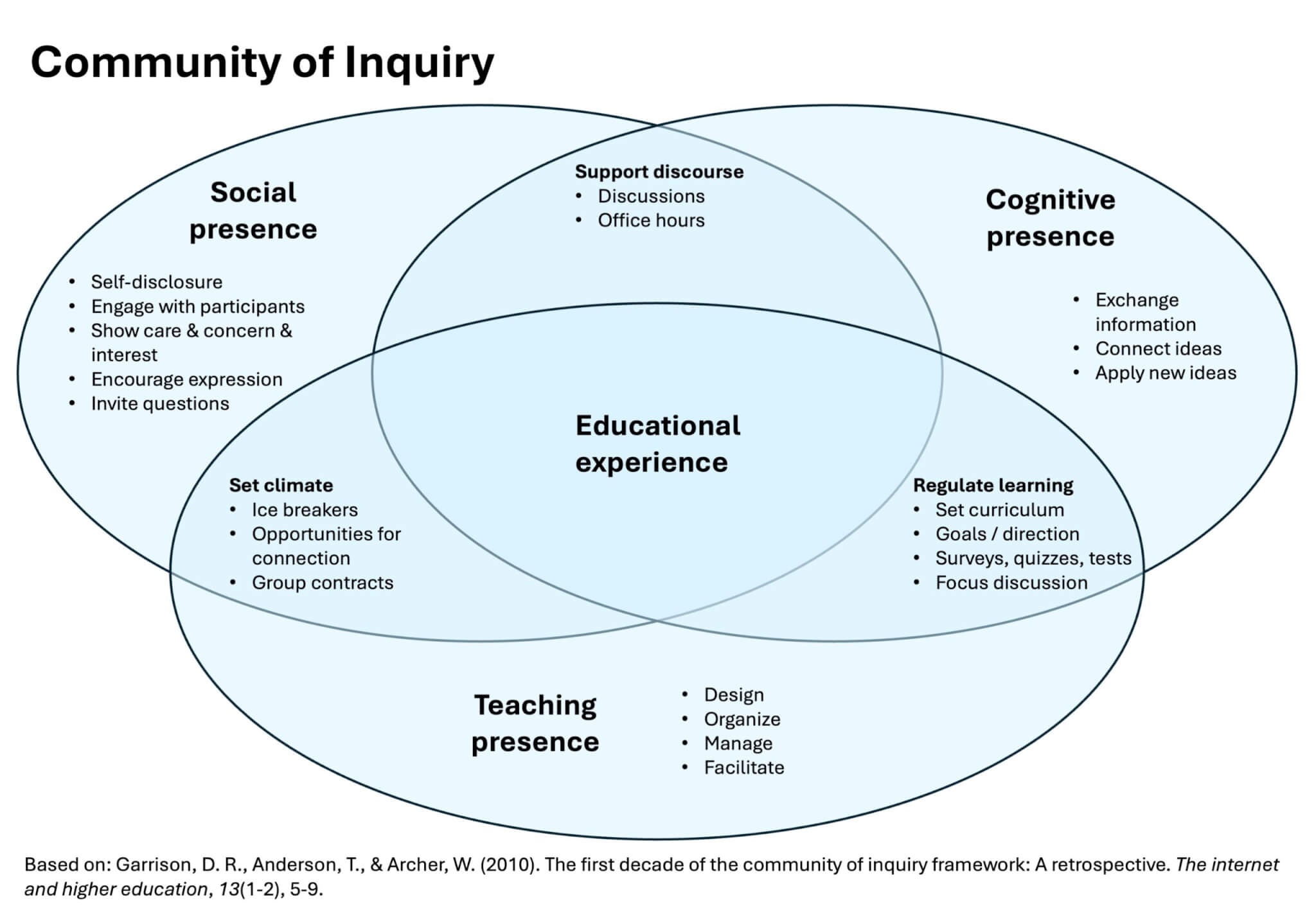
Playing with the Community of Inquiry framework
In an old blog post, I wrote about the importance of facilitation/teaching presence in the context of the pandemic and people teaching on video calls from their homes. In there, I refer to one article that refers to lots of older sources, and I think now I finally read one of those…

Currently reading Nazaretsky et al. (2025): “Can students judge like experts? A large-scale study on the pedagogical quality of AI and human personalized formative feedback”
Ignoring for now that an important aspect of a teacher giving feedback to students is what it signals about the relationship — that the teacher cares enough about the student and their learning to invest time and energy into understanding the students’ thoughts and figuring out how to help them improve — how good a […]

Currently reading Quince et al. (2025) on “Student perceptions of GenAI integration into engineering practice: How students interpret liability, safety, professional conduct and ethics across disciplines”
I’m getting a bit sick of reading GenAI papers, but I guess not reading is also not an alternative… And this one is actually very interesting!

Currently reading Nazaretsky et al. (2026) on “Who Gives Feedback Matters: Student Biases Towards Human and AI-Generated Formative Feedback”
Most teachers I talk with recognize that asking GenAI to grade student exams is a terrible idea, but when it comes to formative feedback, there are a lot of teachers that think that that is maybe not such a terrible idea. Students can get feedback much more promptly than if a teacher has to read […]

Currently reading Kahn et al. (2025) on “Teacher agency and generative artificial intelligence: teaching in higher education as a responsive, cultural activity”
The wide availability of GenAI has introduced challenges to relationships between teachers and students and within the respective groups (see for example Rachel’s and my work on that!). GenAI being able — and to unknown extent being used — to perform actions that before had to be done by humans creates different perceptions of what […]

Now published: Forsyth & Glessmer (2025) on “How teachers build trust with students in the presence of GenAI”
Rachel Forsyth and I are in the process of doing focus group interviews with students and teachers at Lund University on how their relationships to each other are influenced by the availability of GenAI. We are going to present a glimpse into the analysis of what teachers said in the first five interviews at LTH’s […]

Listening to a podcast on the validity of assessments, and on feeding two birds with one scone
I was listening to an episode of “dead ideas in teaching and learning” on my walk back from dipping this morning (now you can really see that fall has come!) and I really enjoyed it and can well imagine using as at “recommended listening” to prepare participants for workshops on AI and/or assessment.

Watching Steen-Johnsen on “Concern and enthusiasm for AI across the globe: the role of trust”
I recently watched a really interesting seminar by Kari Steen-Johnsen (UiO), who is working on the impact of digitalization on democracy. She gave an AI Lund online seminar on “Concern and Enthusiasm for AI Across the Globe. The Role of Trust” (recording here).

Currently reading Nguyen & Welch (2025): “Generative Artificial Intelligence in Qualitative Data Analysis: Analyzing—Or Just Chatting?”
I really enjoyed reading Nguyen and Welch (2025)’s exploration of using GenAI to analyse qualitative data. They come to the same conclusion as Rachel and myself in our article (don’t do it!), but they very comprehensively look at different problematic facets, and explain them in detail.

Currently reading Kumar et al. (2024) on “Guiding Students in Using LLMs in Supported Learning Environments: Effects on Interaction Dynamics, Learner Performance, Confidence, and Trust”
One-on-one tutored students perform 2 standard deviations better than students who learn via traditional instruction. Can LLMs achieve similar results when acting as tutors? Typically, help-seeking behaviour is influenced for example by self-efficacy and task difficulty, availability of tools and their perceived usefulness, and possibly trying to balance independence and learning with reliance on a […]

Notes on a presentation by Deslauriers on “The Illusion of Learning, What to Do About It, and How AI Can Help”
The STEM Education Research Centre at the University of Bergen had a really interesting presentation today (and the sketchy internet connection was more than made up for by all the kind people in the room that started streaming it from different angles!): Louis Deslauriers on “The Illusion of Learning, What to Do About It, and […]


When Communities of Practice and GenAI collide
I was very intrigued when I came across a chapter by Cambridge, Wenger-Trayner, et al. (2024) on “Theoretical and practical principles for generative AI in communities of practice and social learning”. They tell the story of how a contribution by ChatGPT — despite being prompted by a participant in a group conversation, and read out […]

Currently reading Gorichanaz (2023): “Accused: How students respond to allegations of using ChatGPT on assessments”
This is an article that I find interesting both because of the method (searching reddit for accounts of student experiences as data sources!) and because of the findings, which I’ll summarise below.

More reading about GenAI
My notes on GenAI stuff are getting shorter and shorter, and that’s because I am reading the articles with a specific application in mind, and only writing down what seems relevant to answer that question. So don’t use these notes-to-self as summaries that tell you all you need to know about those articles, that’s not […]

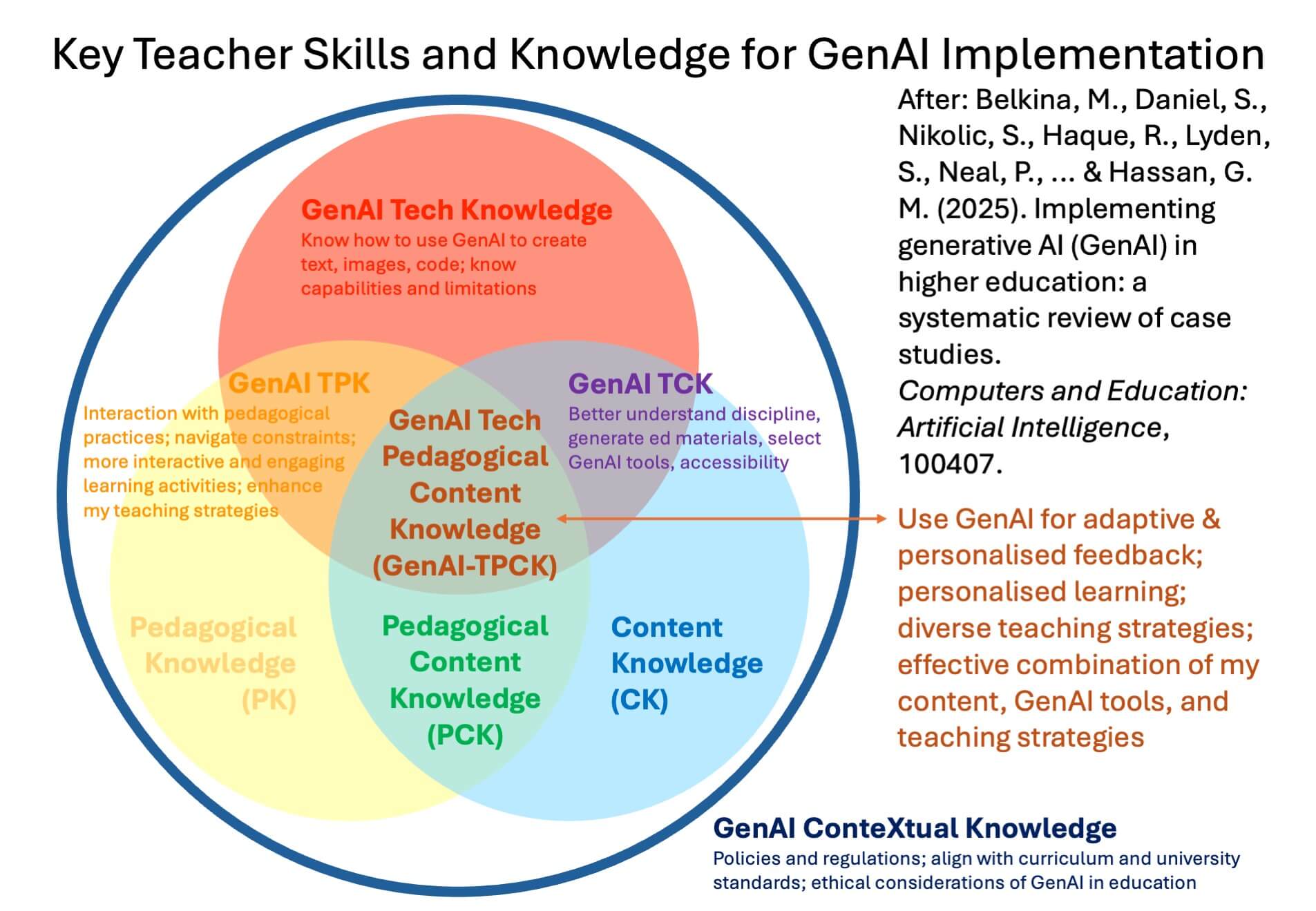
Key teacher skills and knowledge for GenAI implementation? Currently reading Belkina et al. (2025)
Belkina et al. (2025) did a systematic review of case studies of implementations of GenAI in higher education and, based on that, found key teacher skills and knowledge necessary for GenAI implementation: Basically, being able to use GenAI for adaptive & personalised feedback and personalised learning; being able to use it in diverse teaching strategies; […]

Currently reading “Examining Student and Teacher Perspectives on Undisclosed Use of Generative AI in Academic Work” by Adnin et al. (2025)
Yesterday I wrote about how disclosing the use of GenAI erodes trust, but that it is even worse to get caught using GenAI without having disclosed it, So how do students handle this? In their study “Examining Student and Teacher Perspectives on Undisclosed Use of Generative AI in Academic Work“, Adnin et al. (2025) investigate […]

Currently reading Bochniarz et al. (2022) on “Attitudes to AI among high school students: Understanding distrust towards humans will not help us understand distrust towards AI”
This is a very interesting (pre-ChatGPT!) study: Bochniarz et al. (2022) investigate highschool students’ concerns regarding perceived negative intentions of AI, i.e. “cynical hostility” towards AI.

Currently readin Schilke & Reimann (2025) on “The transparency dilemma: How AI disclosure erodes trust”.
When we teach, we have all these policies of how students need to let us know how they used GenAI, and of course the same holds for research publications. Research also finds that students expect a two-way transparency (Luo 2024), meaning they would like for us to disclose how we use GenAI. In general, the […]

Exploring the UDL 3.0 version, inspired by an episode on the Tea for Teaching podcast
It took me a while to appreciate the UDL* framework since I first started looking into it 3 years ago. Without context, it seemed overwhelming in the amount of details that we are supposed to consider when designing teaching. Initially, I tried making sense of all the different facets by finding examples of what they […]


How and why do students use GenAI feedback? Currently reading Henderson et al. (2025)
More reading on trust in GenAI, today on how and why do students use GenAI feedback. Henderson et al. (2025), “Comparing Generative AI and teacher feedback: student perceptions of usefulness and trustworthiness“, use responses from approximately 7000 students to understand their thinking regarding to their use of GenAI.

Currently reading Goldshtein et al. (2025) on “The role of learner trust in generative artificially intelligent learning environments”
The title of Goldshtein et al. (2025)’s editorial, “The role of learner trust in generative artificially intelligent learning environments“, sounded super intriguing. The question of trust in GenAI is so relevant; do students trust GenAI, and to do what, and why? And what does that do to their relationships with their teachers?

What does the availability of GenAI do to trust between students and teachers? Currently reading Luo (2024)
Cheating is not a new phenomenon by any means, but with the raise of GenAI, it seems to be easier than ever, and teachers seem to be more suspicious than ever. But in contrast to direct plagiarism where a source can easily be identified, the use of GenAI to produce text in assignments can mostly […]

Walking the talk, slowing down, cold dipping
As I am writing the summary of the second part of “becoming an everyday changemaker” (summary of Part I here), I am trying to apply what I am reading, and intellectually agreeing with, to my life. Habits are so hard to break… Anyway, I have known for a long time that cold dipping and swimming […]
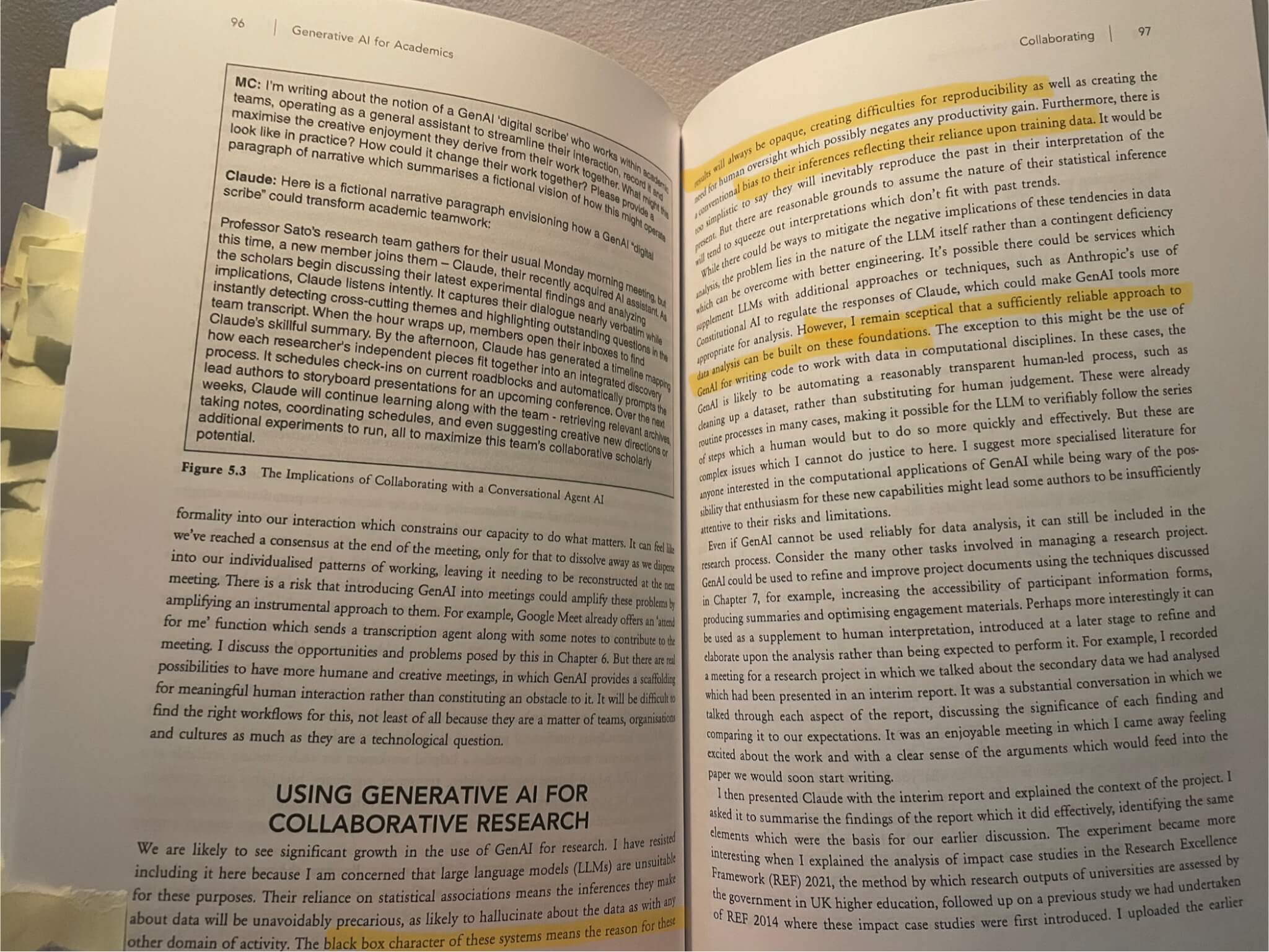
Currently reading “Generative AI for Academics” by Carrigan (2024)
The other day I read something (that I cannot find again) along the lines of “GenAI creates art for people who hate art, music for people who hate music, reading for people who hate reading”, and I have been thinking about that a lot. I have explored what GenAI can and cannot do (for example […]
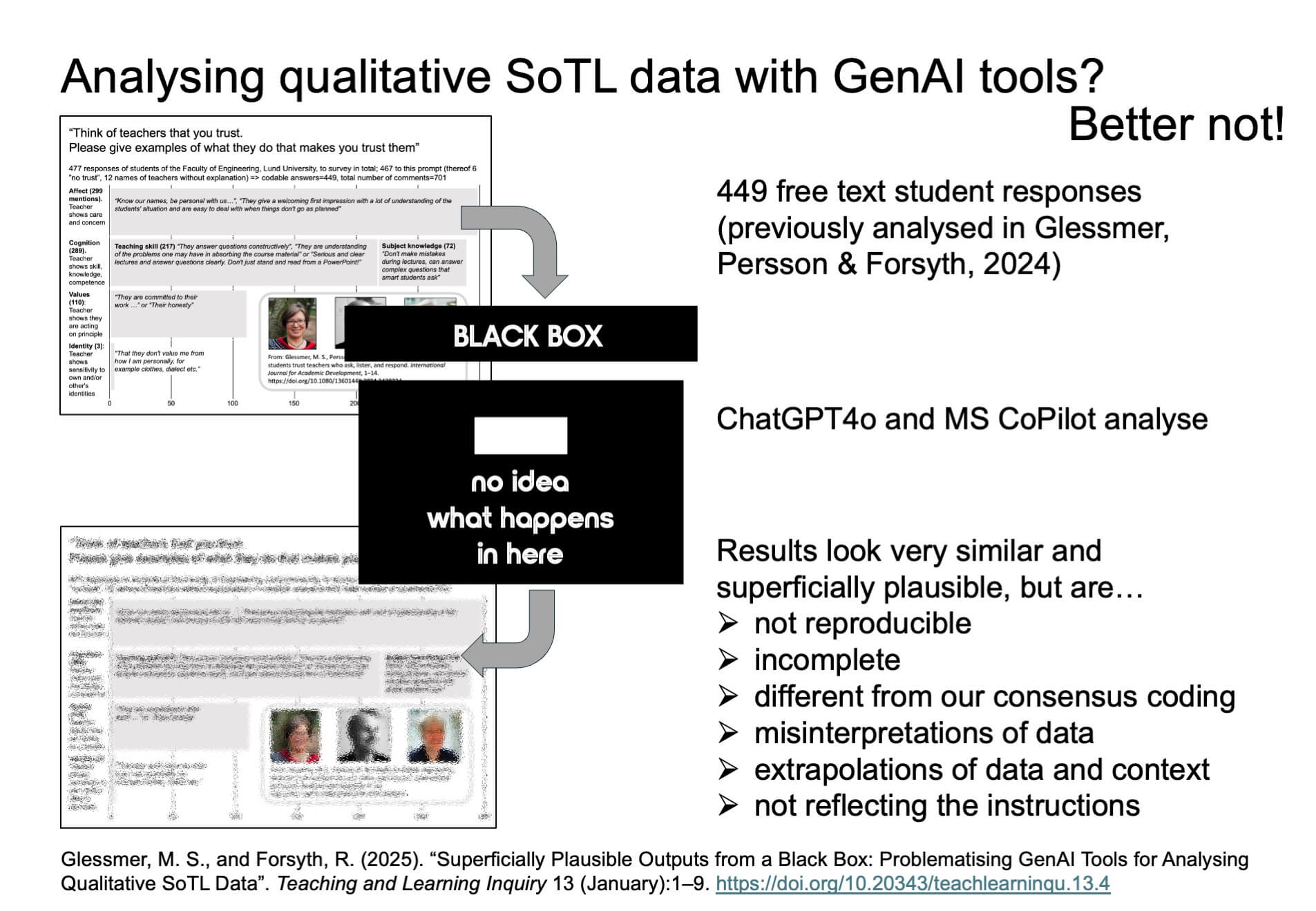
Published! “Superficially plausible outputs from a Black Box: problematising GenAI tools for analysing qualitative SoTL data” Glessmer & Forsyth (2025)
We had spent the last month reading, coding, discussing, re-coding, discussing some more, re-coding, discussing even more, and then consensus coding free-text answers of 449 students, and submitted the manuscript. “Just for fun, let’s plug it all into ChatGPT!” Rachel said. And so we did. And after 4 seconds, out came an analysis that looked […]
Currently reading “Gender Differences in the Use of Generative Artificial Intelligence Chatbots in Higher Education: Characteristics and Consequences” by Møgelvang et al. (2024)
Who uses GenAI, what for, and why does it matter? That’s what Anja Møgelvang (who also does lots of other fascinating work, for example on cooperative learning) and colleagues explore in the article “Gender Differences in the Use of Generative Artificial Intelligence Chatbots in Higher Education: Characteristics and Consequences”. They used responses of almost 2700 […]

Currently reading about “botshit”, and how to avoid it (Hannigan, McCarthy, Spicer; 2024)
When I recently summarized an article that claimed that Large Language Models (LLM) are “bullshit”, I got a lot of strong reactions offline and online about that term, and a comment recommending the article “Beware of botshit: how to manage the epistemic risks of generative chatbots” (Thanks, Ian!). In that article, Hannigan, McCarthy and Spicer […]

According to Hicks et al. (2024), “ChatGPT is bullshit”. And they make good arguments for it, too!
I have written about playing with GAI for certain purposes, most recently to “discuss” the development of a workshop when I had no person to discuss it with. But this article has given me new language (not just the “bullshit” word*, just keep reading) to talk about a highly problematic aspect of GAI.
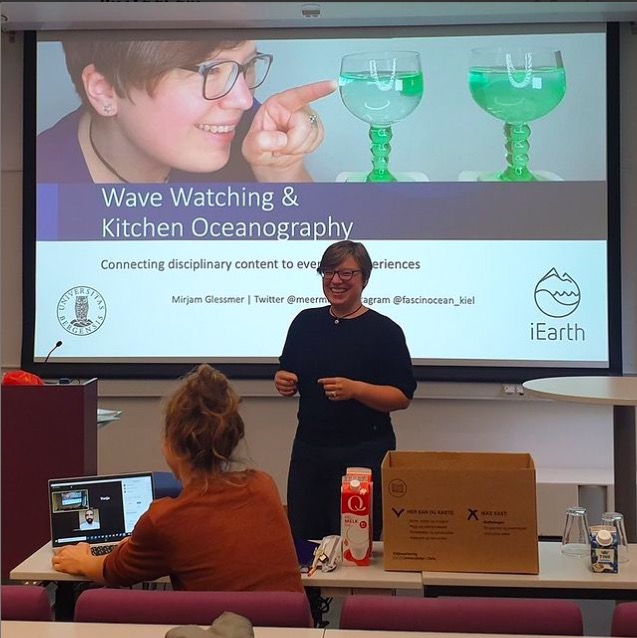
Planning an academic development workshop with GAI Claude
“Hi Claude, I want to plan a 45 minute workshop for university teachers with the title “how do I cultivate joy, passion, and purpose in my teaching, and how do I share it with my students?”. The goal is for the participants to leave the workshop feeling a renewed sense of joy, passion, and purpose […]

How politely should we talk to GAI in order to get the best results? Currently reading Yin et al. (2024)
Thanks to my awesome colleague Rachel and her Teams team I see so many interesting articles on GAI these days! For example the one by Yin et al. (2024) on how politely we should be talking to GAI in order to get the best results.

“It feels like having a smart friend which we ask anything and it can answer”: Currently reading: “Exploring Students’ Perceptions of ChatGPT: Thematic Analysis and Follow-Up Survey” (Shoufan, 2023)
I’m currently thinking a lot, and talking with a lot of students, about what builds trust between students and teachers: Mostly that teachers ask questions, listen, and respond. But then someone pointed out how students appreciate the “human-like” interactions that students have with ChatGPT, and Rachel sent me a study that also shows that.

Prompt engineering and other stuff I never thought I would have to teach about
Last week, I thought a very intensive “Introduction to Teaching and Learning” course where we — like all other teachers everywhere — had to address that GAI has made many of the traditional formats of assessment hard to justify. We had to come up both with guidelines for the participants in our course on how […]


