
Currently reading up on Robinson & colleagues’ work on ESD
I’m reading some of Lund University’s visiting professor in Sustainability in Higher Education Zoe Robinson’s work. Some brief(ish) summaries below. It is such an opportunity and inspiration to have Zoe in Lund!
In “Assessing competencies for future-fit graduates and responsible leaders“, Robinson & Molthan-Hill (2021), present three case studies of developing and assessing sustainability competencies:
- When an experiential field course could not happen, it was replaced with a weekend with the task of “live sustainably and actively think about the sustainability implications of their decisions and actions”, which was assessed in a 500 word reflective blog. They find that this alternative activity can be more inclusive than the trip, but that there are of course drawbacks related to development of a “cohort identity” and sense of belonging. Otherwise learning outcomes, based on key sustainability competencies, can be met and assessed
- In a final year module where student groups act as consultants to external partners to improve sustainability practices in their organizations, students do group presentations and group reports, write a reflective blog, give peer feedback, and are involved in assessment of peers’ contributions to the group process. This helps students practice many key sustainability competencies
- In a MOOC on “sustainability in practice”, students do peer review and self-assessment, online tests to assess understanding, and a flexible assessment, where in the past, students have used for example mood boards, videos, business proposals, poetry, podcasts, fashion shoots. This fully online course still manages to teach and assess key sustainability competencies
Discussing inclusion, they write that “‘Free-riding’ students may legitimise limited engagement in the group process through their ‘group role preferences’ and not seek to improve skills in areas they find challenging. Student choice in assessment must be balanced with the need to develop a wide range of life and employability skills“.
In their proofs (which I read before checking whether the table numbering was the same in the published version, only to discover that the table didn’t make it into the final version! So be careful with the quotes above, they are also from the proofs), they provide a table where they list competencies, what they could look like in learning outcomes, how to then define assessment criteria, and what a matching assessment method could look like. For example, in the case of anticipatory thinking, the ILO might be “Identify the need for decisions about natural resources to involve judgements, not just about economic viability but about risks to future ecological, social or cultural wellbeing“, which would mean that students have to identify appropriate criteria, which they would show for example by including a framework for assessing their solutions in the report.
All three cases place a lot of importance on reflection. Table 4 in the published chapter provides an example of how to balance systems thinking, integrated problem solving, critical thinking, and communication skills and normative competency in reflective blog posts (29%, 30%, 30%, 20%). But of course this depends a lot on context and intentions behind what is being assessed.
On point highlighted in the discussion that I find very important is that the rapid response to the pandemic (including changing to teaching and assessing online, without, as they show in their cases, decreasing quality) as evidence that “we can change and adapt, and this suggests that we do have the capabilities to respond to the urgent sustainability challenges that society faces“. Now we just need to do it!
In “How to repurpose the university: A resilience lens on sustainability governance“, Robinson & Laycock Pedersen (2021) discuss how the university can be reoriented and refocussed towards sustainability. This is not so easy: “to repurpose a university requires us to destabilise our prevailing system, crossing a threshold into a new stable system of a ‘sustainable university’ across all its domains” (with the domains being the campus, research, education, and outreach). Destabilising systems is related to their resilience — and resilience can be both positive and desirable if it refers to sustainable systems that are resilient to stressors, and also meaning that it is really difficult to change something away from whatever state it is in towards sustainability.
They discuss four resiliance principles:
- Managing diversity and redundancy: A lot of diversity and redundancy (in the types and topics of sustainability work, in participation in governance, in motivation, in scale) is needed for a holistic and inclusive approach, and so that there are many different ways to react to stressors. If there is too much, though, the risk is that it develops into lots of small disconnected islands which also makes it difficult for a system to change.
- Managing connectivity: Many and high-quality links and nodes between, for example, the four domains of the university, within the domains, between students and staff, with other universities, with other external partners. This makes me realize that even though I would have said that almost all of our work with the initiative Teaching for Sustainability is focussed on connecting teachers, that is actually not true and we are pretty good at connecting with lots of other actors, too, without having articulated that as part of our mission!
- Managing slow variables (e.g., values, traditions, legal frameworks) and feedbacks: This reminds me of the paradigms discussed in Lidgren et al. (2006), which can hinder sustainability work, and Sundström & Holmberg (2018)’s primary tasks, which override any other efforts or policies if they aren’t aligned with the primary tasks. And the authors also refer to others that use the argument (that I have also heard at LU) that an actual commitment to sustainability is a threat to academic freedom (Which, on a sidenote, I disagree with: academic freedom means that you can disagree without negative consequences, not that a university cannot set and live priorities), but that that understanding is slowly shifting in their UK context.
- Encouraging learning and experimentation within the context of complex adaptive systems: Here, they highlight the different levels of learning, where we need all three in the context of sustainability: single loop (are we doing things right?), douple loop (are we doing the right things?), and triple loop (how do we know what the right things to do are? what are our norms and values, and what would be alternatives?). One approach to do that could be “living labs” where teachers, students, and external stakeholders work on locally relevant questions together.
This all sounds nice and well, however the authors discuss how there is of course a tension between efficiency and resilience: “A drive for efficiency reduces redundancy, reflected in sustainability leadership or “championing” often being restricted to one individual. Efficiency drives can also lead to overwork of these individuals, leading to simpler “doing less bad” than more generative “doing more good” approaches, erosion of relationships (connectivity), and a lack of diversity in participation” (my emphasis because that is exactly what I observe, too!).
One point that Zoe mentioned in a conversation last week is also made in this article: “Controversially, we question the imperative for highly connected sustainability activity. Those seeking to repurpose universities for sustainability can often be heard lamenting that pockets of good practice are isolated. Too much focus on increasing connectivity and understanding everything happening within the university can waste limited resources and also lead to “ownership” of sustainability by a small group of actors, making it vulnerable to changes in governance structure. In contrast, greater modularity in where “repurposing” activities are driven from can lead to enhanced resilience through ensuring multiple centres from where sustainability transformation can ripple.” I am probably one of those people “heard lamenting”, and it is helpful to see the issue framed in this way. I still think that more connection would be good just so that individual actors like they aren’t completely alone, but I get the point that they are making! I also really appreciate the reminder that change, especially in values and norms, is slow, and that we “Paying attention to slow variables and feedbacks reminds us of the need to be patient, and not to expect our actions to have direct and immediate consequences, and the need to monitor change and variables over longer timescales“, not just to see progress, but also to notice changes in the wrong direction early.
The authors present a really useful overview of questions for reflection on sustainability governance regarding the four resilience principles (their Table 2) and end by writing “Finally, we highlight how developing explicit structures and culture to facilitate learning, that critically reflect through double and triple loop learning and engage with failure, are at the core of a university genuinely working towards repurposing towards sustainability.” So what are we waiting for? :-D
In “Geography as responsibility: sustainability through teaching and learning within geography“, Robinson (2019) describes that in an earlier study, “students felt they had a responsibility as geography students – they felt more knowledgeable about sustainability issues than their peers, and hence felt a responsibility to educate others. Yet despite their acknowledged greater knowledge of sustainability issues, this seemed to have little effect on their (self-reported) behaviour, and hence their personal responsibility to a more sustainable world“. Ways to work towards “action and solutions-oriented sustainability education” as part of the formal curriculum (instead of relying on students to take initiative themselves) include letting students do thesis projects based on problems identified together with NGOs, and living labs.
But Robinson (2019) also stresses the need to reflect on whether our assumptions about the impact of our teaching of sustainability are correct: “It is easy to assume that the implicit coverage of sustainability in our courses exonerates us from the responsibilities of explicitly considering the wider societal impacts of our teaching“, and that this comes with implications: “We have a responsibility to ensure that graduates can flourish in a changing and uncertain world, adaptable to a future that cannot yet be envisaged. We have a responsibility not to tell students ‘what to think’, or to try and imbue our own values, but equally we have a responsibility to help learners develop the awareness to think critically about existing structures and the paradigms that have led to our current unsustainable practices in terms of growing social inequality and environmental degradation.” This also means that our teaching needs to be up to scratch, and that we need to stop worrying about being perceived as “political”: “Therefore geography, rather than hiding under a false mask of political neutrality, should accept the impossibility of a neutral education, and encourage deeply critical thinking about the nature of education and the purpose of universities”
Even though this chapter is about geography specifically (not surprising given that it is published in a handbook for geography), I think all of this is equally relevant for other disciplines!
Last thing I want to check out today are Zoe’s chapters in the book Perspectives and Practices of Education for Sustainable Development. But of course I couldn’t go strait there and this figure in Chapter 2 “Education for Sustainable Development–Definitions, Debates and Design” by Price & White (2025), caught my eye. We have used similar ones before but this one I want to keep and use (shared below as a screenshot since it was published under a Creative Commons CC BY-NC-ND license).
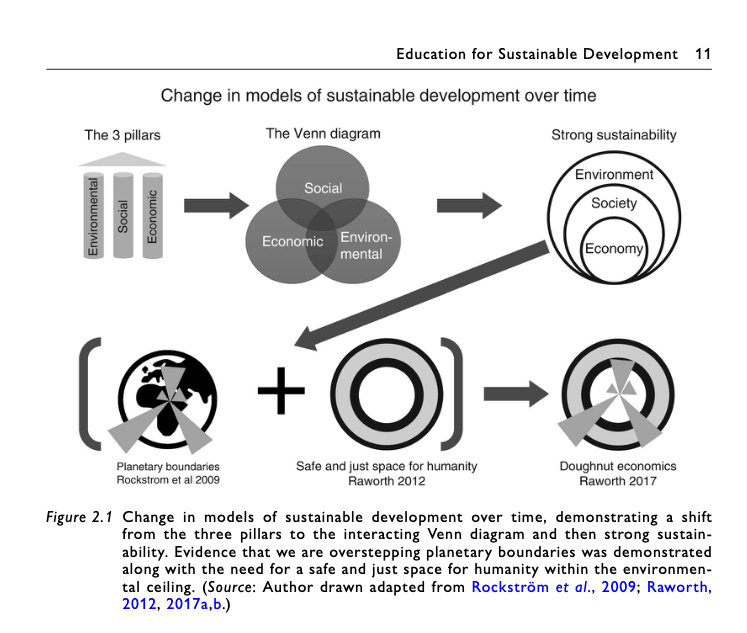
This chapter also presents the “CoDesignS ESD framework”, which combines SDGs, key competencies in sustainability, head-hand-heart, and transformative pedagogies and teaching methods, which can be a really useful starting point!
In Chapter 3 by Robinson et al. (2025), they discuss a question that I’ve also been thinking about: That of incremental vs radical change. In this chapter, they “take a more incremental approach to change exploring what shifts we as individuals whatever our roles can make, while acknowledging the desirability of a radical paradigm change with sustainability at the heart of a university’s purpose“, arguing that “This incremental and pragmatist approach towards a sustainable university acknowledges that universities, along with the rest of society, must go through a transition process over a period of time, and that requires using levers for change within the existing system and sub-systems (domains), steered by a clear direction towards sustainability.”
I really enjoy the exercise they suggest to explore current paradigms and how they need to shift to work towards sustainability, for example
“Current Paradigm: Research is largely talked about by university management in terms of income and publication metrics.
Desired Paradigm: Research is encouraged and celebrated in terms of the positive impact that it has on society.
Mechanisms to Shift Paradigms: Those involved in research at all levels use the language of purpose rather than metrics and openly challenge language solely about income or publication metrics.”
Of course changing paradigms isn’t quite as easy as that and paradigms in academia are much more widely anchored than just in one single university, but at least it is worth a try!
They again point to covid-19 as a catalyst for transformation: “COVID-19 provides a useful reflection point on the sort of catalyst needed to create a transformational shift towards sustainability in our education systems. Such catalysts by their nature mean that their impacts cannot be planned for, suggesting that their impacts for sustainability are as likely to be negative as they are positive. Therefore, maybe the radical shift required lies not in a shock event but through shifting the mindsets of all those working across all domains of our education settings. Everybody will have different triggers to a shift in mindset, but leaders, in whatever part of an education setting they work, can help create the conditions for transformation, through encouraging a language and culture supportive of a sustainability transition.”
They end by stating that “Anything less than whole institution change and a realignment of each domain of the university to support sustainable outcomes implies both a denial of the twin climate and biodiversity emergencies we face, and also a failure to realise the ‘duty of care’ universities have to their current and future generations of students. It is not just what universities do, but the way they do it, and how they demonstrate sustainability values that will impact both students and staff learning for sustainability, and in the ‘not so long-run’ the measure of universities’ contribution towards a sustainable future.” (my emphasis)
In Chapter 8, White et al. (2025) explore “Sustainability research, teaching and practice: towards transdisciplinary knowledge co-production in universities“. What I was most interested in is the part about “Research-Led Teaching and Teaching-Led Research“, where they write “When teaching, we are often required to read more widely or more specifically about particular topics on the edge of our research experience; we are forced to articulate our ideas clearly to a new and non-specialist audience; we engage in discussion with learners and sometimes other stakeholders in new ways. This process can also lead to new research ideas and projects. The critical engagement with learners around topics such as economic growth, for example, may feed back into and shape the framing of this topic in research proposals. Increasingly, universities are recruiting international learners, allowing us to hear a diversity of voices that might facilitate holistic problem definition and generate systems-thinking questions and research projects together.” This is something I have observed repeatedly, and in myself: When teachers start engaging more deeply in teaching for sustainability, that often leads to changes in their research profile, too.
In Chapter 9 on “Leadership and Governance for Education for Sustainable Development: Engagement, Strategy and Transformation” by Longhurst et al. (2025), I particularly like the reflections on leadership (bottom-up, top-down, middle-out) and the case study “A Thorn in the Side“, which is a personal story about leading change by persistently being the reminder that change needs to happen, and encouraging action: “When asked about how to develop the agency to drive sustainability in universities, my response is usually ‘just do it’, or at least, if permission is needed, ‘offer to do it.’”
In Chapter 11 on “Monitoring and evaluating education for sustainable development: co-creating quality learning experiences and outcomes“, White et al. (2025) share the Box 11.7 “Principles to Assess the Quality of ESD Being
Integrated into Higher Education Institutions and to Avoid Greenwashing in ESD Claims (Ryan et al. 2023)” which I find super useful as a starting point (and all four points below are a direct quote):
- Joined up sustainability learning – Sustainability must be connecting social, environmental and economic issues – mentioning the SDGs once or twice is not enough to consider a course as ‘ESD’.
- In a compulsory module – It should not be optional! We cannot ensure that everyone will make better choices if only a few learners choose the modules with the quality ESD.
- From the first year to the final year – Really great courses will embed sustainability throughout from the first year to the final year to ensure the learning is consolidated.
- Assessed is best! – The best skills are developed when they are applied in practice and made relevant to real-world solutions through assessments.
I wrote about the double- and triple-loop learning above, which aren’t really addressed here (are we doing the right things? And how do we know what the right things to do are? What are our norms and values, and what would be alternatives?), but one step at a time…
And then in the last concluding words of the book, they refer to the “‘Trojan mouse’ (phrase courtesy of Zoe Robinson)“, which Zoe also talked about when we spoke last week — finding ways to sneak in sustainability in other contexts, e.g. as the topic to be presented on in a workshop on presentation skills.
The book ends with this paragraph: “Higher education supports learners to acquire knowledge, skills, capacities and competencies to be change agents in the world. ESD can help them be change agents for good, within the complex, contested world they will inhabit. They may be reformist or radical, transformative or transgressive. With access to and the privilege of learning comes responsibility. We hope that our graduates can develop the wisdom to use their learning and power in positive ways. We hope that educators can be (re)inspired to see meaning and have fun when teaching. We hope our higher education institutions can fulfil their potential in society. We hope that this book will make a difference in facilitating sustainability transformations in individuals, institutions and society. Such transformation may be our only hope.” (my emphasis)
And just like that I have read (ok, browsed) a whole book today! And now that is enough for today!
Longhurst, J. W., Robinson, Z. P., & Price, E. A. (2025). Leadership and Governance for Education for Sustainable Development: Engagement, Strategy and Transformation. In Perspectives and Practices of Education for Sustainable Development (pp. 189-210). Routledge.
Price, E. A., & White, R. M. (2025). Education for sustainable development: definitions, debates and design. In Perspectives and Practices of Education for Sustainable Development (pp. 9-35). Routledge.
Robinson, Z. P. (2019). Geography as responsibility: sustainability through teaching and learning within geography. Handbook for Teaching and Learning in Geography, Edward Elgar Publishing, 256-268.
Robinson, Z., & Molthan-Hill, P. (2021). Assessing competencies for future-fit graduates and responsible leaders. Assessment and feedback in a post-pandemic era: A time for learning and inclusion, 196-213.
Robinson, Z. P., & Laycock Pedersen, R. (2021). How to repurpose the university: A resilience lens on sustainability governance. Frontiers in Sustainability, 2, 674210.
Robinson, Z. P., Molthan-Hill, P., & Higgins, P. (2025). Towards a Sustainable University: People, Purpose and Paradigm Shifts. In Perspectives and Practices of Education for Sustainable Development (pp. 36-58). Routledge.
White, R. M., Hayles, C. S., & Gough, G. (2025). Monitoring and evaluating education for sustainable development: co-creating quality learning experiences and outcomes. In Perspectives and Practices of Education for Sustainable Development (pp. 229-254). Routledge.
White, R. M., Price, E. A., & Hack, C. (2025). Critical pedagogies to engage heart, hand and head in education for sustainable development. In Perspectives and Practices of Education for Sustainable Development (pp. 108-128). Routledge.
White, R. M., Saunders, C., & Robinson, Z. P. (2025). Sustainability research, teaching and practice: towards transdisciplinary knowledge co-production in universities. In Perspectives and Practices of Education for Sustainable Development (pp. 162-188). Routledge.
Look at that tree! Now it’s really summer!

And also pretty windy, as you can see from how the sparkle is all over the place today, indicating that the surface is so rough that many places have the right orientation to reflect the sun directly at me!