
Two podcasts, a pink drink, and a webinar
A week ago (on Rachel’s Birthday, to be precise, hence the celebratory drink!) I listened to two really interesting podcasts on facilitation and classroom community, and a webinar on gamification. Here are my summaries!
First, “Everyday Acts of Facilitation” with Beth Cougler Blom on Teaching in Higher Ed. In a nutshell, she does #WaveWatching, except not with waves but with facilitation: She says that “when you love what you do, you see it everywhere“, and finds ideas for facilitation and teaching in everyday experiences. One example were mystery posters with nothing but an email address where, if emailed, someone responds in the persona of the historical figure on the poster. Intriguing! But she also feeds back teaching and facilitation skills into her everyday life, which is something that I have never thought about before explicitly (although you sometimes meet people where you just know that they used to be teachers… But often not in a good way!). She, for example, strives to be the first to say hi, and to extend the invitations that she wished she had gotten herself. And she commits to trying and trying again, while being aware that not everybody clicks with everyone. That was very cool, and I now subscribed to her podcast, “Facilitating on Purpose“, I just haven’t gotten around to listening to it yet. And everyday facilitation is a fun thing to look out for!
The second podcast I listened to was “A classroom ritual for peer affirmation” with Marcus Luther (of the Broken Copier podcast, also a podcast I often listen to). In a nutshell, the idea is to help students recognize co-created classroom values in others, and then let them anonymously nominate each other for a wall-of-fame type display. I like that way of publicly showing appreciation: One thing that I did in a former job where my task was to get a dozen busy PhD students to do science communication on social media was to nominate an “Instagram of the month” as well as a “newcomer of the month”, and that seemed very much appreciated for a while!
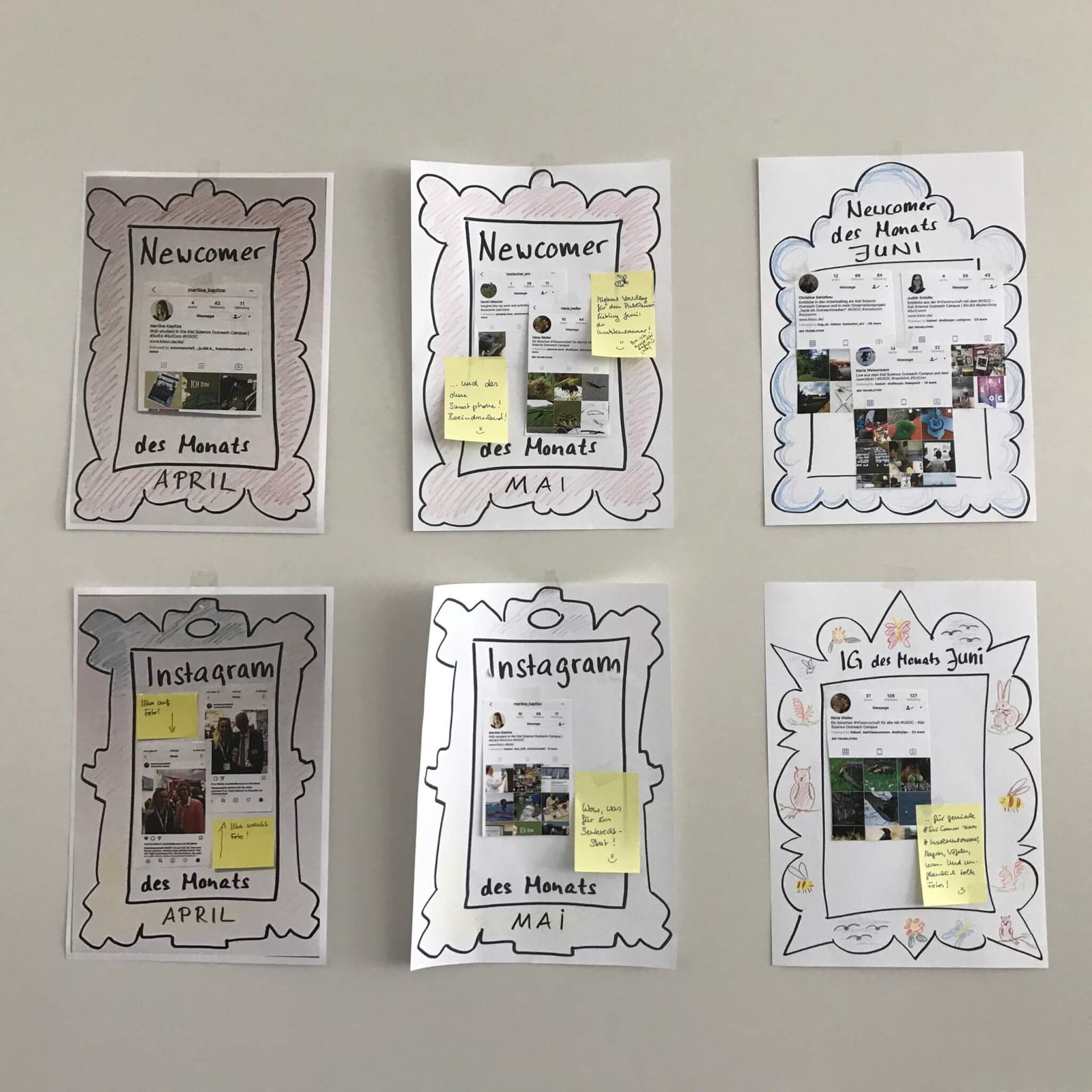
But what I appreciated about the example in the podcast was also the clever twist that nominations happen via an online form, so that there were automatically statistics about who gets nominated (or not), so that the teacher had the chance to maybe check in with the more quiet people, and understand classroom dynamics from a different perspective. And he is talking about the method as a tool belt to recognize awesome things about his students by seeing them through their eyes, which I also think is really great.
Another idea that I thought was awesome in the context of a big school where not all students know each other was to use information collected through an online form (I think in this case about what they value, but it could be any get-to-know-you information) and to put it on class roster for both the teacher but also students, so you have the quick cheat sheet if you need something to talk to people about!
And I also really liked the motivation for this: To learn to build community with people that you didn’t choose. So important!
Lastly, the webinar! It was by Marie-Jo Leroux (love her youtube channel and have written about it before) on designing a gamified learning activity. Already the run-up to the workshop was great: She sent out a questionnaire for preparation, asking about peoples’ target audiences, learning outcomes, etc.. That obviously helps her to tailor the workshop to whoever is going to be there’s interests (or at least gives participants the impression that that is what she will do), but it also is a good way to get people to actually think about what they actually want before they show up. Activation of prior knowledge, goal setting, and some thinking about the actual task all already a week before the call even starts! And it was interesting to reflect on my own expectations going in and investing at least that much brainpower in preparation to let her know what I want to do in my own context (although my application was very different from the examples she gave in the survey).
Anyway, she explained that “in games, learning is the drug“, so what keeps us engaging with a game is, ultimately, that we are learning something through trial-error-feedback, so we are always so focussed on the current goal that time just melts away. Cognitive mechanics are all we need, motivational mechanics are just a bonus.
For the process to design a game, she recommends starting by designing the final challenge (at the desired level of the ILO, and using for example realistic time constraints). The final challenge needs to be buildable in e-learning (so we can learn what knit and purl stitches look like, but not the actual act of knitting), and it should be so hard that newbies cannot figure it out right away. It is important that people start from realistic expectations, that the challenge will be so hard they cannot do it on their first attempt, so that then failure isn’t hard, but motivates them to keep going.
For that final challenge, she then suggests to build a functional, not pretty, prototype, and then think about difficulty modifiers (e.g., giving less and less time, starting out with a lower number of categories, …), and then to introduce a loop that starts out with more extra info or hints and gives immediate feedback.
I then looked at two more of her youtube videos on soft skills (since that’s what I am mostly interested in but the webinar only touched on those very ligthly): “Make soft skills training that works – step by step” and “Effective e-learning for soft skills“. Here again, the advice is to focus on what will pay off the most. Learning objective needs to be obtainable, e.g. “win a trial” or “convince jury” is not. But “build optimal closing argument” could be. Then can be broken down into behaviors, which can then be gamified. If we have a model for how to react to a certain situation and that is what we want to train, we could imagine that it consists of several steps that need to be done in the correct order, and that within each step, there are some questions that need to be asked and then the decision to move on to the next step needs to be done at the correct time. So being able to do that would show that people have learned that soft skill. So in the gamified version, they might for example initially be given the phase name and a bunch of possible questions, and they need to pick the right option. Over time, things become more difficult: The name of the phases could not be displayed any more, the options among which people have to choose could become more similar, they might have to pick the best options in the right order without being shown which phase they are in… And then we can build several practice scenarios.
Can I see that working for my topics, e.g. how to deal with microaggressions? On the one hand I want to say that nooo, how to react always depends on so much context, that cannot possibly be simplified into such a game! On the other hand, I do work with example scripts a lot, for example for microaggressions, or the one I shared recently from the Deacon et al. (2025) “Presenter Survival Guide“:
- Ask for clarification, typ “I’m sorry, I may have misunderstood. Can you clarify what you mean to say?“. If the person doesn’t retract or reformulate, escalate to 2:
- “Can you see how some people might experience that as hurtful?” and then if they continue to argue,
- “This no longer feels like a topic for the whole group. Can you and I check-in while the rest of the group works on ___?“, so instead of seeing sparks fly, the audience sees a calm and collected presenter “while still directly acknowledging that what was said will not continue for the good of the group“
There is a clear recipe to follow and it can certainly be learned in a gamified way rather than reading about it or me presenting it! And maybe that would be the better way to learn about it, too, because it is more active? So maybe it is not the best way to train reacting to such situations (then it would probably much better to do role plays or similar), but to explore the scripts, and then discuss, it could be quite cool. Maybe something I need to try?
And here some more pics from my way home!
Red leaves look soo much like fall already…