Currently reading Fan et al. (2026): “A metacognitive approach to learning and performance in human-AI interaction”
When does using GenAI improve performance yet hinder learning, and how can we get both learning and performance together? Fan et al. (2026) propose the conceptual “Synergetic Notion of Human-AI Skills and Knowledge Construction” (SYNC) model to help us get a idea.
First, it is important to understand that there are three types of cognitive load:
- “intrinsic load” that the task itself requires
- “extraneous load”, i.e. the friction produced by e.g. ineffective materials
- “germane load” from organising, connecting, reflecting, i.e. actual learning by investing into constructing understanding
When AI is used to reduce friction, i.e. for cognitive offloading, that can — but does not necessarily — make capacity available for actual learning. But it can also improve performance without learning, and it can lead to reliance on external resources (like the internet or AI), and to prevent that from happening, metacognition needs to be active to disrupt that loop.
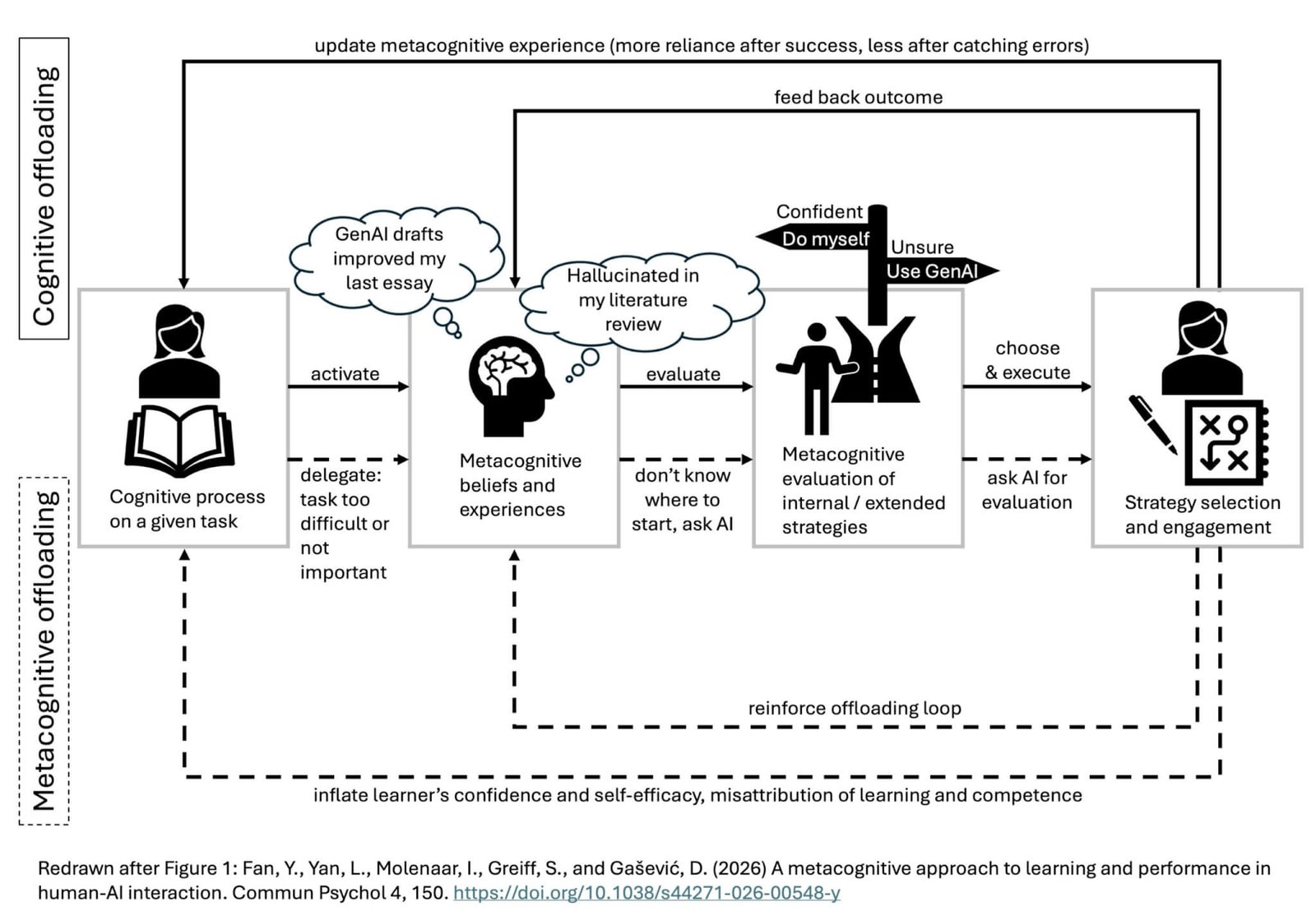
Fan et al. (2026) show the different loops for cognitive offloading and metacognitive offloading in their Figure 1 (which I redraw below, because I want to use the slide in an upcoming course and need it to build step by step then).
In a nutshell:
- in cognitive offloading, the learner makes decisions about what to offload and what to do themselves based on prior experiences and beliefs, for example whether AI made mistakes (that they caught) last time. So they make a conscious decision about strategy, whether to do something themselves or outsource it to AI. They evaluate the outcome and use that the next time they need to make a decision.
- in metacognitive offloading, the choice is not about how well suited an AI tool is for a given task, but about how difficult or unimportant a task is deemed to be. Outcomes aren’t evaluated as carefully, and this reinforces an offloading loop which, over time, also changes how the learner perceives themselves, misattributing learning and competence and leading to inflated confidence and self-efficacy.
Fan et al. (2026) mention strategies that might be helpful to keep metacognition active, i.e. “metacognitive onloading”:
- set goals and be explicit about intention and criteria before engaging external support
- if the decision is to offload, think about how the newly freed-up capacity will be used (e.g. on testing counter-examples)
- make sure to not uncritically use AI outputs but to interpret, verify, judge etc
- explain answers yourself without external support
- judge whether your learning strategies need to be adjusted
This, they write, can (and should) be scaffolded, for example by checklists even before engagement with a task, questions during a task to re-engage learners in describing what a good answer looks like, or whether the task is on track according to the instructions given, and doing no-AI transfers afterwards to make sure that learning happens. This “learning how to learn” is probably necessary now in ways that it wasn’t before AI was universally available, but teachers need to be careful not to over-scaffold, which would disrupt students who already know how to learn, and also probably hinder learning to learn in those that still need to learn it.
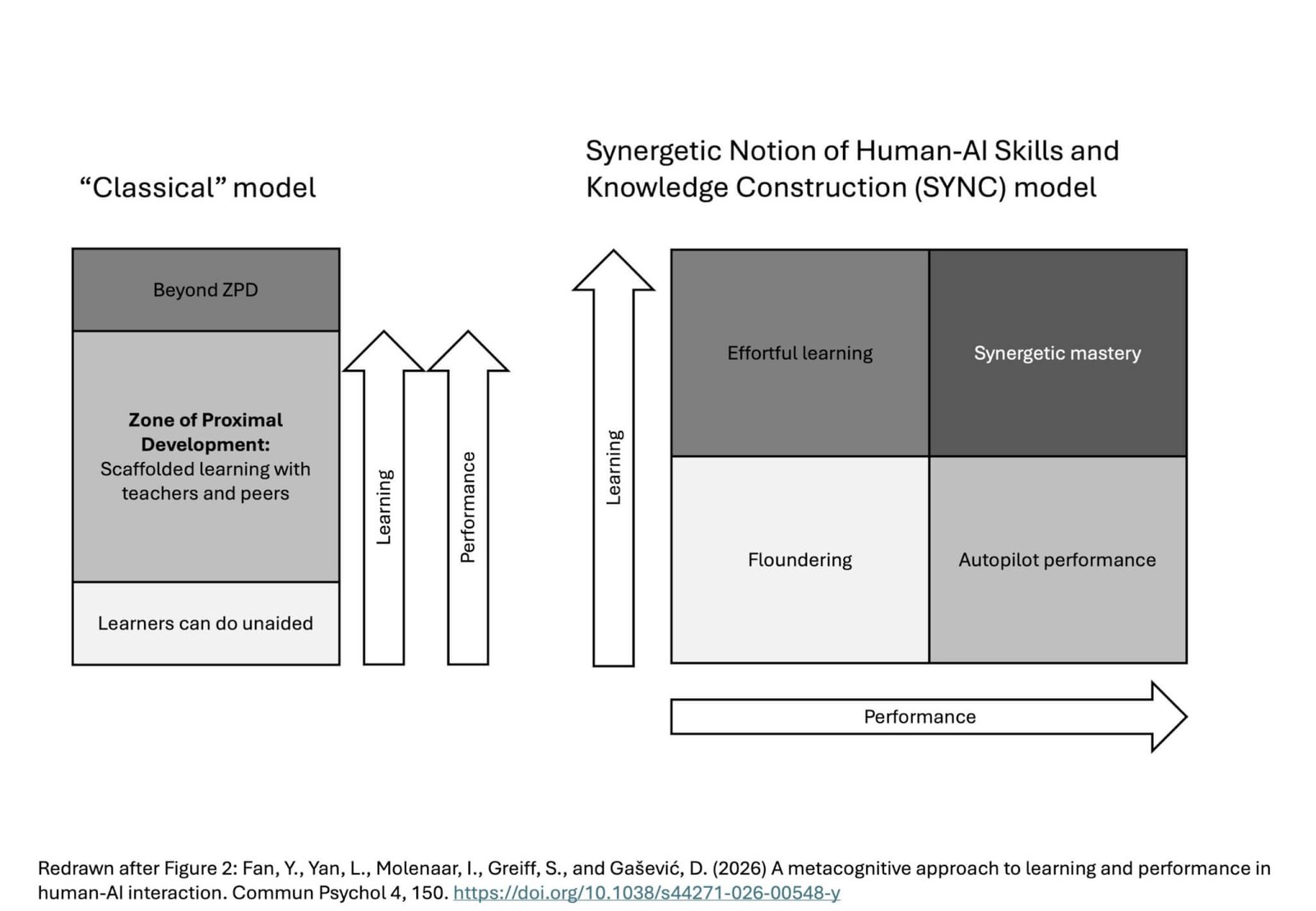
Classically, we (or at least Vygotsgy in his Zone of Proximal Development) have assumed that learning and performance are coupled, and that learning happens in the zone that is slightly out of reach for what a learner can already do, but where they can work with scaffolding or together with peers and still make it. But with GenAI available, learning and performance are now not necessarily connected any more. So now on to the SYNC model, where learning and performance are decoupled (again, see my redrawn figure below).
In the SYNC model, since learning and performance are decoupled, there are four quadrants:
- “Floundering” (which does not come from the fish, I looked it up!) is when students are neither performing nor learning. Students might be in this quadrant because of lacking prior knowledge, scaffolding, support, or because of high extraneous load. There are no desirable difficulties or productive failure here, and learning, if it happens, is not effective.
- “Effortful learning” is high learning with initially low task performance (so basically what everybody has been doing for centuries). It is likely scaffolded and possibly in a community, and AI use is limited so that students do not fall into offloading and dependence traps. Learners plan, monitor, evaluate their learning and thus practice metacognitive skills, and this can be guided for example by reflection tasks. Effortful learning leads to slow but long-lasting results.
- “Autopilot performance” is when cognitive and metacognitive processes are offloaded to AI, so while performance might be good, not a lot of learning is happening. Learners easily get stuck here and loose control over their AI use.
- “Synergetic mastery” — high learning AND high (AI-assisted) performance — is probably where we want to end up, and we are more likely to reach it if students go through effortful learning first (and thus can plan, monitor, evaluate their own learning already) and only then learn to work efficiently and responsibly with AI.
I find this figure super helpful to show how learning and performing have traditionally been taken as coupled, but are clearly not in the presence of AI. These four quadrants, and the discussion of having to move through “effortful learning” before being able to reach “synergetic mastery” would be super useful also to have with students!
So how can we make sure learners avoid AI pitfalls? Fan et al. (2026) give several recommendations:
- The Pitfall of Fluency, mistaking easy to read AI outputs for own competence and understanding, can be addressed by onloading metacognition in the form of “desirable frictions”, micro-interruptions slowing down the process at key moments to prompt monitoring and evaluation. This could be built into the AI (e.g. by checking correct understanding of learner intentions, prompting quality-checking of answers, or reminding learners to be critical) ((but of course this could also be done by the teacher — if my AI did that to me and I did not explicitly ask for it myself, I might just switch to one that doesn’t do it))
- The Pitfall of Pandering, falling victim to AI’s sycophancy and ending up in an echo chamber, can be prevented through engineered dissent (meaning that the AI provides counterarguments or different perspectives unprompted, or prompts the learner to reflect on what makes them change their mind, when AI agrees with them, etc.
- The Pitfall of Coherence, uncritically taking on unsupported claims because a text reads so nicely and is structured so convincingly, can be addressed by making sure that AI does not over-scaffold, but provides “balanced aid”, e.g. only a hint for the next step and not a complete solution, and only if the learner requests it.
- The Pitfall of Transparency, falling for the expert-like framing of outputs, references, and step-by-step explanations as evidence of something they are not (e.g. a guarantee of correctness), requires scaffolded and contextualised verification as counterbalance.
This is a super cool paper and a super helpful conceptual model (and in my summary, I completely skipped over all the evidence they bring in support of the model!). My only criticism is that the quadrants in the graph do not fit with the description, for example “effortful learning” in the figure cannot have a higher performance than “autopilot performance”, even though it does in the text. So I would really like to see something like what I sketched below. But then I guess I would complain that with “effortful learning”, one can only get 1/3rd as productive as with “autopilot performance”, and then I would play with the angles and get stuck in that rabbit hole. So maybe I should just accept a conceptual model as a conceptual model… 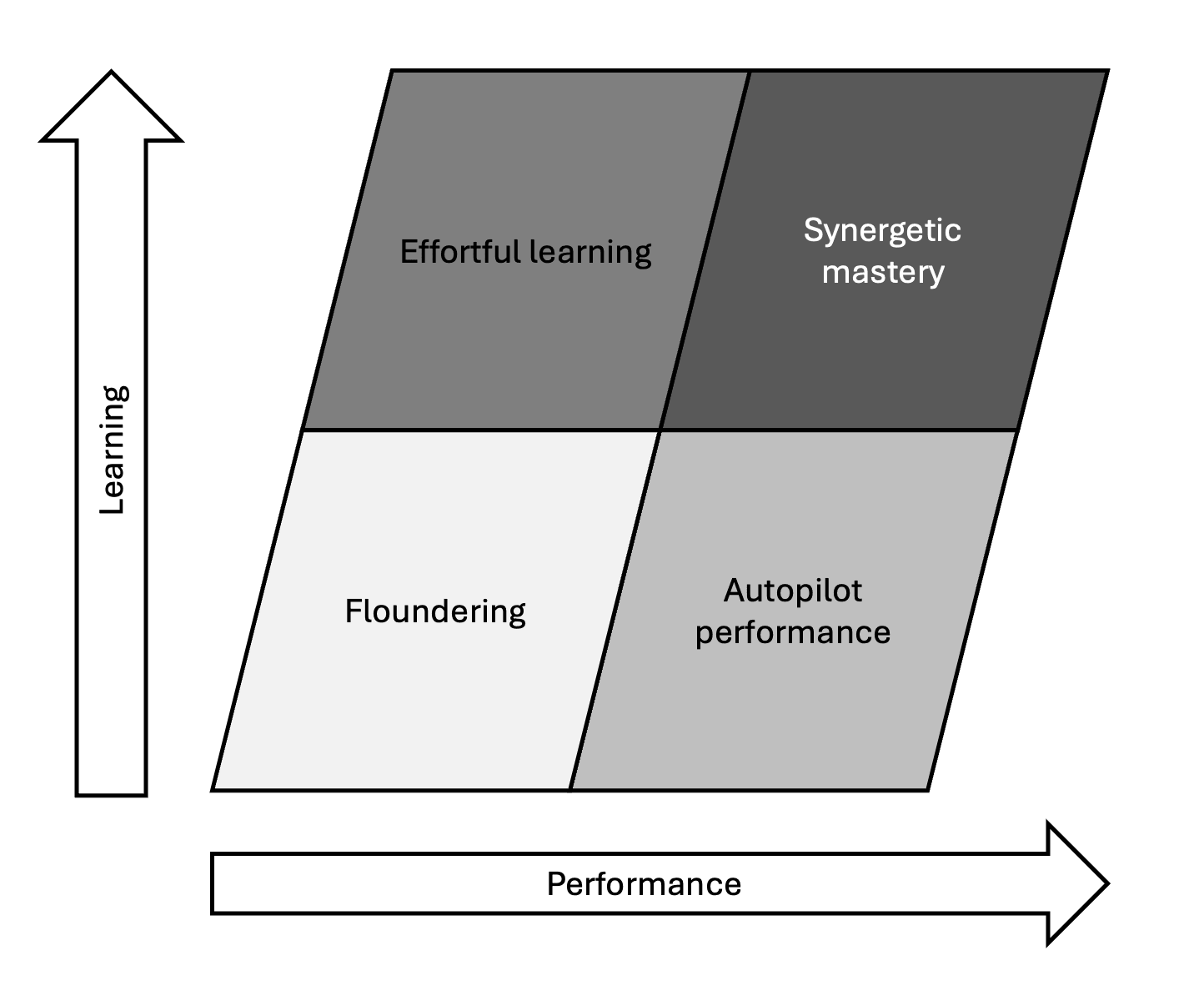
Anyway, that’s it for today, thanks for reading! :-)
Fan, Y., Yan, L., Molenaar, I., Greiff, S., and Gašević, D. (2026) A metacognitive approach to learning and performance in human-AI interaction. Commun Psychol 4, 150. https://doi.org/10.1038/s44271-026-00548-y


