Lund University Teaching and Learning conference 2026
Yesterday’s LUTL26 theme was “Cultivating Judgment, Creativity and Critical Thinking in the Age of AI” and wow, what a day!
One presentation that I really enjoyed very much was “Whose AI Guidance Is It Anyway? Building shared approaches to AI from different starting points” presented by Darcy Thompson for a team of her colleagues. Darcy described the AI task force at the Human Rights division, which has co-created a guidance on appropriate and responsible GenAI use. This is of course not an easy task since people have so vastly different opinions, so even more that these things are negotiated! They had meetings with teachers and then meetings with 2nd & 3rd year students, produced a draft guidance for thesis writing, ran a workshop for incoming students (and have planned later follow-up workshops as those students progress in the programme). This sounds great!
They wrote the guidance document in a process grounded in values, for example participation of students and teachers so that everybody is heard, and following LU policy as common institutional framework (but how can it be applicable in classrooms needs to be negotiated in the concrete context, where practical details need to be worked out). Ultimately, they produced a “living document” (and I just had a look at it, thanks for sharing, Darcy, it gave me so many ideas of things to reconsider in my own policy!) that is expected to change over time as it is re-negotiated with new actors or changing contexts.
The learnings from this process that Darcy reported on are interesting, too:
- Shared values do not mean shared views (nor shared levels of comfort with AI, or skills, or opinions about appropriate use, etc)
- Participation does not necessarily generate consensus (but there is merit in the process to create a cohesiveness)
- Guidance should help develop judgement, not simply prescribe behaviour
- And: Students craved opportunity to discuss and seemed to be disappointed that it came so late, so go talk to your students!
And, as Darcy says: It’s a long game challenge! But it also raises the question of how much agreement we actually need to develop shared AI guidelines? Who knows. And also how big a system can be covered in one guidance document. A course, like in mine? A programme?
Another really interesting presentation was given by Peter Persson on his work with Henrik Danielsson: “Designing Courses for Flow and Meaning in Higher Education: Vital Engagement as a Reflective Tool”. We have talked about vital engagement for a while now, and by now Peter and Henrik have two years worth of student data on how students think the different components contributing to “flow” and “meaning” are realised in their courses, plus some free-text responses of what they mean to the students. This is a framework that is clearly very useful to consider ways to increase student engagement through design choices that make the course both more meaningful to them, but also gets them into a state of flow.
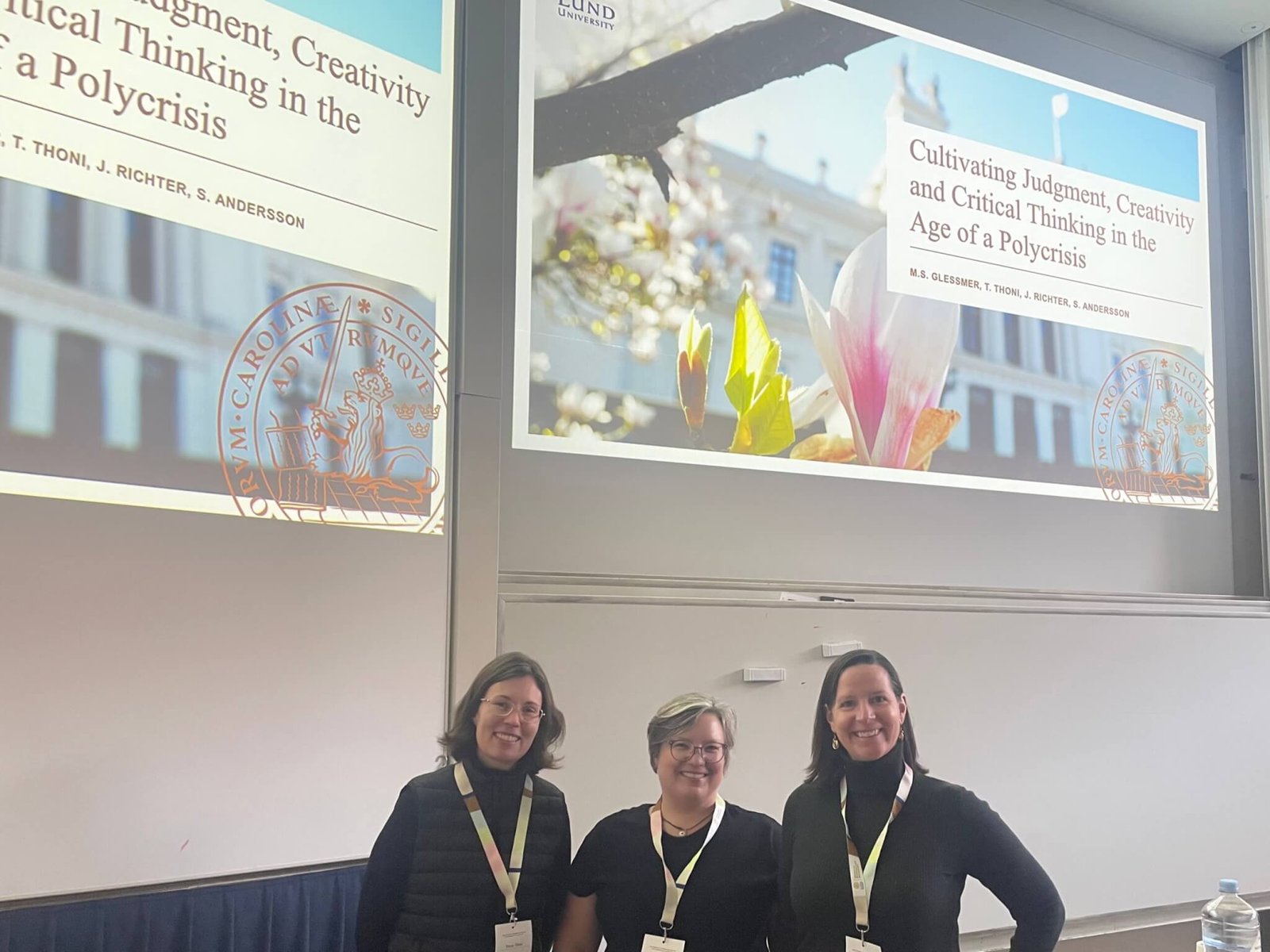
And then, there were of course our own workshop “So many question and no simple answer! Exploring GenAI in university teaching” and presentation “Cultivating Judgment, Creativity and Critical Thinking in the Age of a Polycrisis” (see also featured image with Terese, myself, and Jessika).
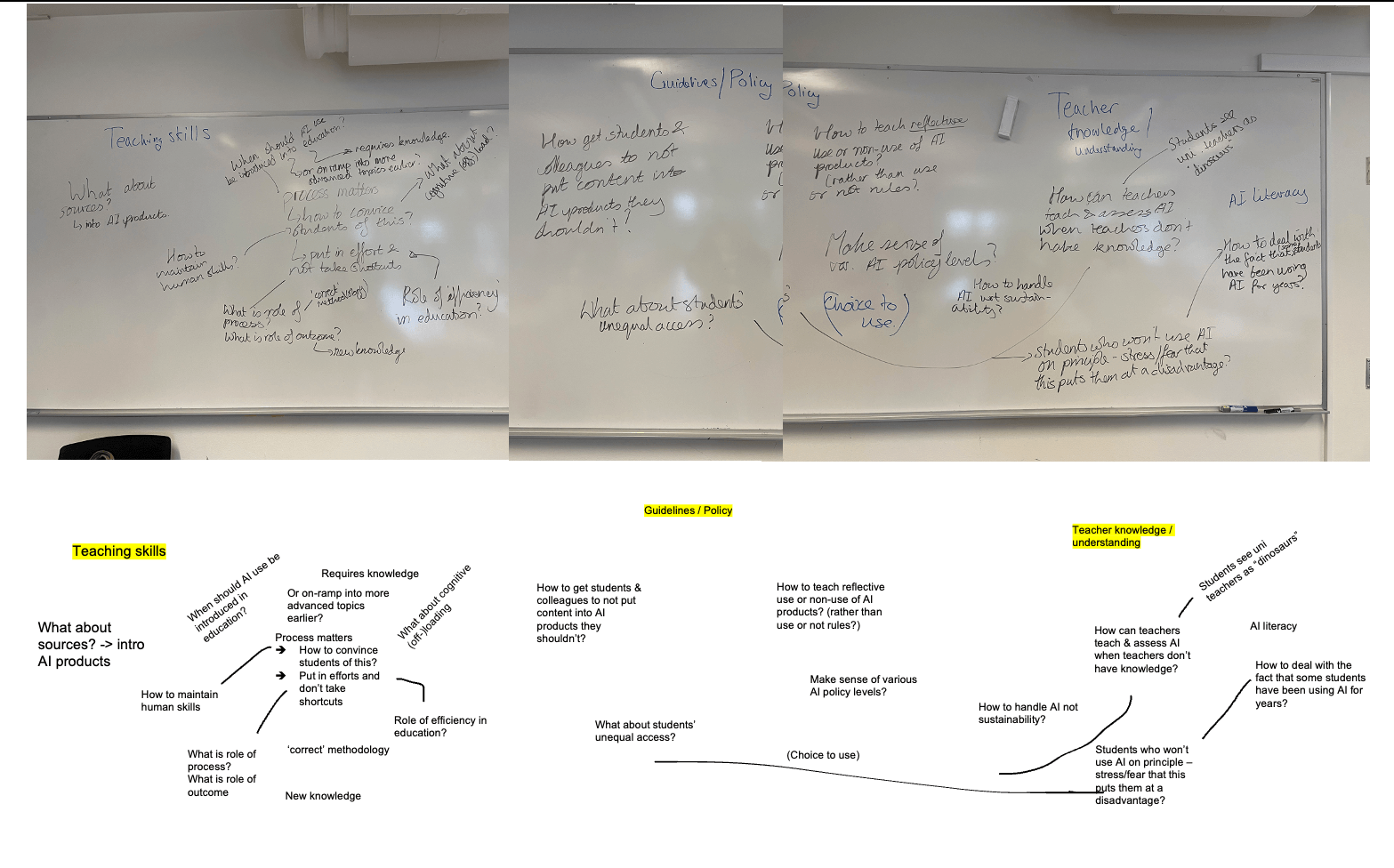
In our workshop, we basically facilitated conversations about AI between teachers on whatever questions they brought up. We first let people talk to their neighbour and write down their questions on post-its, then they read them out. There were sooooo many, thanks Kirsty and Rachel for documenting and clustering! And then everybody got up, found a spot in front of the whiteboard near the question they wanted to discuss, and that’s how we created small groups (thanks everybody for cooperating, this could have gone so wrong!!). Luckily, we had many people from the AiGORA team there, too: Michael, Darcy, Jan-Fredrik, and of course Rachel and Kirsty, so we could have one of us in each of the small group discussions. I think it went really well! And hopefully many people will now come to AiGORA.se and use it!
In our presentation “Cultivating Judgment, Creativity and Critical Thinking in the Age of a Polycrisis”, we basically made the point that AI is a sustainability issue, both from CO2, energy use, rare minerals, etc perspective, but also from geopolitical conflicts, biases, equality perspectives, and that students need to learn not just how to use AI, but also to make good decisions about when to use it and when not. And there are tools that can help design instruction to teach and practice those skills, for example key competencies for sustainability, and examples for how to use them in practice, like in the Complex Course we are currently teaching. And then, of course, the main goal was to invite everybody to join our initiative Teaching for Sustainability!
During the rest of the conference, many good questions were brought up, e.g. “When does a system open a path to learning and when does it take the place of learning?” or “Who is given time and the conditions to develop judgement, and who is expected to follow?”, but also very different positions were expressed, from just accepting AI as “intelligent” on the one end to highlighting that it is a state of power that we need to really think through before adopting on the other. One thing that became very clear to me listening to Darcy’s and other presentations is that I want to explicitly include the “right to refuse GenAI use” in my guidance document. In my context, GenAI is not a learning outcome, so that means that students can choose to not use it, and should not feel bad about making that choice if they want to. I think that is implicitly in it already, but I want to make it explicit.
So that’s my LUTL26 experience in a nutshell!


