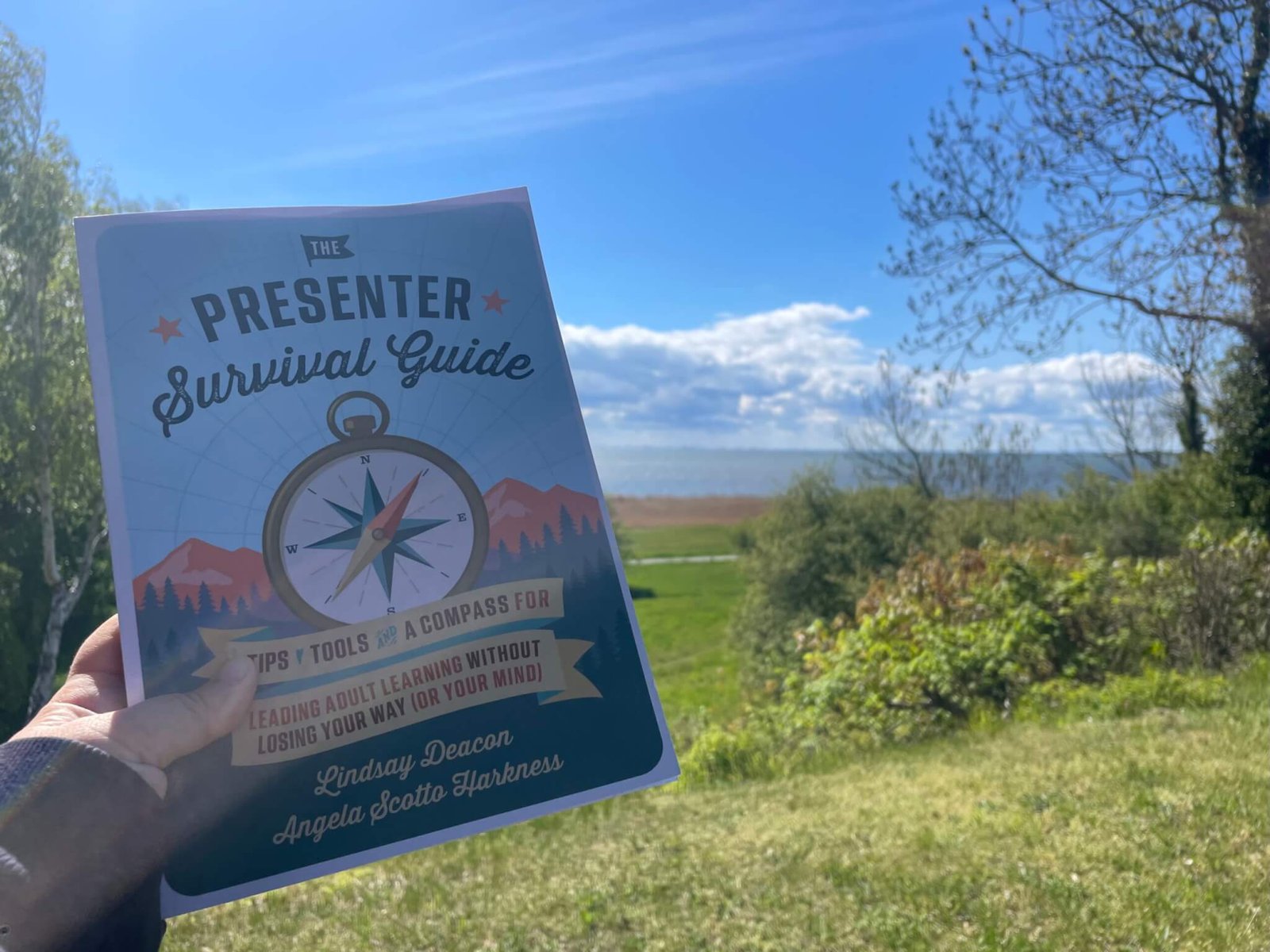
Currently reading: Deacon et al. (2025): “The Presenter Survival Guide: Tips, tools, and a compass for leading adult learning without losing your way (or your mind)”
I browsed this book and I think it is SO USEFUL, especially probably for people who don’t have a ton of experience with leading staff development workshops.
It is a collection of a lot of vignettes of situations that you are likely to encounter: your time getting hijacked, participants displaying open resistance, the audience getting hangry — and provides several suggestions for how to deal with those situations. For example, in preparation, color-code your schedule with what is absolutely essential and which parts you could drop if you had to. Or your own kit of pens and snacks so you can work with whatever workshop space you end up with. Or checklists of what to do if you have to cancel a workshop on short notice; who to inform, what information to send etc.. And one ice breaker to create connections fast I really liked: It’s called “fast friends” and the idea is that people in pairs have to find as many things they have in common in three minutes. That sounds like fun!
But there are also lots of ways to help you reframe situations. For example, if there is a lot of side-talking in the audience, is it possible that you aren’t providing them with enough time to process all the new concepts and information? Or if you have a really annoying participant, imagine floating over the room, looking down on the situation, noticing how it is only one person and in the bigger scheme of things maybe not so important.
For if and when participant(s) use toxic language or behavior, they provide a script that I think is really good:
- Ask for clarification, typ “I’m sorry, I may have misunderstood. Can you clarify what you mean to say?“. If the person doesn’t retract or reformulate, escalate to 2:
- “Can you see how some people might experience that as hurtful?” and then if they continue to argue,
- “This no longer feels like a topic for the whole group. Can you and I check-in while the rest of the group works on ___?“, so instead of seeing sparks fly, the audience sees a calm and collected presenter “while still directly acknowledging that what was said will not continue for the good of the group“
I think in combination with Noah (2025)’s book “Designing and Facilitating Workshops with Intentionality: A Guide to Crafting Engaging Professional Learning Experiences in Higher Education”, this is a great preparation for new academic developers!
The book is independently published (only available on Amazon!), and while I really appreciate the independently published part and how well it is made and that from the way I saw it advertised on LinkedIn it never occurred to me that it wasn’t from some academic publishing house, I am really not a fan of Amazon… But that’s really the only thing I don’t like about this book, otherwise it is super useful!
Deacon, L, Harkness, A. S., and Spingies, S. (2025) The Presenter Survival Guide: Tips, tools, and a compass for leading adult learning without losing your way (or your mind). Independently published. ISBN 13: 9798290440767


Two podcasts, a pink drink, and a webinar - Adventures in Oceanography and Teaching says:
[…] Can I see that working for my topics, e.g. how to deal with microaggressions? On the one hand I want to say that nooo, how to react always depends on so much context, that cannot possibly be simplified into such a game! On the other hand, I do work with example scripts a lot, for example for microaggressions, or the one I shared recently from the Deacon et al. (2025) “Presenter Survival Guide“: […]
Intervening when witnessing microaggressions (my backup plan in case I don’t have time for this slide in an upcoming seminar) - Adventures in Oceanography and Teaching says:
[…] and those who sympathise with them. For if and when participant(s) use toxic language or behavior, Deacon et al. (2025) provide a script that I think is really […]