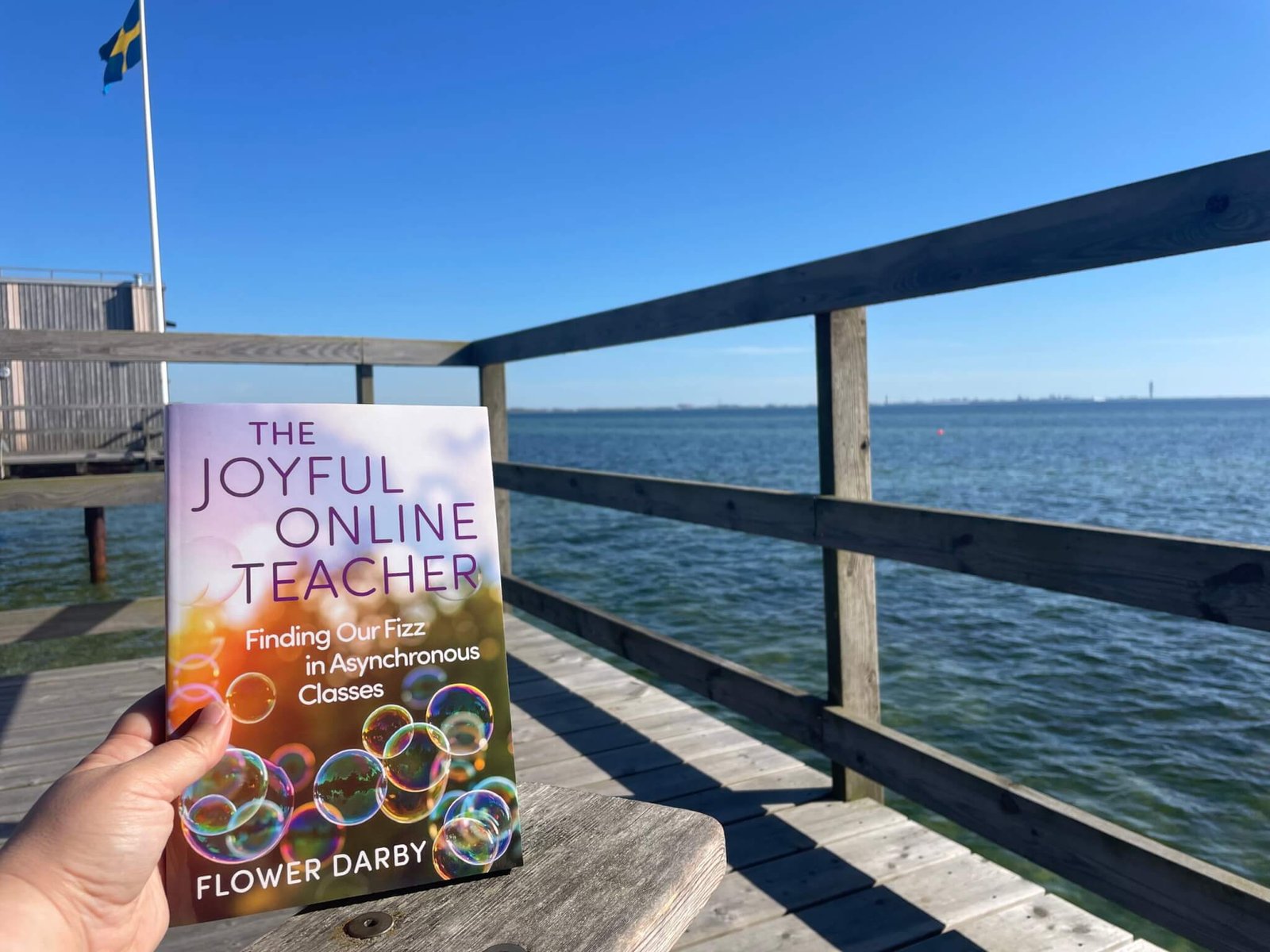
Currently reading: Darby (2026) “The Joyful Online Teacher: Finding Our Fizz in Asynchronous Classes”
I am so excited to finally read this book! There are so many things to think about, and so many practical tips and tricks; I totally recommend any online teacher to read it (and even in-person teachers, it will definitely be good for you to read, too!).
The book is written to convince teachers how online asynchronous can be joyful, and then provides a ton of great advice for how to make it so. I already really liked teaching online, and reading all the examples of why online teaching can be great made me think about what I like specifically. There are four main reasons that are especially important for me personally:
- I really enjoy preparing teaching in detail. I also have a fairly wide corridor of tolerance and think it is fun to improvise in the moment when I see that students or participants need something other than what I had planned, but I really really enjoy the planning and material-building phase of teaching, writing detailed plans of what I want people to do when and why, checking for consistency throughout the course, and making things pretty. This is of course also important in synchronous in-person teaching, but even more so asynchronously online when there is no way to quickly improvise to explain something in other words, or lift the mood because something was too badly organized to find all documents needed.
- I like having time to think. In an asynchronous setting, as a learner, I can pause, reflect, revisit, look at other resources, talk to someone, and continue. As a teacher, I can also wait a moment before I respond, look up something, get someone’s advice. Of course I need to respond in a somewhat timely manner, but not having to respond immediately makes everything a lot less stressful and a lot more enjoyable for me.
- I like connecting more intentionally. I like sharing my love of water, for example, but I can do it in a format that I like without the social conventions of small talk etc. (and I guess an extreme example of that is this blog). I also really like that I can check in with individuals in a backchannel in real time without the whole class knowing about it or it being a big deal. And I like the one-on-one chats that develop on the topics that participants approach me about. This also happens in person, of course, but if the whole conversation started out in writing, it is more likely to continue even after the course is over. Maybe those kinds of relationships develop more with other people who like to write, but overall, more of them develop for me in online settings than in person.
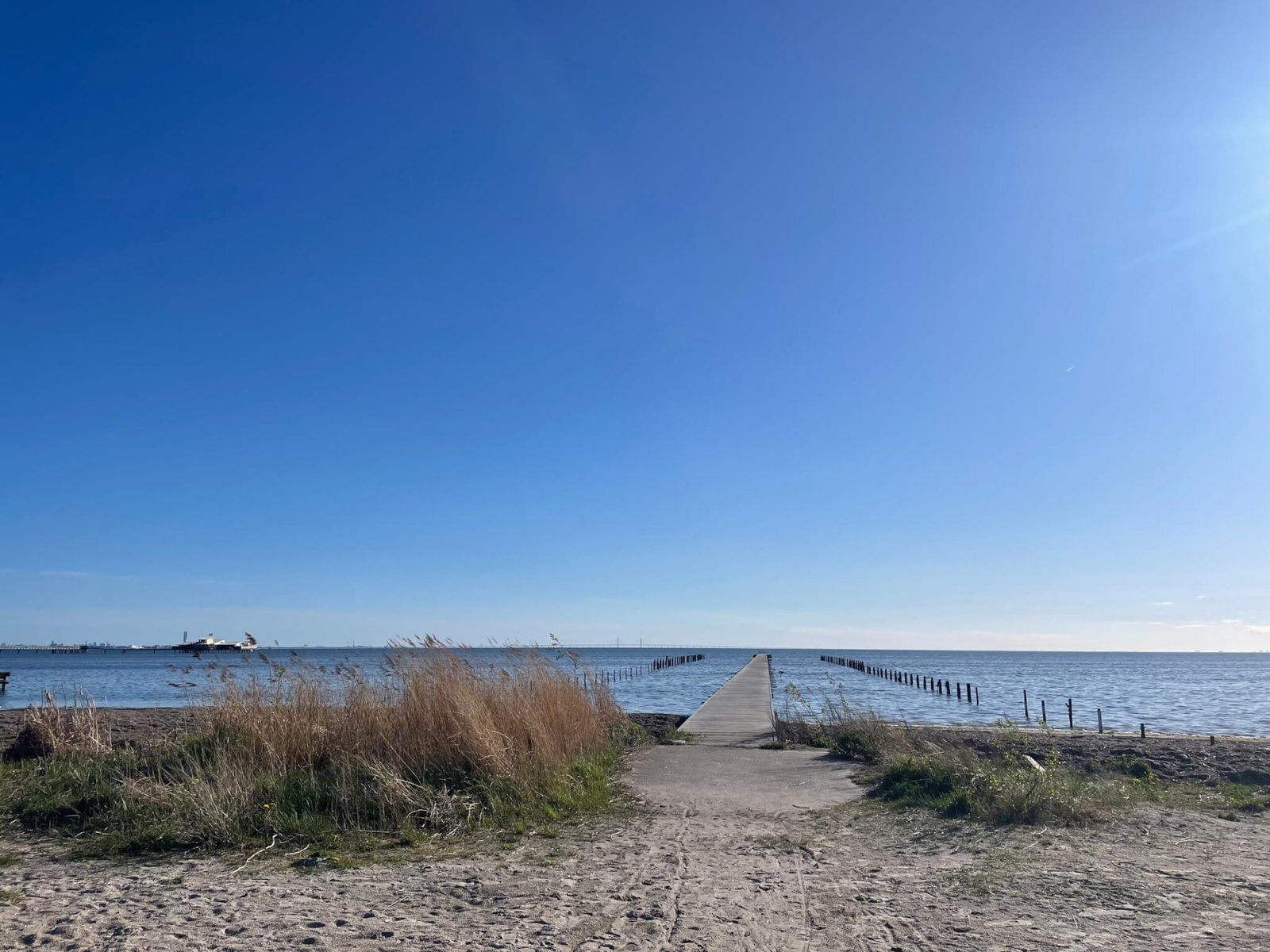
- I like that I am free to do the teaching from wherever I like, and also that I can build it around my life. Not as in squeeze it into some niche, but as in go for a walk and dip when the weather is nice and work late instead. Or get up super early to do it, and then take the rest of the day off. And I like that I can set my work environment. For certain tasks, I work well by the sea, or in cafés. For others, I need total quiet and hours of uninterrupted time. If I don’t have to be in a classroom or office, I can create the environment in which I am most productive. Even in zoom calls, I find that it is easier to focus on the participants and the teaching than in a classroom. I takes a lot of energy from me to not get distracted when the air conditioning in a room is quacking (like in the room I most often teach in), … The pictures in this post are from the day I started reading the book, which I did at the place where I go swimming. Being able to take my work to where I love being, having all these positive emotions of the beautiful weather and first lush green of trees connected to the asynchronous learning I am doing — in this case by reading a book — is so important to me!
Anyway, back to the book. In a nutshell, I think Rachel’s favorite teaching advice summarizes it: “look like you actually want to be there!” To me, this consists of three parts:
BE THERE
It’s not so difficult, and also not so different from in-person teaching: Even though a huge amount of preparation (possibly including scripting and filming, editing and posting, the latter possibly even by someone else than us) has gone into it already before a course starts, the course isn’t done until the course is done. And until then: Be there! Share joy and interests authentically — both in the pre-produced content, but importantly also along the way whenever there are relevant, fun, curious news items popping up, a new publication comes out, or you see a good example of a concept out in the wild.
BE AVAILABLE
The concept Darby uses are “immediacy cues”: in person, we might be hunkering down next to a group to talk with them, and make sure we look at students and not the projection of our slides or the laptop. How do we translate that into online teaching? Darby has a bunch of suggestions, for example looking directly into the camera when filming or in video calls, sending individual emails and making sure that names spelled correctly, use humor (for example memes, gif, emojis that reveal something about your personality), notice perspectives that students bring up and refer back to students’ points in discussions, send quick personal messages when something makes you think of a specific student’s interest or a point they brought up, and lastly pay attention to pronouns! Not just in correctly addressing people the way they want to be addressed, but for example also in writing things like “this week, we will dive into …” instead of “this week, you will read about …”.
All of this of course takes time and requires some pre-planning so that it is even possible to react spontaneously. One suggestion is to pre-commit time in the schedule (specifically to have conversations with students about boundary violations or errors related to AI, but equally importantly to send out those personal messages etc), and let people know when they can expect a response and then be consistent in responding. One specific recommendation is to plan catch-up days into courses and that makes life so much easier!
SHOW THAT YOU CARE
Some care is of course already signaled by an instructor bothering to be there and be available, but Darby (2026) recommends “intentional effort to project confidence and optimism about students’ abilities to learn”. And to explicitly say repeatedly that I’m here to help! Sometimes I am surprised by how surprised people are when I do stuff to help them that is part of my job. How many more times do we have to say we are here to help?
Another way to show care is to add a “what’s on your mind” (related to the current topic or in general) question to the reflection questions at the end of the week or module, and students can respond to one or more of those, including the more open one.
There were also two suggested activities that I really liked:
- An ice-breaker activity where people pick one (or three) meaningful photos from their phones’ libraries and write a sentence or two about what makes those pictures meaningful. When I read that, I was thinking about a recent pic in my camera role — the cable in the locking mechanism in my parent’s car’s trunk lid. Meaningful because it was fun to open the stuck luggage compartment from the inside after I had read that cars need to be able to be opened from the inside! A good tip in the book related to this exercise is to make sure to follow up on pictures with dark themes.
- A “Build Connections” activity. Students fill two columns on a paper: one with hobbies, interests, and goals; and the other one with all the topics / concepts / stuff in class. Then they draw connections between items in the two columns and write a short reflection. That sounds like fun!
So that’s it for me — you should really read the book! It also introduces a cool model for mental well-being PERMA (Positive emotions, Engagement, Relationships, Meaning, and Accomplishments) which can be really useful for reflection!
P.S.: I love a good how-to guide! Since it fits perfectly with the topic: Mendoza et al. (2026) use the Community of Inquiry framework and combine it with UDL strategies and best practices for inclusive blended-learning in their enormous Table 2, which is totally worth checking out!
P.P.S.: Salehi Shahraki & Alavizadeh (2026) review the literature on teaching presence in the Community of Inquiry in online environments. They suggest, for example, “treating discussion prompts, response templates, and moderation norms as design artefacts, rather than as an individual instructor’s discretionary style“. While having a responsive instructor in discussion fora is desirable, this is only true to a certain point since “over-participation can crowd out peer interaction if it collapses a discussion into an instructor-led Q&A“. And since, when courses need to be scalable to large participant numbers and remain consistent across instructors, instruction needs to become reusable (e.g. video tutorials, discussion templates), they create a whole framework of design principles, including, for example, “Treat communication cadence as curriculum infrastructure” with “Start-, mid-, and end-of-week, plus pre-deadline message templates“. Also a super useful article!
Darby, F. (2026). The Joyful Online Teacher: Finding Our Fizz in Asynchronous Classes. University of Oklahoma Press.
Mendoza, A., Venables, A., & Linden, T. (2026). Inclusive Curricula: A Framework and Recommendations to Promote Students’ Sense of Belonging in Blended-Learning Environments. International Journal of Learning Teaching and Educational Research, 25(4), pp. 575-601. https://doi.org/10.26803/ijlter.25.4.27.
Salehi Shahraki, A., & Alavizadeh, H. (2026). Operationalising Teaching Presence at Scale: A Design Model for Foundational Cybersecurity Education. Computers, 15(4), 257.
And here some more pictures from that beautiful day! Walking down to the beach…

I just love the green!

And blooming trees!
So beautiful!
And flowers!
And the sea!

And the water!

Being in sunny water is just the best!

I love watching sun on and in water!

And tiny capillary waves

Here you can even see the structure of the sandy seafloor!

Maybe hard to spot, but even the willows are getting new leaves!

More beach views.

Fresh green leaves and water make me soo happy!

I cannot believe how happy it makes me that winter is over!

But no boats out yet.
Only nice waves!

And my favourite view to wrap this up.