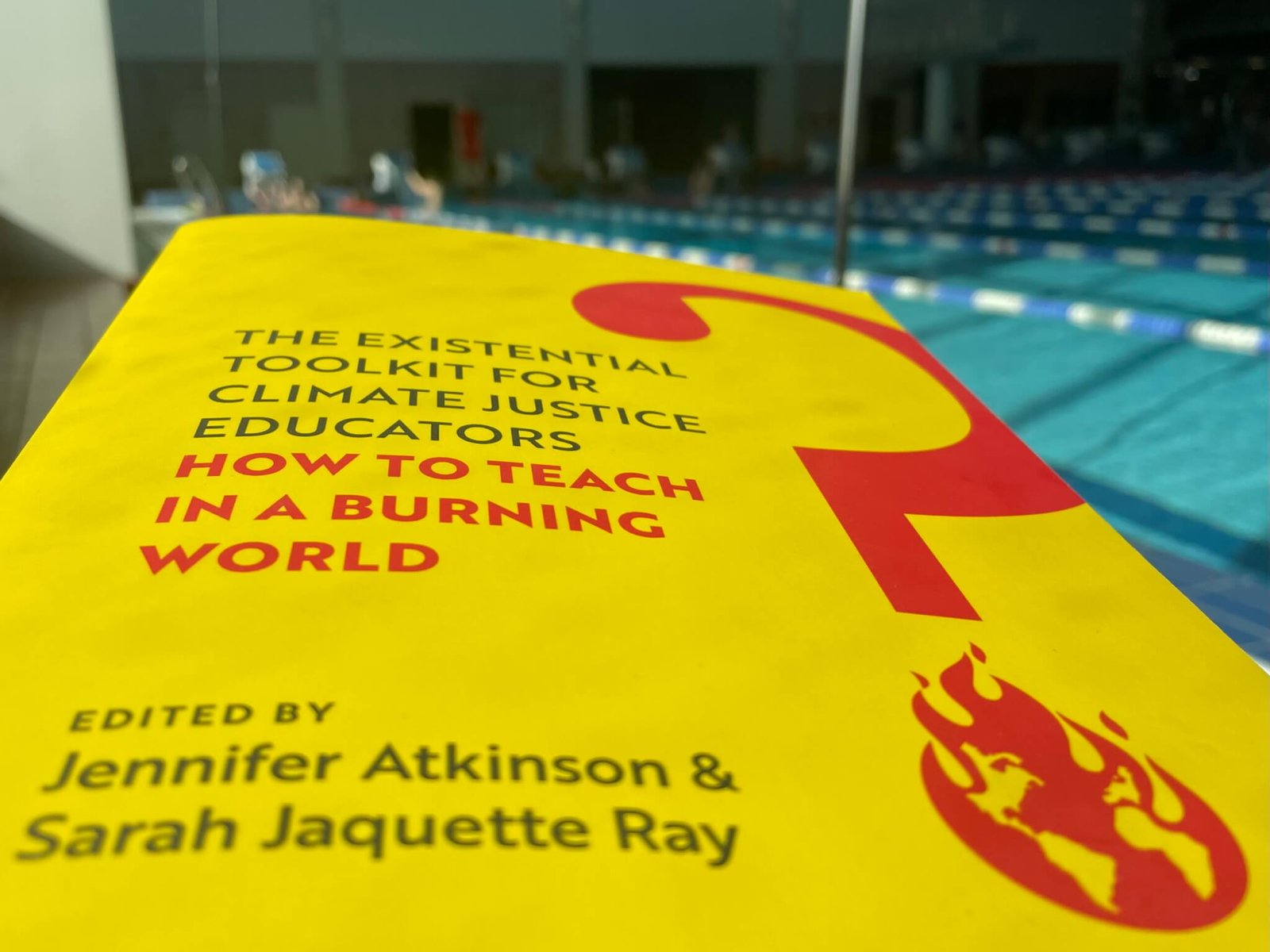
Currently reading “The existential toolkit for climate justice educators: How to teach in a burning world” (2024)
Sunday at the pool, waiting for my training to start, I read about the first half of the book “the existential toolkit for climate justice educators: how to teach in a burning world“.
Already in the first chapter, “balancing feelings and action” by Bryant, a very useful model is presented. It is a four-step loop model that consists of the steps feel, talk, unite, and act. This is quite similar to many other models for dealing with echo emotions, but I really like the descriptions of the steps in this chapter, and I also really like how open they are to everybody interpreting them in whatever way works for them, because, as Bryant writes: “The forces of climate crisis, environmental destruction, and ecological injustice are so huge, so multifaceted, and so potentially overwhelming that no one solution, strategy, of style of engagement is sufficient to save us. We need each person to engage their particular unique strength, capacities, and resources in defense of our ecosystem and our future, rather than trying to emulate others, compare themselves, or expect that they need to “save the world” on their own.”
I will use the four steps as a structure to also summarize the main points that stood out to me in the other chapters.
1. Feel
Bryant suggests to always start from the feeling rather than acting. This is different from other advice I’ve seen where the advice is to get people into doing, and then their emotions and convictions would follow. The reason Bryant suggests we should start from feeling, even though it might seem like a waste of time, or might feel indulgent or unproductive, is that we need to understand our feelings so we don’t act out of panic and do something that isn’t actually aligned with what we want to do and that is suited for us, but rather identify actions that work well with us and that have the greatest impact (and we’ll find out what those are over the next steps later). Which sounds very sensible!
The importance of starting from feelings is also mentioned in the chapter by Davenport, who writes “a valuable first step in freeing ourselves from the powerful and sometimes destructive pull of unconscious emotional suppression is to create a safe place to express feelings. There’s a pervasive myth that acknowledging and expressing our feelings about climate change is unproductive, a waste of valuable time, and that we’ll end up falling into an abyss of pain and sorrow with no way out. But just the opposite is true: it’s our unacknowledged and disenfranchised emotions that keep us stuck. We can dispel the taboo of expressing feelings as part of climate work by learning and promoting a more accurate understanding of our emotional landscape and creating the space and time to talk about emotions in a group setting” Powerful words!
Garvey, in the chapter “leveraging affect for climate justice“, suggests many methods to connect with feelings, but I love this one: “Paddle: experience the history, geology and hydrology of a place via boat, responding to the current, wind, and bends of the water via self-propulsion. Consider how a well-known perspective changes when on the water. Paddel with a mission to educate, raise funds, collect data, or blockade.” It probably comes as a surprise to noone that this resonates with me! In my mind I am floating down a river, looking at the plants and wildlive, the capillary waves when a gust of wind comes around a corner… We really need to include such experiences of nature and connectedness with the world much more, and much more purposefully, in education!
I also really liked the writing prompts in the emotional impact statement exercise that Manning suggests as one way to access feelings about reading difficult materials, e.g. on thoughts: “Did you skim the material, thinking “I already know this?” Did you question or doubt the content in the reading? Was your curiosity aroused: “Really? I need to look into that…“, on emotions: “What emotions were evoked by the reading? Did you feel angry? Sad? Overwhelmed? Did you feel numb and paralyzed? Or did the reading make you feel determined and energized? Did you feel excited about the potential for creating a more sustainable and justice-oriented community or world?“, and on behaviors: “What did you do with your reactions? Distract yourself with internet, social media, TV, or text messages? Did you crawl into a bag of potato chips or crack open a beer? Did you call a friend to talk about the thoughts and feelings you were having about the climate crisis? Did you investigate advocacy or activist groups you could join?” I find it so valuable that the questions include reflection about how the emotions manifested in behavior, and how the the questions don’t just include unproductive ways to deal with it but also suggest more productive ones, like calling a friend. Which leads us to the next step…
2. Talk
The second step, talking, this about typical suggestions to provide space for conversations in the classroom; leaving time at the end of a class, so students can talk about their feelings; write down a word or a sentence that expresses the feelings; or even having discussions in class.
Other suggestions in other chapters include “using poetry to resist alienation in the climate change classroom” (Maczynska), which we have also experimented with in a recent lunch gathering; and my absolutely favourite method at the moment, photovoice. Trott writes the chapter “photovoice for the climate justice classroom–inviting students effective and social political engagement“, where they describe photovoice (basically taking a picture and adding a title and a caption, otherwise also known as my “active lunch break” exercise) as participatory action research when pared with critical reflection and dialogue, and taking action. “Photovoice can invite students to recognize and collectively process their emotions, critically reflect on the sociopolitical dimensions of present-day challenges, and imagine and bring into being better futures through their own actions“. I am interviewing several people working with photovoice methods in sustainability soon for our MOOC, and I am very much looking forward to that!
3. Unite
The “unite” step is about finding community in which we can talk about feelings and process them together. And I really like many of the suggestions here because it’s not just about joining climate activist groups (which can, of course, be a great way to deal with climate emotions through doing something productive), but also, for example, joining a trail maintenance crew, or a community garden, or a climate fiction book club, and even professional development or organizations aligned with students career aspirations in the climate field. Many of those don’t seem “dangerous” in an activist-y way, they are really low threshold, but they can still provide community and support.
The author writes “the key here is not to find the one group that seems to be the most effective, most outspoken, or most “activist”, but rather the one that will be the most supportive of each student’s particular process of discovery. Spending time with others which have similar concerns about the climate, or similar appreciation for the Earth, enrich as us and energize us to stay engaged“.
And Devenport also stresses that anyone can lead a climate circle, we don’t need any specialized degree or expertise. It’s just about coming together and starting to talk.
4. Act
The fourth step, acting, is then again not necessarily about climate activism, even though that can of course be the case. It is about everybody acting on what makes the most sense, what is most meaningful to them. One example that the author mentions is someone who decided to buy a bike after realizing that she’s worrying all the time about the planet, without actually giving herself a chance to experience what she loves about the natural world. And with biking, she finds a way to connect back with the world and to gain inspiration. And the author stresses that they are not sure that was the final step in her journey, but it was clearly something she needed to do in order to remain engaged. And as this four-step model is a cycle, this is where we would go back to emotions and start over! So getting a bike (or a canoe) is a good step to get into the feelings of connectedness that can ultimately result in larger scale, or more targeted, climate action.
The next part of the book will be on discomfort and difficult knowledge, but that is for another day!
The existential toolkit for climate justice educators: How to teach in a burning world: Edited by Jennifer Atkinson and Sarah Jaquette Ray, Oakland, California, University of California Press, 2024, ISBN 9780520397118


Currently reading Peters et al. (2026) on “Dread, hope and the politics of emotion in engineering education” - Adventures in Oceanography and Teaching says:
[…] suggested to talk about emotions and to find supportive community to process and deal with them (see for example the steps talk and unite here), most often there is no discussion of how emotions are shaped by society in the first place. […]