Quick recap of the “Sustainability Research and Teaching in a time of polycrisis” symposium at Södertörn University
It is maybe too soon to write a recap of a symposium that ended only hours ago, before I have had time to process it, but here are two things that are on my mind right now (also, did you know that Södertörn is actually Sweden’s 3rd largest island? Not that you would notice you are on an island from where I was…).
1. Sustainability teaching as repairing
Sustainability is often perceived as involving giving up something. Flying, buying stuff, building huge houses, all those things. Even when people try to frame things positively — for example me talking about how I like slow travel because it gives me time to transition properly and also because I enjoy ferries and trains and usually work quite well because the internet is usually so bad that I cannot distract myself — that sometimes feels a bit forced and like we really have to tell those stories to convince ourselves (especially after the kind of train trip I had getting here a couple of days ago…). But at this symposium, there were so many stories of people who think about about working for sustainability as repair. Repair of relationships in countries in the western Balkans where people used to shoot at each other across a river not so long ago and are now working together to protect that same river. Repair of Ukraine in new and better ways once the war is over. Repair of identity of teachers in exile. Repair of wellbeing when a campus is recognized and treated as not just a work place but a place on which we spend substantial amounts of our lives (note to self: Next “outdoor office day” is on June 6th, 2027!). Restoring villages as spaces to which people who left for the opportunities offered by big cities want to return to. There are so many positive visions (and mine typically involve water), for example swimmable cities or drinkable rivers.
Often these repairs are about repairing the sense of home. One concept that I want to explore more deeply is that of home-Home-HOME, where home means the everyday practices, Home is more symbolic — values, cultures, traditions, memories, emotions, and HOME I don’t really understand yet, but it’s about macro-level things. This was discussed in the context of displacement (which is often talked about as either the catastrophic, one-time event (the flood, or volcano, or war) that caused it, or as something that needs to be resolved, but with very little discussion of the actual duration of displacement) and of how people build a sense of place. My own context is of course very different and extremely privileged, but somehow this and the idea of trying to create continuity across contexts — either by the objects we bring, or by the relationships, culture, traditions, values we uphold — touched me deeply. When I am moving soon, how much of all the stuff that I own do I actually want to bring into a new space, and why is it so hard to let go of things that I really don’t want or need any more? The idea of trying to create continuity was really enlightening also for my own situation!
But anyway, working for sustainability together can create overarching identities that are bigger than ethnicity, nationality, or whatever else divides people. So this is another argument for a whole institution approach and sustainability as a practice embedded into everything we do!
2. Dismantling the Master’s house with the Master’s tools?
One tension that I felt very clearly throughout the two days was about whether we can dismantle the Master’s house with the Master’s tools, which I wrote about before. In sustainability teaching, we want transformation, at the same time, we need to treat it as a wicked problem and do small steps and evaluate the results before we decide on the next one. We want epistemic transformation, but we are looking for established (western) knowledge to validate new knowledge created elsewhere or with different methods. We try to change things at university by giving the university exactly what (we think) it wants from us: publications, awards, international recognition, … Which is of course exactly what we were doing by participating in the symposium (in addition, of course, to also learning so much!).
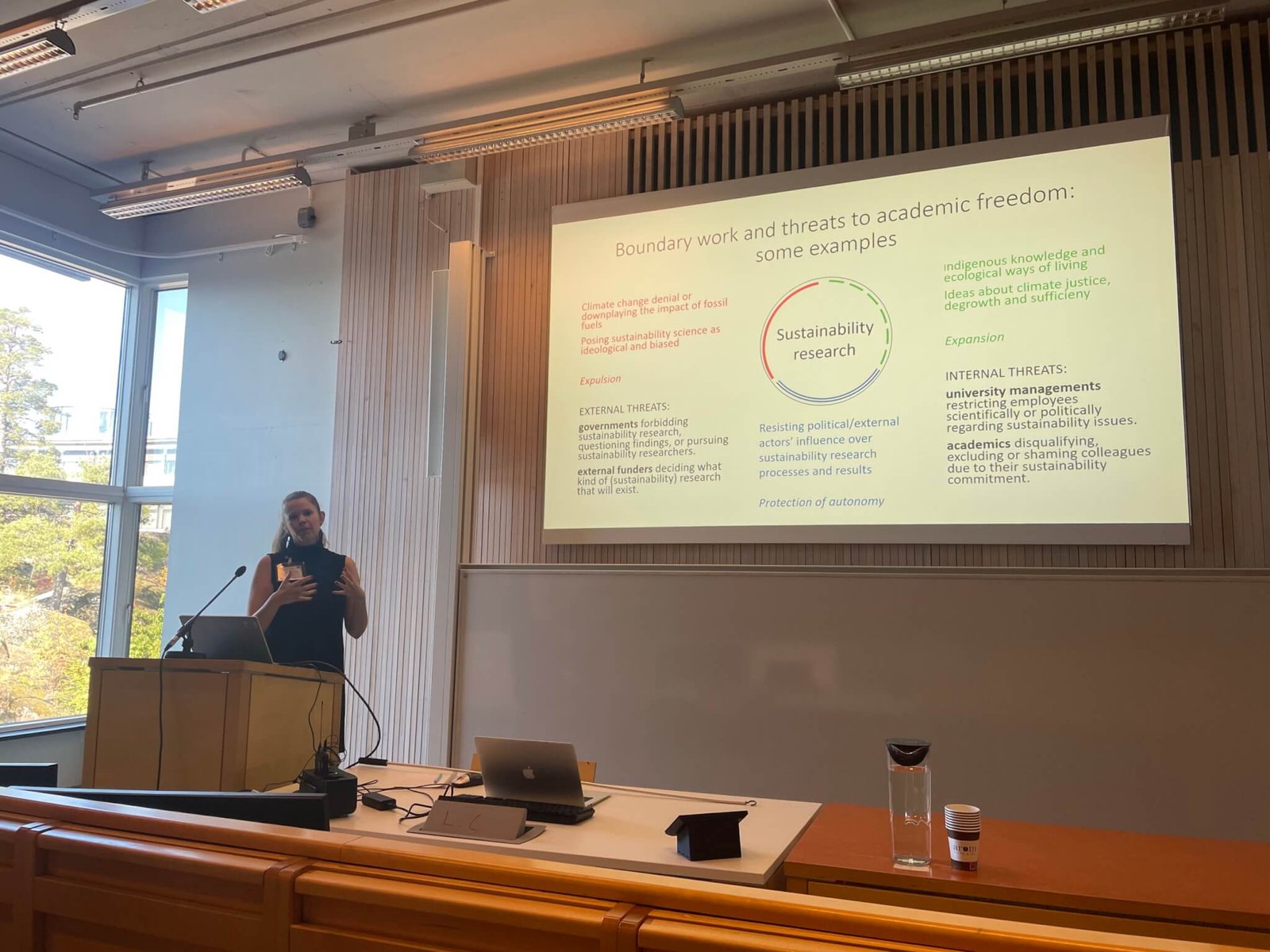
My awesome colleague Elisabeth Kring (see also in the featured image) talked about boundary work on what separates science from non-science. She adds a fourth defense to the three that are traditionally mentioned:
- expulsion (for example exclude climate change deniers from debates, or exclude anything that seems ideological or biased)
- expansion (for example include indigenous knowledge, climate justice, degrowth, …)
- protection of autonomy (resisting external actors; governments that prescribe what can and cannot be investigated, funders that influence what can be done, university management that restricts, or even colleagues that shame or try to disqualify)
- embrace political judgment and engagement (since there is no “non-political”, value-free science anyway, we should be open about it. And we are a mind within a body within the world)
She ended on a call to bring together the work for academic freedom and for sustainability. As she says, there is no academic freedom if there is no planet to live on. And nobody is free until everybody is free!


News article about our course “Critical Thinking and Complex Systems: Challenges and Futures”! - Adventures in Oceanography and Teaching says:
[…] development of that course was also the topic of our presentation a while ago at Södertörn University, and we are currently finalizing the proceedings where we write more about the process, the […]