
“When smart groups fail”: A guest post by Sarah Ruth Schmid on Barron (2009)
Today I am excited to share a guest post Sarah Ruth Schmid, PhD student in geodidactics at the University of Oslo, in preparation of an iEarth journal club. Here it goes:
When smart groups fail
As teachers and educators, we probably all have some assumptions about what kinds of groups are likely to master a challenging task. Put the strongest students together, we might think, and the group will be more likely to succeed. Or perhaps we assume that a group with highly active and talkative students will have an advantage over a quieter group. Barron (2009) challenges this way of thinking about group work. In her study of collaborative problem solving, neither students’ prior achievement nor the number of correct ideas generated by a group could explain why some groups succeeded while others failed. Instead, what mattered was what happened between the students: how they responded to each other’s ideas, how they maintained joint attention, and how they negotiated both the problem they were trying to solve and their relationships with one another. This makes group work rather more complicated than simply putting good students together. As Barron puts it, even though “the average knowledge of a group is equivalent and the collaborative work assigned is the same, learning outcomes resulting from member interaction differ significantly” (p. 308).
So, what actually makes a group successful?
A group is more than the sum of its parts
Barron starts with an understanding of learning as something that happens through interaction. Knowledge is not simply something that individual students possess and then bring into a group. Rather, ideas are developed, challenged, accepted, rejected and transformed through interaction with other people and with the materials available to them. This is close to a social constructivist understanding of learning: knowledge is constructed dynamically rather than simply transferred from one person to another. It also resonates with perspectives that understand learning as distributed across people, tools and other elements of the learning environment.
This is important because collaborative work has considerable potential. Working with others can require students to resolve different perspectives, share original insights and negotiate solutions to shared problems. These processes can develop higher level problem-solving and communication skills that might not emerge in the same way when students work individually.
But there are also challenges associated with it.
The same interaction that creates opportunities for learning can also create disagreement, frustration and failure. Group work can therefore be both a powerful learning environment and a rather painful one. Barron is particularly interested in understanding why these complex interactions happen during group learning.
What are students actually doing when they work together? And how do these small interactions eventually become differences in group performance and individual learning?
It is not just about having the right answer
One of the most striking findings in Barron’s study is that the less successful groups were not unsuccessful because they lacked the knowledge required to solve the problem. In fact, the groups generated similar numbers of correct proposals. The difference was what happened after a correct idea was proposed.
Barron coded students’ responses as accept, discuss, or reject/ignore. Successful groups were much more likely to engage with correct proposals, while less successful groups were more likely to ignore or reject them.
Imagine a student saying, “Maybe we should divide these two numbers first?”
In one group, another student might respond: “OK. Why would we do that?” A third student picks up the workbook and starts working through the calculation. The first student explains their reasoning, the second adds something, and gradually the group develops a shared solution.
In another group, the same suggestion might be met with silence. Someone changes the subject. Another student continues working on their own part of the problem. The idea disappears.
The knowledge available to the two groups might therefore be almost identical. What differs is what they do with it. This is why Barron focuses on micro-interactional processes. The small details of communication matter: whether someone listens, whether an idea is taken up, whether disagreement leads to further discussion, and whether students coordinate their attention.
Interestingly, the amount of talking itself was not what distinguished successful from unsuccessful groups either. The groups did not differ significantly in the total number of conversational turns.
If neither knowing the solution nor talking more is the answer, what exactly needs to happen during the conversation?
Welcome to the joint problem space
One of Barron’s central concepts is the joint problem space. This refers to the shared understanding that students develop about the problem they are trying to solve. To create this space, students need to coordinate their attention, particularly at what Barron describes as solution-critical moments: moments when something important is happening in the process of reaching a solution.
Students can establish this joint attention in surprisingly ordinary ways: making eye contact, pointing at something in the workbook, tapping another student, moving closer to share a visual perspective, or simple comments such as, “Wait, let’s stay on track.” Barron’s observations show that both speakers and listeners have an important role in establishing and maintaining this shared attention. It is not enough for one student to communicate clearly. Someone else also has to notice, listen and respond. This leads to another important idea in the paper: when students work together, they are not only solving the academic problem in front of them. They are also navigating a complex relational situation, which comes with challenges, as well as opportunities.
Barron describes this as a dual problem space. One space concerns the content: What is the answer? Which idea should we use? The other concerns the relationship between the people trying to solve it: Are we listening to each other? Who is doing what? How do we deal with disagreement?
These two spaces compete for attention, but they are also deeply connected. A disagreement about mathematics can become an interpersonal disagreement. A struggle for control of the conversation can prevent the mathematical problem from being solved. Conversely, a respectful and coordinated interaction can make it easier to think together.
This might help explain why group work can be so demanding. Students are doing cognitive and social work at the same time.
So, what does a successful group actually look like?
Interaction makes the difference
Barron’s analysis identifies several characteristics of successful groups. They maintained joint attention, participated actively, monitored their progress, confirmed information, persisted when problems arose and developed a shared sense of ownership over the final product. They also showed co-regulation, adjusting their own behaviour in relation to what their partners were doing.
Less successful groups showed very different patterns: competing claims of competence, parallel attempts to solve different parts of the problem, failures to understand each other, struggles for control and a more individualistic orientation.
Some students were also eager to take over the conversational floor, while other students’ hesitant contributions could disappear before they had a chance to become part of the group’s thinking.
What can teachers actually do?
Barron’s findings raise an important pedagogical question. If productive collaboration depends on such complicated interactional processes, how can we create conditions in which these processes can develop?
Barron suggests four conditions:
- Create a problem that gives students something meaningful to work out together.
- Give students authority to address the problem, rather than solving it for them.
- Hold students accountable to shared discourse norms.
- Provide relevant educational resources that students can use in their problem solving.
The materials matter, too. In Barron’s study, the workbook became a centre of coordination, giving students something concrete around which they could organise their joint attention.
But what about higher education? Barron’s participants were sixth graders. How much of this scaffolding do university students need? Should we explicitly teach students how to collaborate, establish discourse norms and regulate their group interactions? Barron gives us good reason to question the assumption that putting university students into groups automatically creates collaborative learning.
So, if successful group work depends so much on interaction, what kind of social connections between students help make collaboration work?
Should we just put friends together?
One of the findings I found particularly interesting was the role of friendship.
Students who were friends tended to engage in more productive dialogue and more transactive exchanges, which are interactions where students build on, question, or use each other’s knowledge to advance their shared understanding and problem-solving. They talked more, offered more ideas and appeared more comfortable developing a shared problem-solving space. Familiarity with each other’s knowledge, communication styles and ways of thinking may make it easier to coordinate interaction.
This does not mean that every group assignment should become a friendship exercise. But it does complicate the idea that group composition can be understood only through academic ability.
Perhaps the question is not “Who are the strongest students?” but “Who can work productively together?”
From group composition to group interaction
What I find most useful about Barron’s paper is that it shifts our attention away from the characteristics of individual students and towards the relationships between them.
We often think about group work in terms of composition. Put a high-achieving student with two weaker students. Mix different abilities. Make sure everyone participates.
These considerations may be useful, but Barron suggests that they are not enough. The successful and unsuccessful groups in her study had access to similar knowledge. They generated similar numbers of correct ideas. They also talked for roughly the same amount of time. Yet their outcomes were dramatically different.
What distinguished them was how they interacted.
And these differences mattered beyond the group task itself. Students from the more successful groups subsequently performed better on individual mastery and transfer problems, suggesting that high-quality collaborative interaction created learning opportunities that carried over into individual problem solving and further skill development.
So perhaps group work should not be evaluated on whether the students worked together, but rather based on the quality of their interaction and collaboration.
And perhaps this is the most important lesson I take from When Smart Groups Fail: a group is not simply a collection of capable individuals. The group itself takes shape through the ways in which its members interact, respond to one another and negotiate their shared work. If we want group work to support learning, we therefore need to pay attention not only to who we put together, but to the conditions that allow them to think together.
Barron, B. (2003). When smart groups fail. The journal of the learning sciences, 12(3), 307-359. https://www.tandfonline.com/doi/pdf/10.1207/S15327809JLS1203_1
I don’t know if Sarah is into dipping, but I’m sure everybody enjoys some pictures of water!

Especially when there are cool waves to observe, and you clearly see so many different wavelengths all at once!

My personal favorite: Groups of capillary waves!

I think looking at waves from water level is the best!

But they are also pretty from a more common perspective…
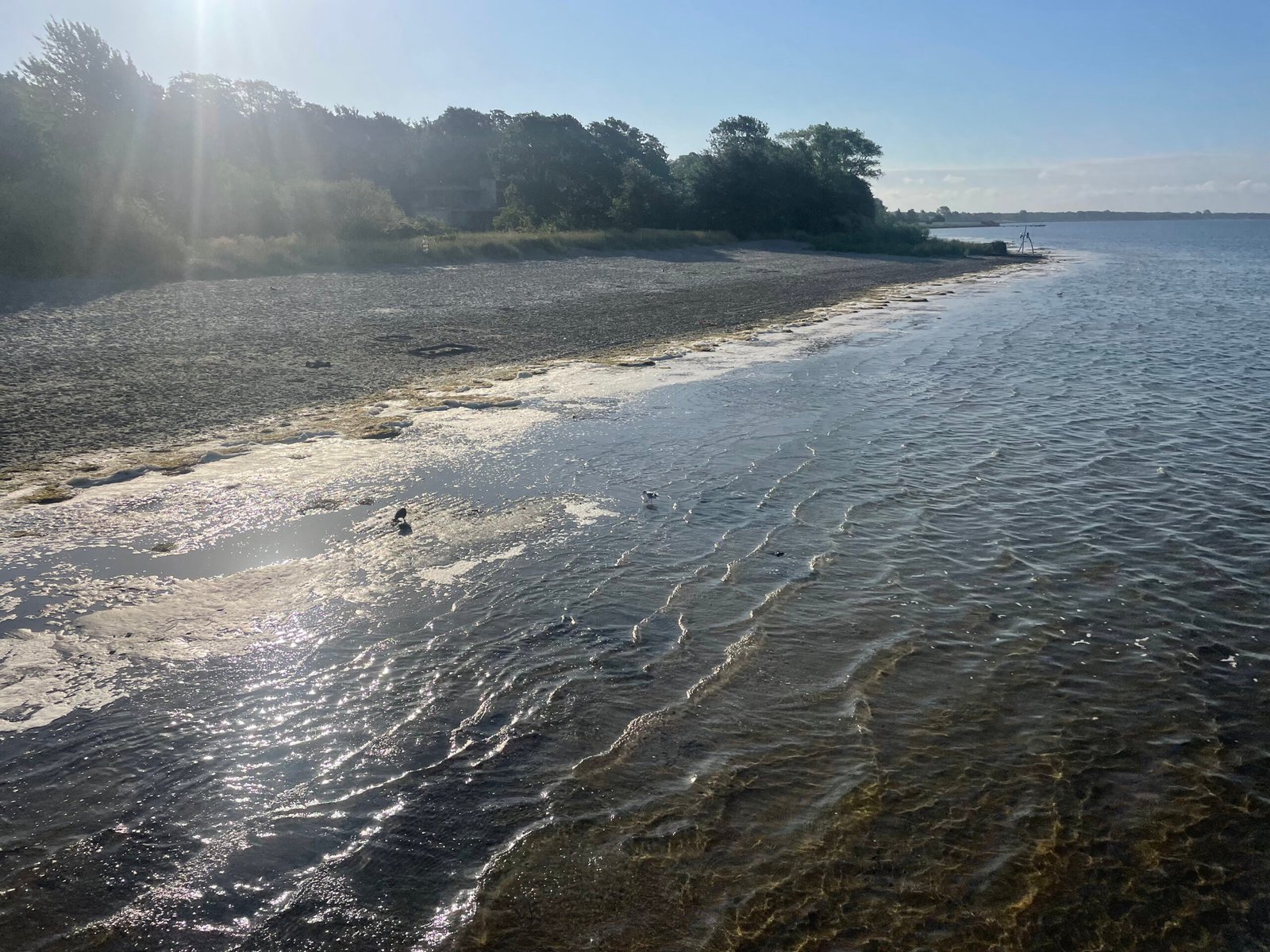
And last not least, a picture of my favourite spot!