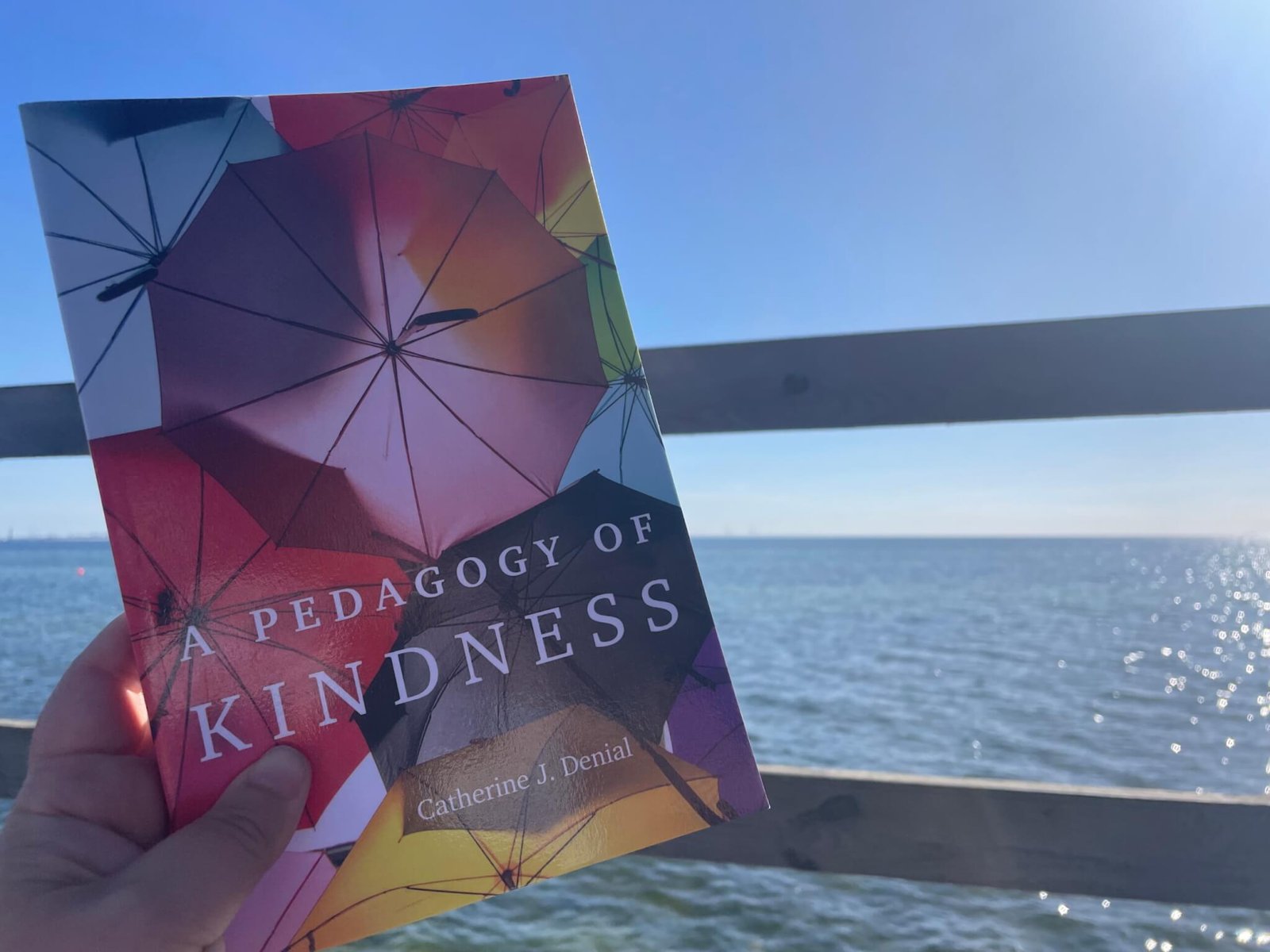
Currently reading: Denial (2024) “A pedagogy of kindness”
This is a really great book with lots of food for thought to reflect on teaching practices and bring more humanity into teaching. Since I have thought about trust and ways to build it quite a lot, as well as about inclusive (or even better, nonclusive) teaching and many related concepts, my notes below are on what stood out to me most, but you should read the book for yourself — this is not a summary!
One very important point that I really needed to read is that “[k]indness is not a practice that appears in a vacuum. If we want to be kind to others, to create classroom experiences that are alive with compassion for everyone involved, we have to start by being kind to ourselves“, especially with the addition that “[m]any people love the profession of education and derive tremendous satisfaction and affirmation from working in this field. But even then we must remember we are all so much more than the work we do.” I love the work that I am doing (most of the time), and especially in combination with this blog (which I do on my own time); sometimes I give myself very little time where I am not thinking about questions related to my work, because most of the time it is just so much fun. Especially during the days when I was reading this book and we were producing a MOOC and I also have quite a big project on AI in teaching happening in parallel. So it was really good for me to read the reminder that “[w]hen we act with care toward ourselves, we act in our holistic best interest so that our future self will appreciate what we’ve done.” I am great at making my future self happy in terms of the work that I have done, but I really suck at prioritizing eating healthy or taking time off!
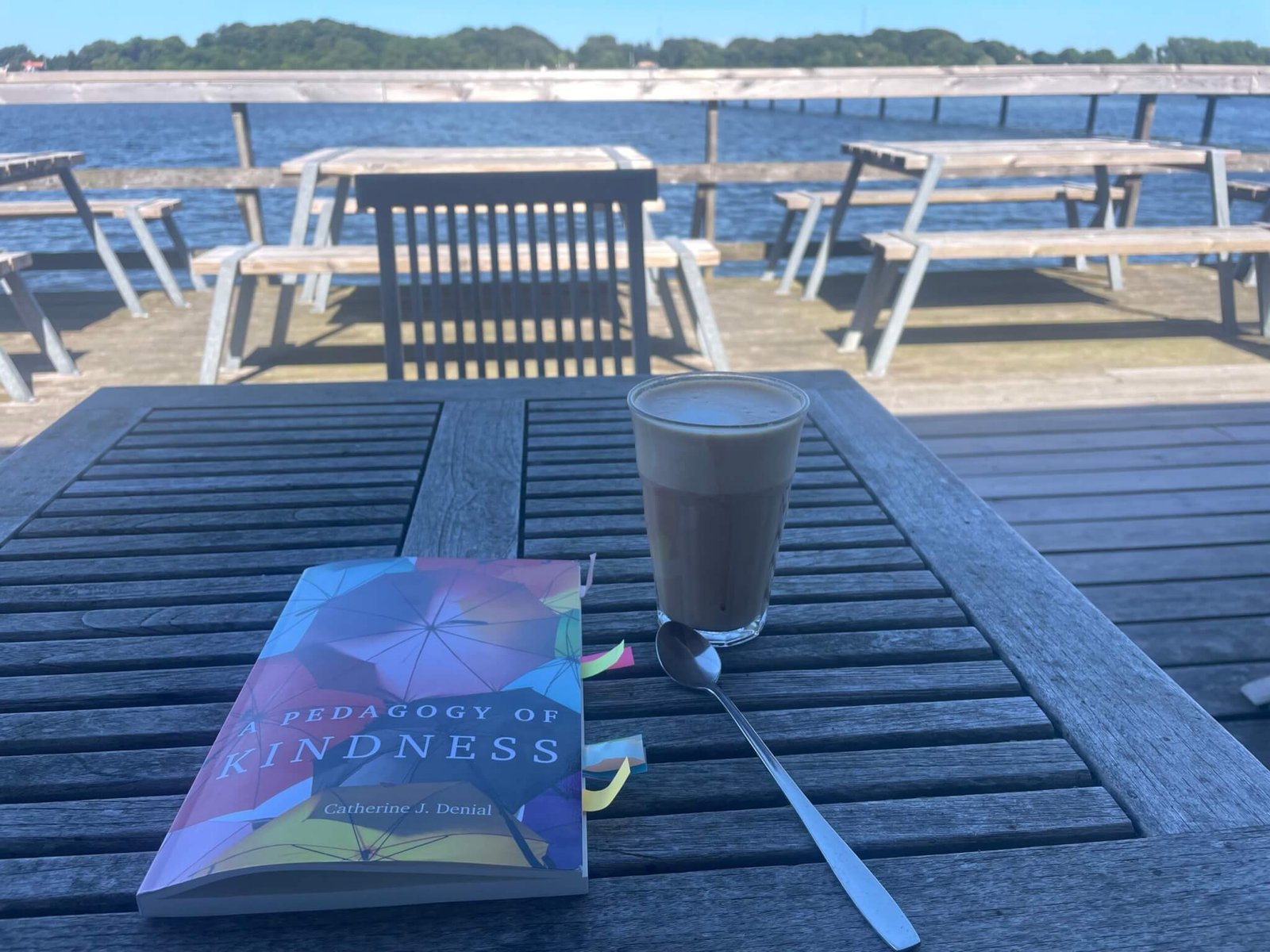
In the part “boundaries as the bedrock of kindness“, Denial (2024) writes that while “we cannot lose sight of the enormous work ahead of us to make higher education welcoming, just, and achievable for everyone […] the things which we control are usually small […]“. This is followed with quite a list of things we can do, though, for example to invest in our pedagogical development because that will make our jobs as teachers easier in the long run, and to take time off email. Which I, funnily enough, had just started doing when I reached those sections: I had just decided that I was going to continue reading this book, but sitting in the shade with a nice coffee and a great view! See for yourself (and continue reading below :-D)
But there are many more really important points made in this book. Here a subjective selection of what spoke to me!
First, really important in my work is the question of what implicit messages are we sending students about who they are. Do we treat them as if they were trustworthy and motivated, for example? Denial (2024) writes “We should believe students, and we should believe in students. Believing in students means seeing them as collaborators–believing they have valuable contributions to make to the way in which syllabi, assignments, and assessment are designed, and life experiences that should be respected in the classroom” (respecting life experience also highlighted as really important when teaching personally relevant topics in Osborne et al. 2026), and that is exactly the attitude that we need if we are serious about co-creating teaching and learning! But Denial (2024) also acknowledges that we are socialized into assumptions about teaching and students: “I anticipated conflict; I thought my students’ default was to be suspicious of me and everything I brought to the table. In truth, I was suspicious of them, and–without a foundation of trust between us–I resigned myself daily to brace for the worst.” We need to recognize and overcome such socializations before we can see and treat students as partners. But, really encouraging in that context is the message that “[a] pedagogy of kindness is within our collective reach“. It is, if we make it a shared vision (and think what quality criteria a vision needs to fulfill)!
Another thing that I thought about a lot is this suggestion for an alternative assignment: “show me what you’ve learned this term in any medium BUT a paper. That means you could create art, photography, music, dance, poetry, rap, a map, a zine … the sky is the limit. Think about what skills you have that you can bring to this assignment!” Students write a proposal and then bring a project to class together with a reflection and bibliography. This comes with this important reminder: “Remember that when a discipline prioritizes one method of communication over others–writing over speaking; speaking over making; making over writing–we are narrowing our students’ ability to not only express what they know but to learn new things altogether.”
Reading this reminded me of a video I recently watched on youtube, “Stop Explaining in E‑Learning (Do This Instead)” by
Marie-Jo Leroux (whose channel I wrote about here already, it’s awesome!). In that video, she uses the example of people having to learn the method of triangulation to find moose. While they could learn the method in theory by reading about it, including why the method is called triangulation etc, they can — as she demonstrates — also learn it by doing. But what I found so interesting there is that what the learners will be able to do in the end is probably exactly what is in the learning outcomes: Use that method to find the animals. What they will probably not be able to do, or at least not all of them, is to define terminology. They might discover why it’s called triangulation or they might not. It doesn’t matter to whether they can apply the method, but it shows how extremely important it is that assessment matches the learning outcomes. It would be so easy to imagine that people do that training and then in the end have to do a multiple-choice test to “demonstrate their learning”, which would really be testing something that is completely irrelevant to the task they were being prepared for AND not aligned with the tasks they were being trained on… Anyway, check out the channel, it is really interesting!
Another point that stood out to me is which identities we are most aware of: usually those where we are “targeted for oppression“. I looked back at when I wrote about my positionality and it’s interesting to see that indeed, the identity facets that I had thought about a lot were being a foreigner in Sweden and a woman in a male-dominated field (and then some where I have very obvious privilege that I had reflected on, like coming from an academic household with no money problems and now being on a permanent position). A lot of other facets I just brush away, and I am definitely not “targeted for oppression” on those!
Then there are a bunch of smaller tips and tricks that I want to remember:
- Calling the activity a “warm up” and not an “ice breaker” (so much warmer!), and a really nice one: “Complete the sentence: I’m the one who…“
- Trigger warning text on syllabus that I really like: “I have tried to anticipate where you may need a content warning, but if you have concerns or want to check that a particular trigger has been taken into account, please let me know. I am happy to provide that warning so that you can interact with class material safely, and on your own terms“
- The importance of pauses in difficult conversations: Take a short break or even wait until the next session, saying something like “[t]his situation needs our time and reflection. We’ll return to it in our next class“
- The advice that if you are worried about something, imagine that a dear friend was telling you about them worrying about it, and advise them on what to do! We are so much kinder to our friends than to ourselves…
- “Build catch-up days into your courses” — love that idea ever since I first read about “harbor days” in my favorite book and actually went and blocked some into my calendar until Christmas! Future me will be very happy about that in a couple of months!
- Related to harbor days, the idea to pool resources and expertise not just on harbor days, but for example collect expertise on something in a forum. We do this a little bit in Teams groups at work, but we can definitely be better at offering our expertise more explicitly!
- Creating a video (or audio) of our teaching philosophy. I really want to do that now! Although a lot of that is collected in my MOOC, but not explicitly in one place… Frankie, can we do this?
- The task of annotating a syllabus, with these instructions: “To annotate simply means to take notes, and it’s a skill that will be very helpful in this course. Read through the syllabus and add comments–what do you like and why? What are your concerns? What needs clarifying? Have this ready to talk about in class on Friday.“
I read this book three weeks ago and wrote most of this post then. Now I’m laying on my bed with the window wide open and the cool evening air coming in, finishing the post (not good at boundaries, as I wrote above). But it is giving me so much energy and I feel so inspired, looking back through all these great ideas. It reminds me of how inspired I felt last summer, sitting in my parents’ garden, working through Tolu Noah (2025)‘s book and applying those ideas to my sustainability course (many of those, btw, also feeding into our sustainability MOOC!). My future self will be happy that I read the books and wrote these blogposts, because it made me think through them again. But maybe I also need to learn to make my future and present self happy about taking a step away from thinking about teaching and learning every now and then, even if it is so much fun?
Denial, C. J. (2024). A pedagogy of kindness (Vol. 1). University of Oklahoma Press.
Walking home from a beautiful dip and reading my book in the shade with a coffee and a view…

I think it’s cool to see the Turning Torso and the Öresundsbridge on the horizon every time I walk here! (Well, almost, sometimes there is fog, too)
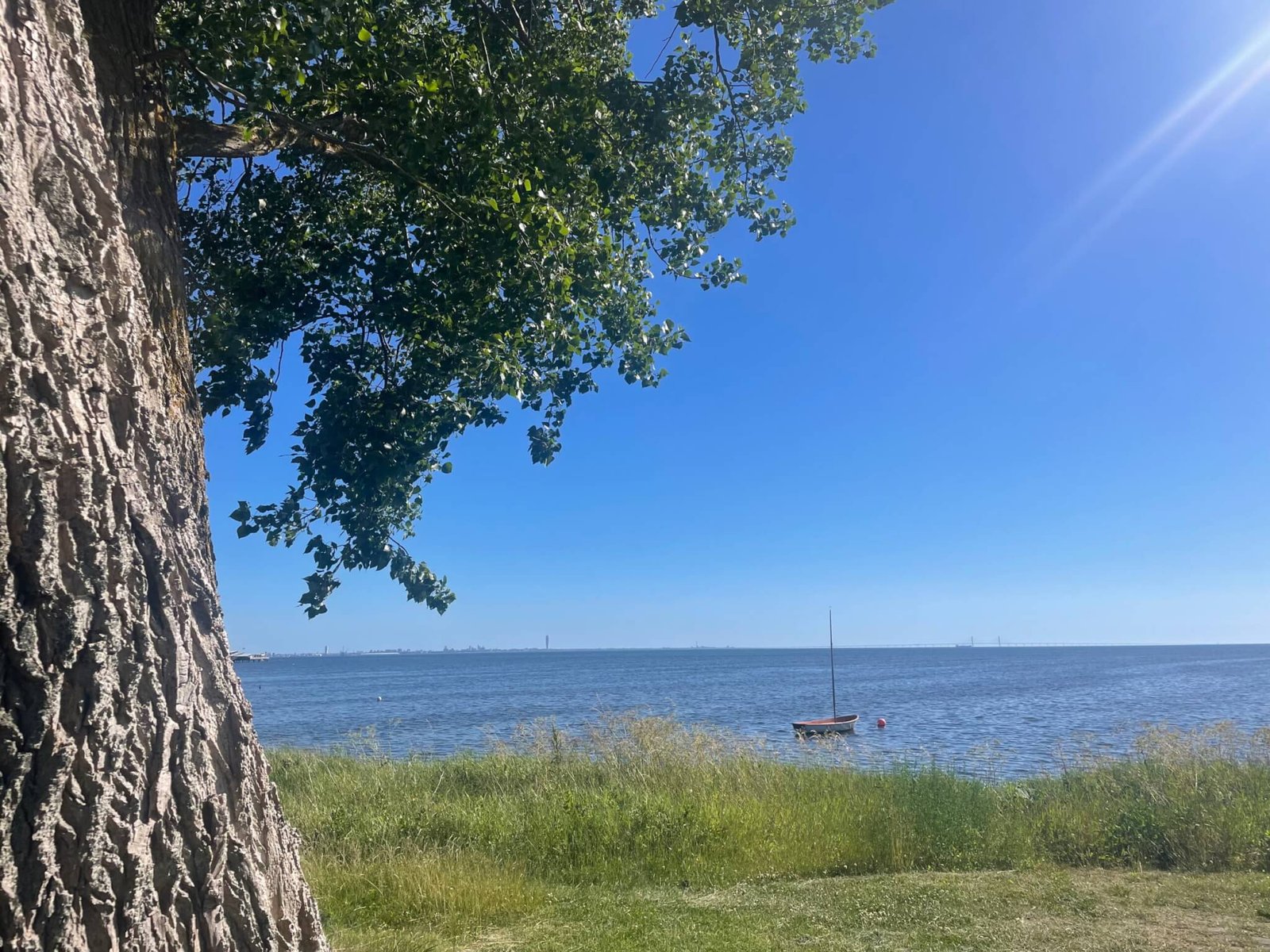
And for everyone who was worried: The picknick benches are still there! Just moved to the other side of the lawn!