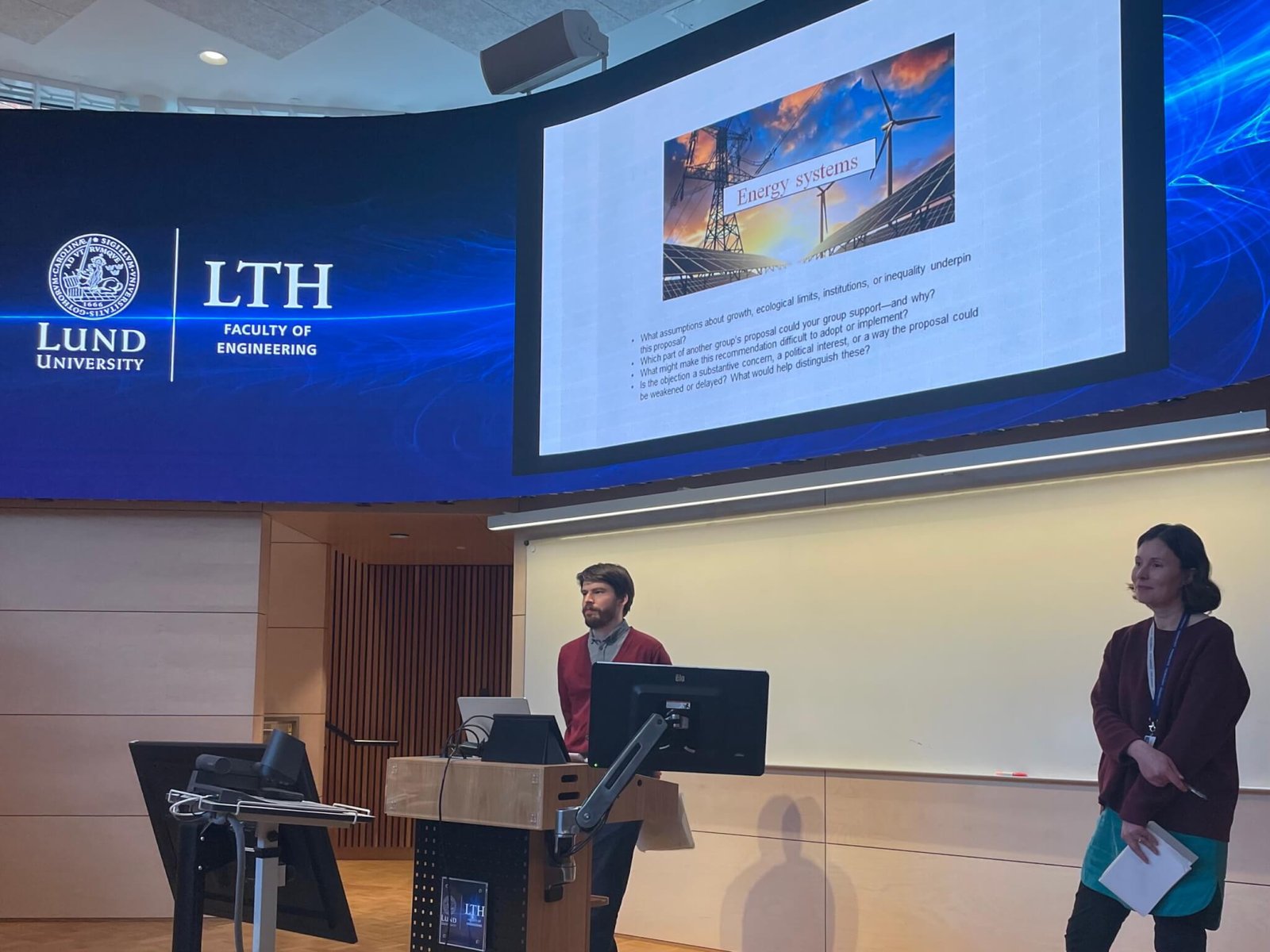
The “complex” course is half way done!
I just yesterday finished teaching “my” last session in the new “complex course” we’ve developed, and here are first thoughts about how the first half of this course worked out in practice! (For a better reflection, you’ll have to wait until I’ve actually had time to digest everything, I am writing this very early in the morning because I cannot sleep any more).
For background: This is a course for engineering students in their year 4 or 5, running over 8 weeks at ca 50%, which we have developed as an interdisciplinary team of teachers and students, very much with the key competencies for sustainability in mind, so with a focus on practicing futures-, values-, systems-, and strategies thinking in an integrated way and implementing them in a case that runs through the whole course. We were also heavily inspired by Eriksson et al. (2022)‘s work with eco anxiety in an engineering course. The former, the framework for key competencies in sustainability, has really been guiding the whole design process of the course that we did in a team, and there my role is mostly a normal academic developer role (you know, suggesting a group contract activity, or social annotation as a method to help students close read important texts), but the actual implementation of teaching was done by others. Many of the activities were tried and tested in other courses (on students in programs like political or environmental science) and modified to work in our engineering context. And then we had a ton of meetings over a year and a half to somehow stitch everything together in a cohesive way.
The latter, working with climate anxiety, we also discussed during the design process and it led to some activities that are very closely connected to course content (for example one photo voice activity, where students were asked to find lock-ins in their daily lives, take a picture and describe the kind of lock-in they found and what they might do about it, so in a way very similar to (and definitely inspired by!) the “carving space” activity by Holmqvist & Millenberg (2024), which worked out super well: Of course there were plenty of cars, but also for example bananas as an easy snack at university came up repeatedly), and some activities where we leave it up to students to make whatever connections they want to make. And those are the ones that I led myself.
For example, we did an Inner Team values exercise similar to what I discussed in the blogpost I wrote when planning it: I prompted students to think about situations that were relevant to them, choose relevant values from a list, and draw an Inner Team, first for personally relevant values, then for professionally relevant values, and then “let the teams discuss”. And then students talked to their neighbors about what conflicting values they might have found, and how they might resolve those. In the discussion in the plenum afterward, surprisingly many students said that they have the same values personally and professionally and that they didn’t find conflicts. But many also said that even though their values might be the same, the way they are enacted personally and professionally might still be in conflict to each other. Some mentioned values, but I did not ask them to share with the whole group if they didn’t volunteer. For students who missed the session, I gave a make-up assignment, where they went through the exercise themselves, but since they couldn’t discuss with their peers, I asked them to send me a short voice message with their main reflections. Which I actually loved listening to, because even though I warned explicitly to not share anything that they weren’t comfortable sharing, those reflections were quite personal and gave me insights into the students’ inner thoughts and feelings that I wouldn’t usually get. So that felt really meaningful and rewarding! Next time, if there are “enough” people who miss that session, I might actually ask them to organise themselves with one or two other students who missed it, do the discussion with them, and send me a recording of either the whole discussion, or their shared summary of the discussion (idea inspired by Sarah Silverman). This might also be a way to run this specific activity asynchronously for everybody if that makes more sense schedule-wise next time!
Then yesterday, I did a session on climate emotions. We do have a page in the learning management system with resources on climate anxiety (this blogpost was the draft when I first developed that page) because we wanted to make them available to students whenever they felt they wanted to engage with it, but we also wanted to spend some in-person time on the topic to also mark that we think it is important enough to talk about it that we actually make time for it in the schedule. So in the session, I started out with a climate emotions wheel and a blob tree as discussion starters in small groups regarding feelings that come up for students when they think about the polycrisis we are in (although next year I need to do the prompting better, and probably also in writing on a slide). I then showed some statistics on climate anxiety in young people, and also referred back to an entry survey we had done with the group to get an idea about how they felt about their future in a polycrisis (pretty much as was to be expected from the statistics). I then talked through the general process of eco anxiety to give students an idea of how what they might be experiencing relates to what a development might look like (and interestingly we were asked about how we as teachers were dealing!), and then I did the Active Hope exercise with the seven sentence starters (which I loved in the book, but was very inspired by having watched the recording of Anne’s keynote in Bergen!). I had never run that in an in-person session before, so that was an interesting experience. Not easy to just stand there silently, trying to figure out how long to wait before giving the next prompt! But almost all students seemed very engaged, writing a lot by hand on the print-outs I had provided (as they also did with the Inner Team exercise), and feedback on the activity later was that it had indeed been meaningful.
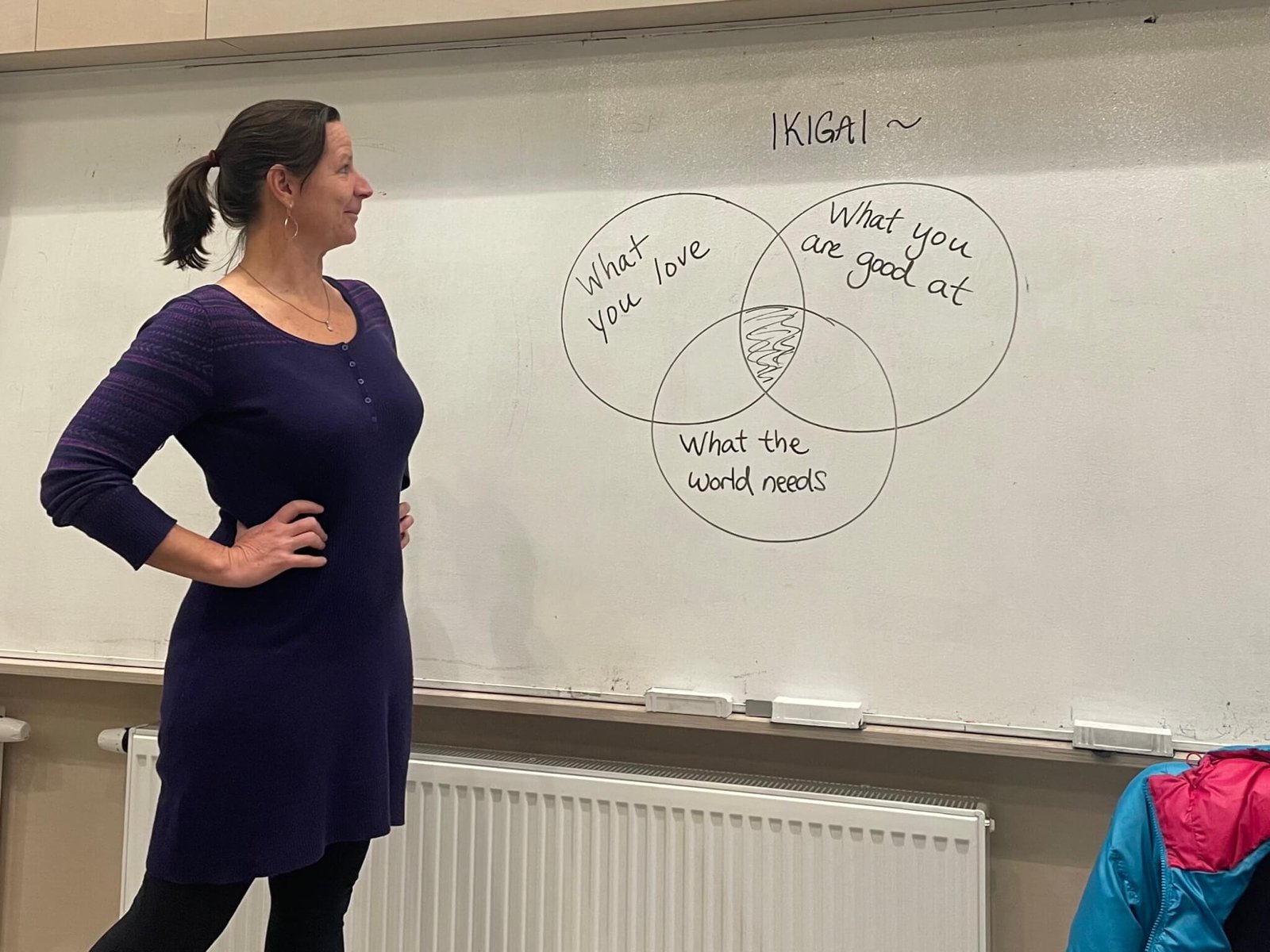
One idea that Jessika added was that Kim Nicholas is working with a Climate Action ikigai, which is different way to think about what you can do as an individual, so this is something we’ll include in our resources for next year, too (for this year, we included the photo below in the documentation of the session).
After a break, we wanted to discuss how teachers are, and should, position themselves when teaching controversial issues. I had one slide about that in the very first lecture we did, and back then, most students said they wanted a mix of “present a wide range of different views on every issue” and “devil’s advocate”. We had anticipated that students would want us to be explicit about what we stand for, but that was only asked for by one student (but then, yesterday another student asked us about our own climate anxiety, so maybe there is more interest than that data showed). I initially wanted to run a full activity about the roles teachers can and should take when teaching controversial issues also to be clear about what roles we are taking and that while we of course have our own (well-founded, I might add) opinions, our goal is not to indoctrinate them, but to let them come to their own conclusions, whatever those may be. But that really did not seem necessary with this specific group based on all the interactions we’ve had with them so far, so we started out asking the student representatives to talk about the mid-way evaluation they had done, and then the conversation naturally developed into a general reflection about the first half of the course.
Generally, students seemed very happy and said the course was very interesting, and the main concerns that were brought up in the student representatives’ summary were things we were already aware of, like a messy learning management system, lectures on zoom being annoying (we agree, and we actually changed some back to in-person after we knew how many students were taking the course and that we would be able to fit them in one room), and scheduling issues. And that 8 weeks on 20 hours a week is really not enough time for all there is to learn on this topic. This, together with all of our observations of our own teaching and students’ reactions, is something we should really be proud of!
Other stuff I am thinking about in relation to this course?
We co-created the GenAI guidance document. I am writing this up in a separate post, but in a nutshell, I first created a GenAI guidance document using Rachel’s GenAI guidance wizard on CanAI.education (see steps 1-3 below).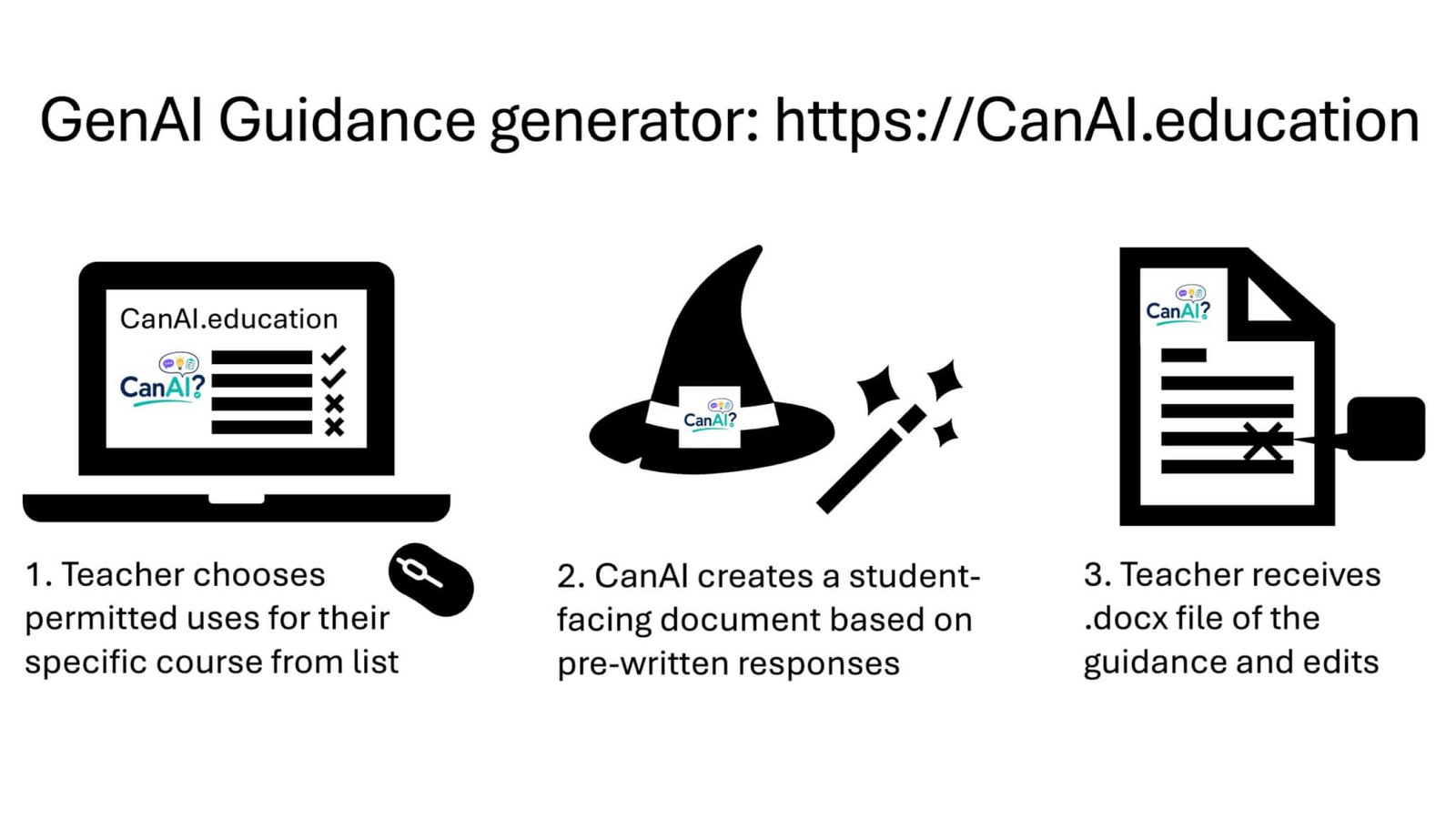
I then uploaded that document (of course after discussion with the other teachers!) to the learning management system and students used a plugin for social annotation. I read and responded to their comments, we discussed in class, voted on one issue, I modified based on the discussion, and created and uploaded the final guidance document (see steps 4-6 below).
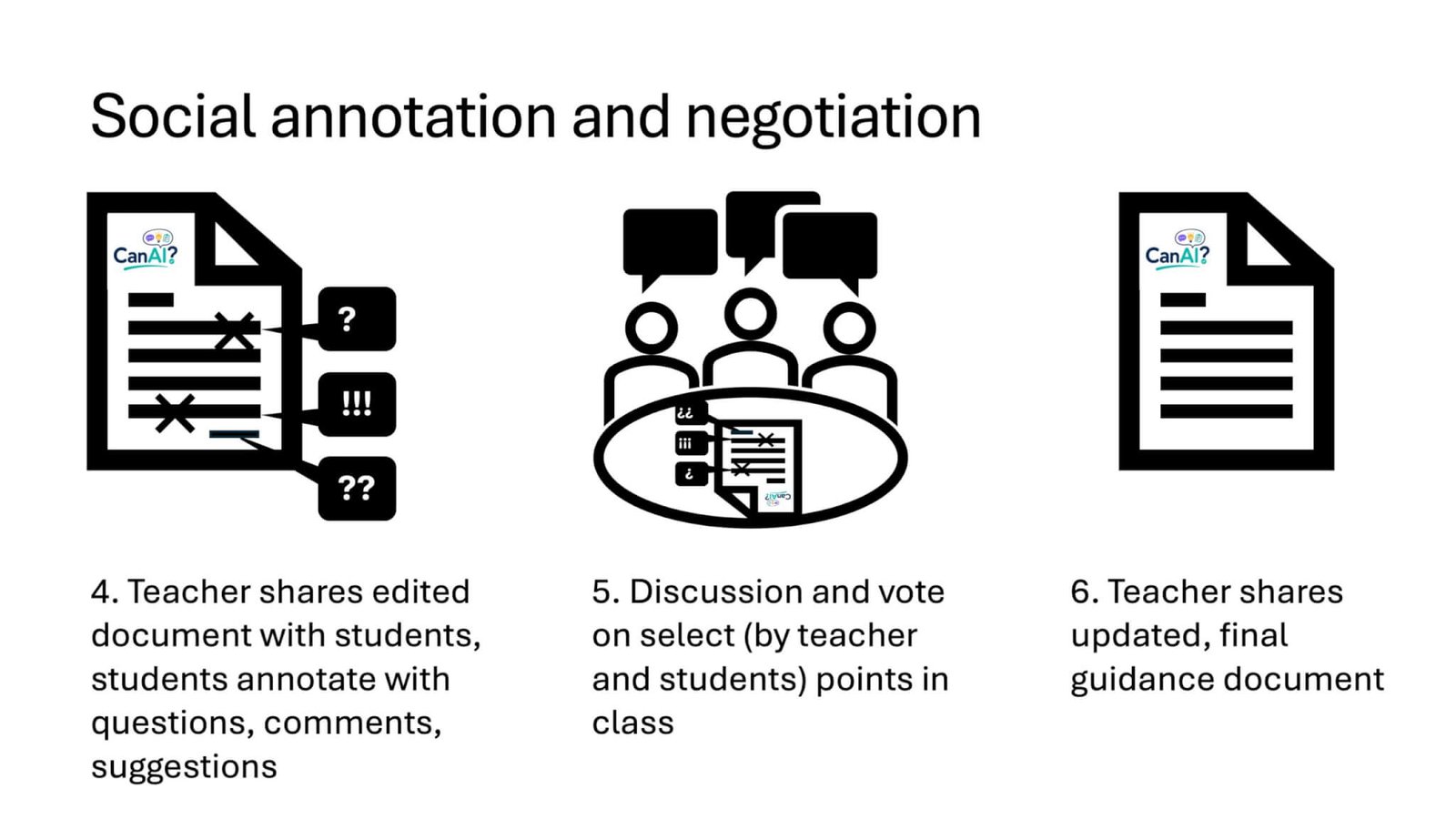
I had been wanting to try social annotation with students for a long time, but since I don’t get to teach students very much these days, this was the first time I was actually doing it myself. And it worked beautifully, I think! But Jessika really did the pioneering work with this specific tool and our confidence to use it every week to help students engage with texts really came from her initial positive experiences with it. We did include instructions like “every student needs to leave at least one comment and respond to one other” etc, and that probably helped, but the comments were very good and in the case of the GenAI guidance document gave me a lot of stuff to think about and adapt. The document changed substantially based on the feedback and discussions. So I count this as a success!
Another highlight for me was a role play on world views, which was initially developed by Thomas, and then run by Karl with help of Terese (see featured image). I am really not a fan of participating in role plays myself, but I can (grudgingly ;-)) acknowledge their value in education. In this case, students had read some literature and prepared to represent one out of four different world views, and then Karl invited them in (“Dear colleagues! We are gathered here today to use your expert advice to negotiate…”) to give opening statements and then negotiate three different topics. And that went super well! We ran this role play twice with half the class each, and it was super interesting to see how the two different instances played out. They were in very different rooms (the first time in a large, airy one with the huge screen, the other one in a typical group discussion room), at different times (Thursday afternoon 13:15 as compared to Friday morning 8:15), but also the groups reacted very differently. I am hoping Karl will write this up and publish it! :-)
And we have a project track that is running in parallel to the education track with inputs on theory and methods, and the reflection track. Here, students work on cases given by many different people from across the university and beyond. We assigned group and they chose a case from a list of 17 cases, and each week they have to apply new methods to look at their cases in new ways. And each week, they have a group check-in with Carina and me to talk about how their work is going. In the first meetings it was about coming together as a group, their group contract, figuring out times and modes to work together, etc. Then, how to re-write their case so it reflects their interests while keeping complexity, but keeping it manageable. And now the tools are getting more specialised. This week, for example, they drew causal-loop diagrams and presented them to us in those check-ins. Those meetings are so much fun, and even though we only have 15 minutes per group, it gives us pretty good insights into what they are up to (and their group dynamics).
So here we are, half way through this course! I have ignored most of the actual content input since that’s other people’s ideas and teaching that they should be writing about themselves, and I have also ignored the enormous behind-the-scenes logistics involved in this course. Carina has been, and is, doing an amazing job juggling all the different tasks that are actually an enormous amount of work: communicating with everybody who needs some special accommodation for something, organising the teaching team, dealing with all the admin stuff so we have a working course not only in the learning management system, but also in the university system, preparing all the different sessions so she could jump in if the designated teacher didn’t show for whatever reason, and so many more things. Thank you, this course would not exist without you!
And now today and tomorrow, I am looking forward to sessions on Futures Thinking run by Jessika and Suzan, and then I am also looking forward to the second half of this course that will feature many more very cool activities! Stay tuned! :-)


