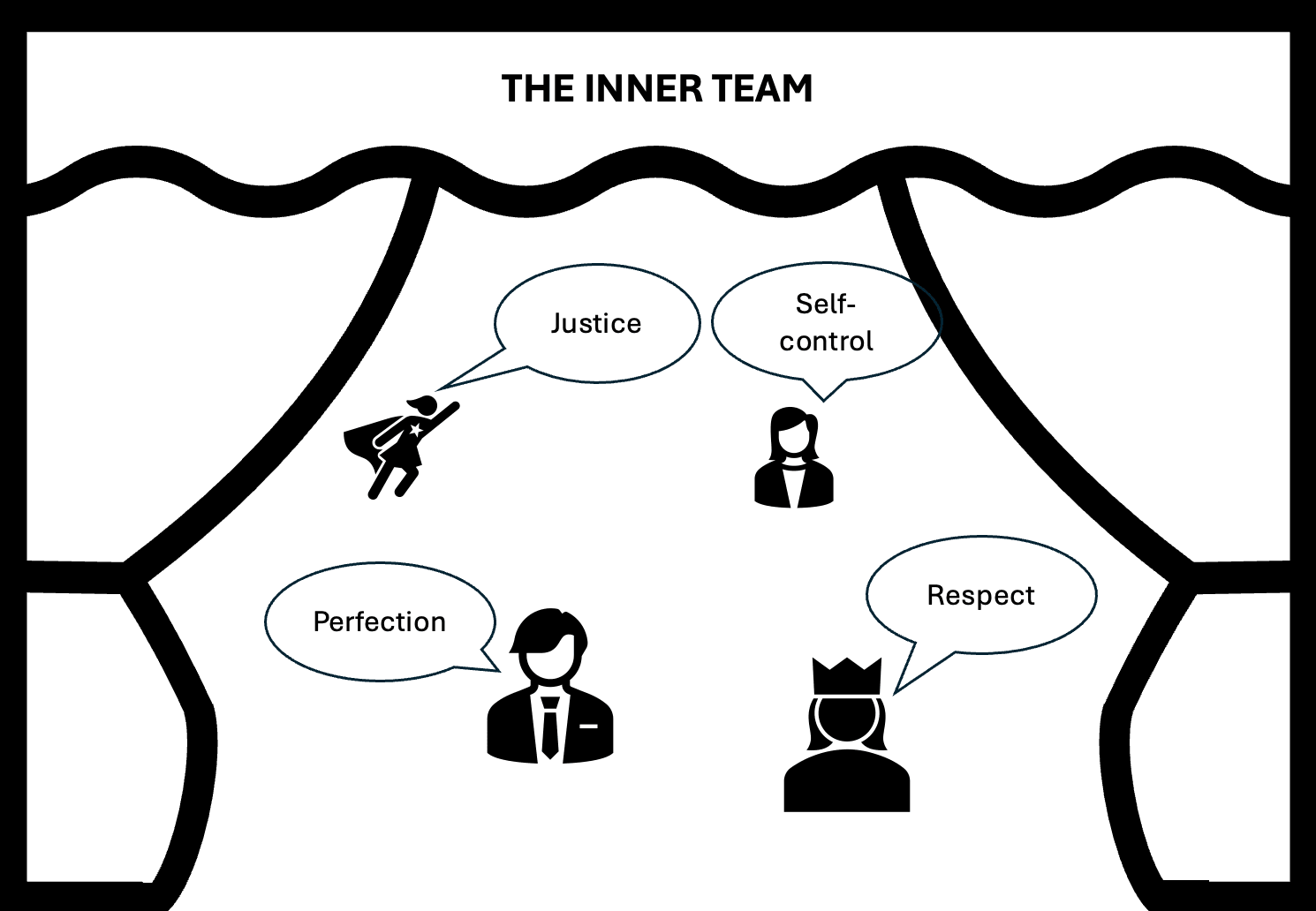
Some thoughts on using the “Inner Team” in an asynchronous setting
For a course I am currently planning, I had pitched using the “inner team” (“Inneres Team” von Schulz von Thun) as a method to reflect on personal and professional values and which ones come into play in different situations. I was thinking about using them on paper in a session where everybody works on their own inner team but then has the opportunity to discuss in small groups later, but now that session has somehow moved online and I am wondering how to do it then.
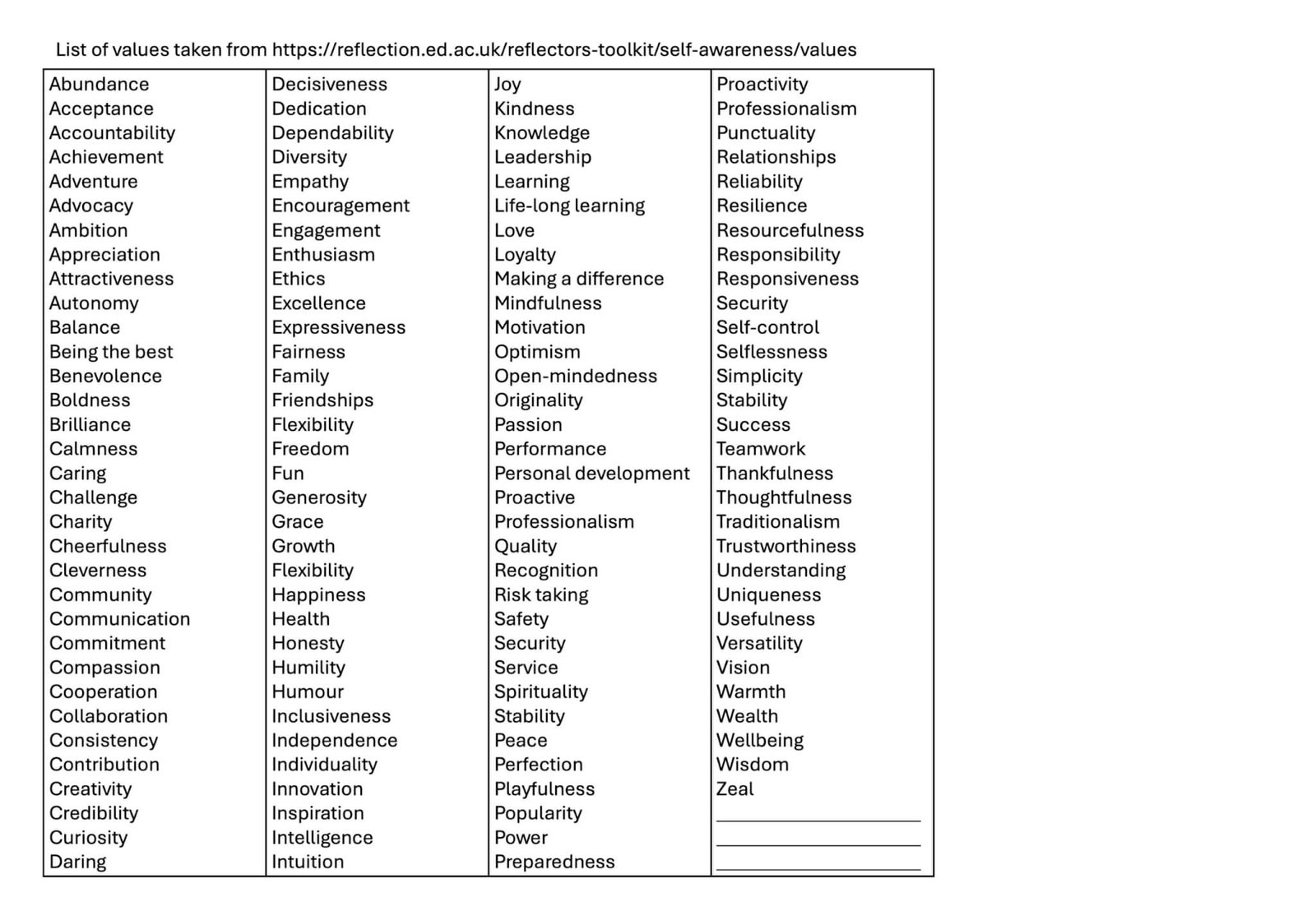
First: The in-person plan was to ask participants to think about a meaningful experience they have had in their life, then give them a list of values (e.g. this one), ask them to mark the ones that resonate the most with them, cluster them into a maximum of five groups, and assign a (positive!) “job description”, e.g. “promoting wellbeing” or “ensuring quality”, write that on their little people (possibly drawing on faces, hats, tools, whatever illustrates their function), and position them into the outline of a person, which they would draw on an A3 paper to illustrate themselves. They would then repeat* that exercise thinking about values that are important to their future professional role. The resulting new figures would be marked in a different color and also added to the “self”. And then it would be time to reflect on alignment and conflicts between the different inner voices and let them (the inner voices, moderated by the self) discuss how each of them contributes something valuable to the “self”, and let the “self” decide what the conclusions from those discussions mean for them and their choices going forward.
*actually, we were going to do an A/B testing, with one group starting with the personal and moving to the professional, and the other group starting with the professional and moving to the personal. We know that we are priming whichever way we start, we are just not sure what the effect of the priming will be!
Anyway, now that this exercise has moved online, I started researching if and how other people have done that. And it seems to me that most people who are using the inner team online are doing this in a synchronous coaching context (which is, I guess, where it typically belongs), not as an asynchronous online activity. For example, Helmut Jansen on the channel “LAUF-RAT” on youtube shows his implementation as a tool in online supervision or coaching: In his version, the inner team is visualized as different actors on a stage where we decide who should be foregrounded in any given situation vs sent to the back (Maybe even who gets a microphone or spotlight and who does not? Me thinks). I really like this idea! I think it makes it easier for people to accept the activity when they just need to identify actors on a stage and not visualize them as tiny people inside of them.
There are also surprisingly many paid online tools available (even in immersive virtual reality!), but I don’t want to go the paid route, both because I don’t want to pay and because I don’t want to send students to yet another platform. Looking through the tools, I am also realizing that the problem isn’t the technial implementation at all. Students can easily move icons around on a pptx stage, or get printed versions in an in-person session that they take home to work with later, or draw on paper. Which option they choose does not really matter. What is going to be more difficult in an asynchronous online setting, though, is to make sure that students recognize this activity as meaningful enough to actually engage with it, to possibly sit with discomfort and come back to the exercise later, even though we don’t want to require that they share their “inner teams” with us or anyone else. Can we ask them to share one of their actors from the personal and professional teams each, so they can choose two that don’t require more self-disclosure than they are comfortable with?
Also I think the really important part is to talk about the experience with someone, whether in a call or in person. The exercise will run in week 2, so we cannot expect trust in the group yet; on the other hand, discussing this could also be a trust-building exercise! For example, if we ask participants to bring pictures of their “inner teams” (for example on their phones — for their own reference, not to share with anyone) and then discuss in small groups questions like
- how large was the overlap and alignment between the personal and professional team?
- which voice(s) became more or less important when discussing with others?
- did you experience anything that surprised you?
- where do you feel a conflict between personal and professional values?
If we don’t want to use synchronous class time on this, can we ask students to meet up with a peer, virtually or in person, to talk about the questions? Do we want to follow this up by them submitting some kind of reflection, or would that just be policing compliance rather than fostering meaningful engagement with an exercise that we believe is really helpful for personal reflection?
The more I am thinking about it, the more I feel that this really deserves synchronous class time.
But one thing we can do even in online asynchronous is record a video with the instructions, and maybe even a personal example of how we are working with the tool ourselves!
Never mind — a month after writing this and never publishing it, the class is back in an in-person sessions! So now I am suggesting the instructions below, we’ll see what happens in the end…
The Inner Team exercise – overview
The Inner Team is a method originally developed by Friedemann Schulz von Thun to help recognize personality facets within us, and to facilitate reflection on how to resolve potential conflicts between them. Originally, the “inner team” is visualized by drawing little people, symbolizing the different inner voices, into a large person, which symbolizes us as the team leader.
We will use a modified version of the Inner Team, where we we focus on values, not personality facets, and where we think of ourselves as a theater director with the different values as performers on a stage.
In the exercise, you will each individually go through the following steps:
- Think about situations that are personally meaningfully to you
- Identify personally relevant values on a list
- Cluster them into a maximum of five clusters, marking the most important one in each cluster
- Add them as little actors to a stage
- Move them around as you decide which ones to have front and center (and possibly even with a microphone)
We will debrief the exercise on a general level, you will not be asked to share your Inner Team or list of most important values with anyone!
The Inner Team exercise – instructions (1)
- Think about three experiences that were meaningful to you personally. Describe them to yourself in as many details as you remember
- Identify the values on the list that are most meaningful to you personally. If an important value is missing, you are welcome to add it yourself
- Cluster your most meaningful values into a maximum of five clusters, mark the most important one in each cluster
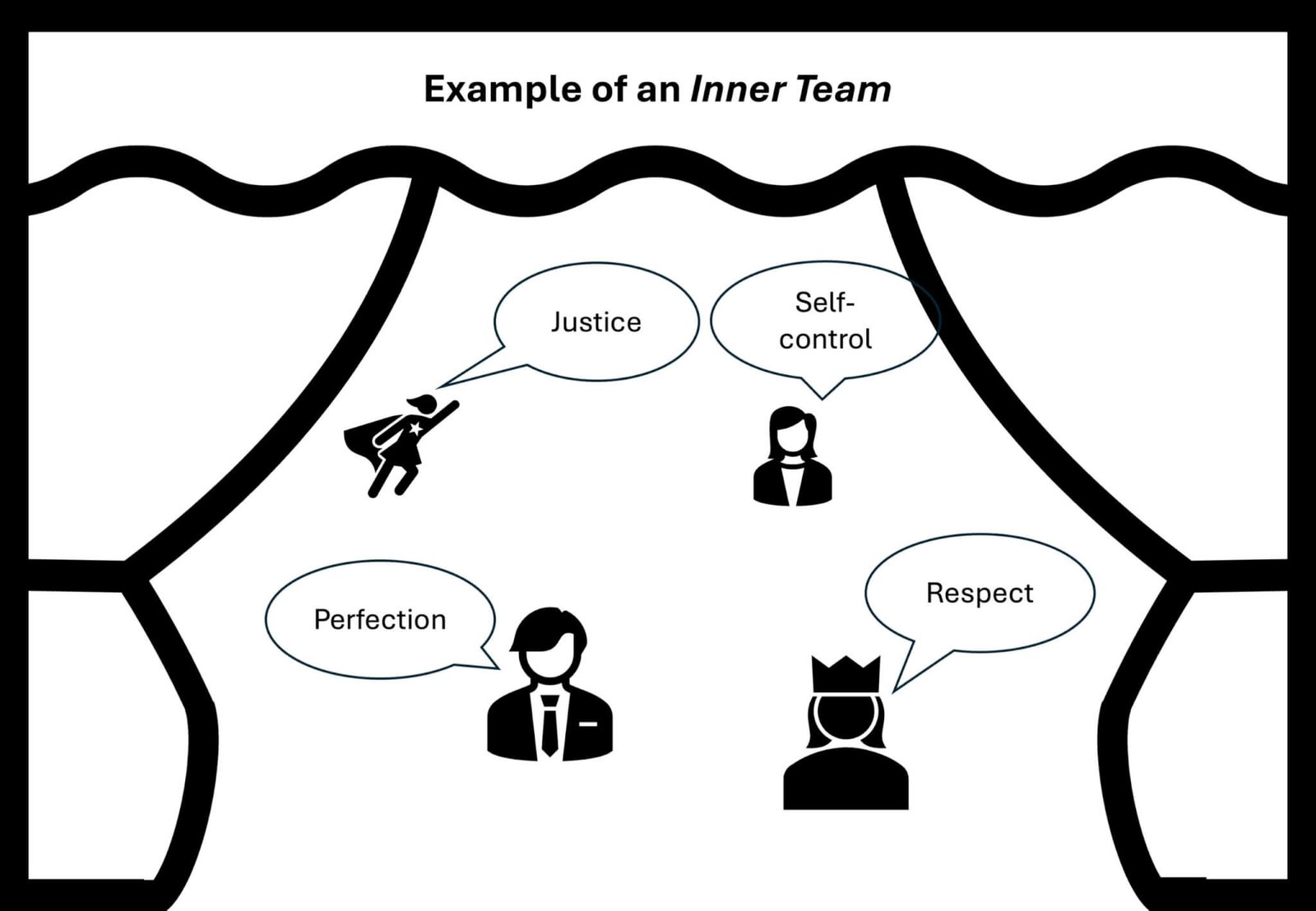
- Convert them into actors. Think about their different personalities based on how you think about those values: some are louder or more quiet, faster or need more time to think, … Use the little paper figures and draw on any accessory that helps you identify what value they represent (see example)
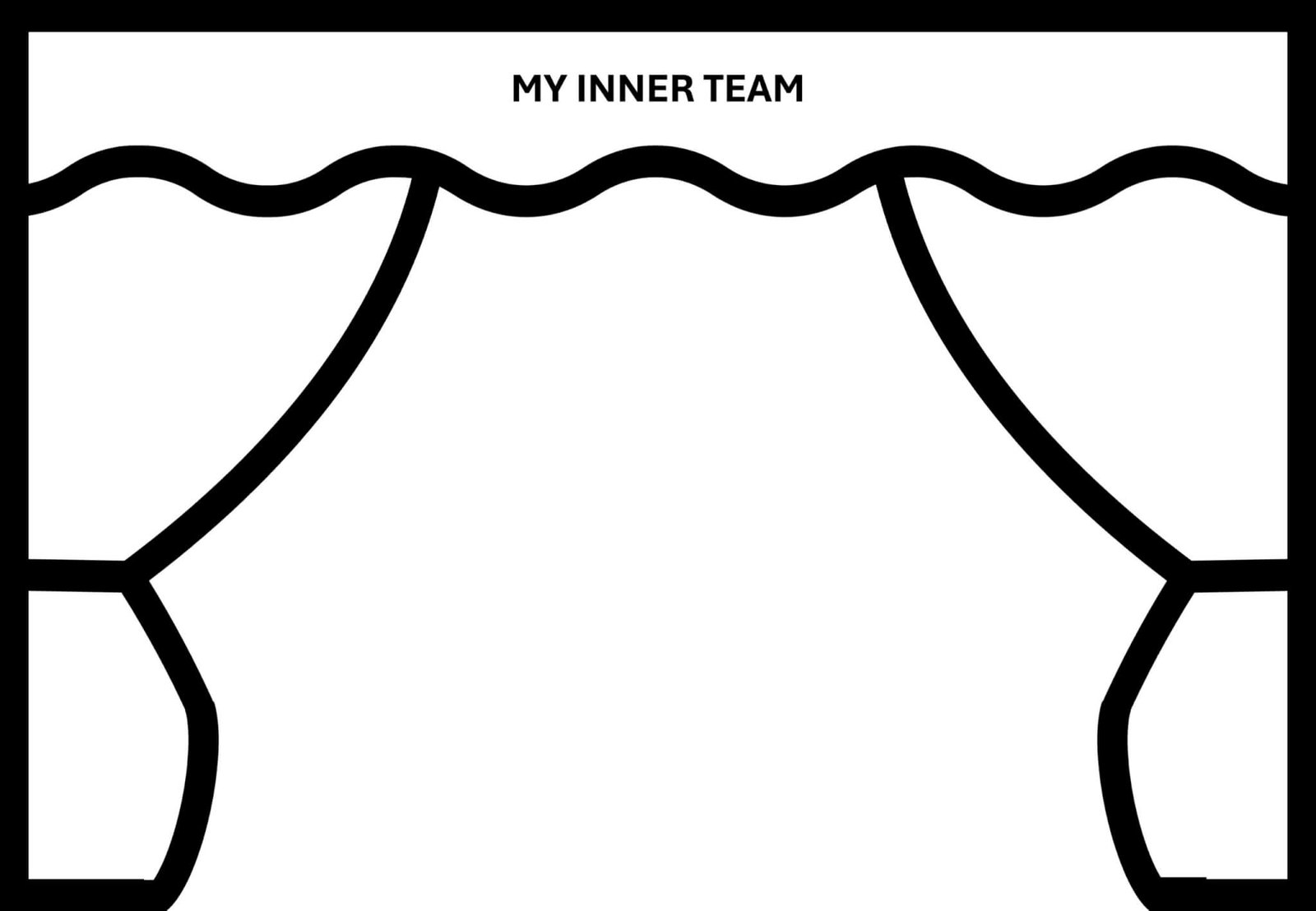
- Add them to the large stage
- If they could speak, what would they be telling you and each other? Add keywords in speech bubbles
- Move them around as you decide which ones to place front and center (and possibly even with a microphone and/or spotlight!)
The Inner Team exercise – materials
Example of an Inner Team and the actors “in role”
List of values
Little people that we’ll print and cut to size so that they can be brought into character

The stage
The Inner Team exercise – instructions (2)
[These instructions are only “revealed” to the students after they have done the first part, and we want to test swapping the order for different groups]
- Think about three experiences that were meaningful to you professionally or shaping what you are hoping for for your future career. Describe them to yourself in as many details as you remember
- Identify the values on the list that are most meaningful to you in that context . If an important value is missing, you are welcome to add it yourself
- Cluster your most meaningful values into a maximum of five clusters, mark the most important one in each cluster
- Convert them into actors. Think about their different personalities based on how you think about those values: some are louder or more quiet, faster or need more time to think, … Use the little paper figures and draw on any accessory that helps you identify what value they represent (see example)
- Add them to the large stage and the other five actors
- If they could speak, what would they be telling you and each other? Add keywords in speech bubbles
- Move the old and new actors around as you decide which ones to place front and center (and possibly even with a microphone and/or spotlight!
The Inner Team exercise – debrief
In small groups, discuss:
- How large was the overlap and alignment between the personal and professional team?
- Which voice(s) became more or less important when discussing with others?
- Did you experience anything that surprised you?
- Where do you feel a conflict between personal and professional values?
- Which insight of this discussion is interesting to share back with the large group?
Remember: You do not have to share your Inner Team with the other group members. The idea is that you discuss this on an abstract level!
So far, so good, now let’s see what the team (the outer one, not the inner one!) says about this!


