Summary of this morning’s workshop on sustainable pedagogies
This morning, I ran a workshop for university teachers called “Teaching for Sustainability: Practicing for a sustainable future through sustainable pedagogies“. You can look at all the slides here, or see some of them below together with a quick summary of what I said about them. Most of what I am writing below I have written about earlier on this blog, so you have my explicit permission to scroll and see if any of the slides look unfamiliar and then only read there ;-)
Before we start the summary: the idea for this workshop (which is no 2 of 3 in a series) is to give participants a short input on a topic, and then mostly to provide space and time to think and work on participants’ own challenges in their teaching, and to support that through colleagial discussions with me and the other participants.
To start the seminar, I used one of my favourite methods: Impromptu Networking from the Liberating Structures.
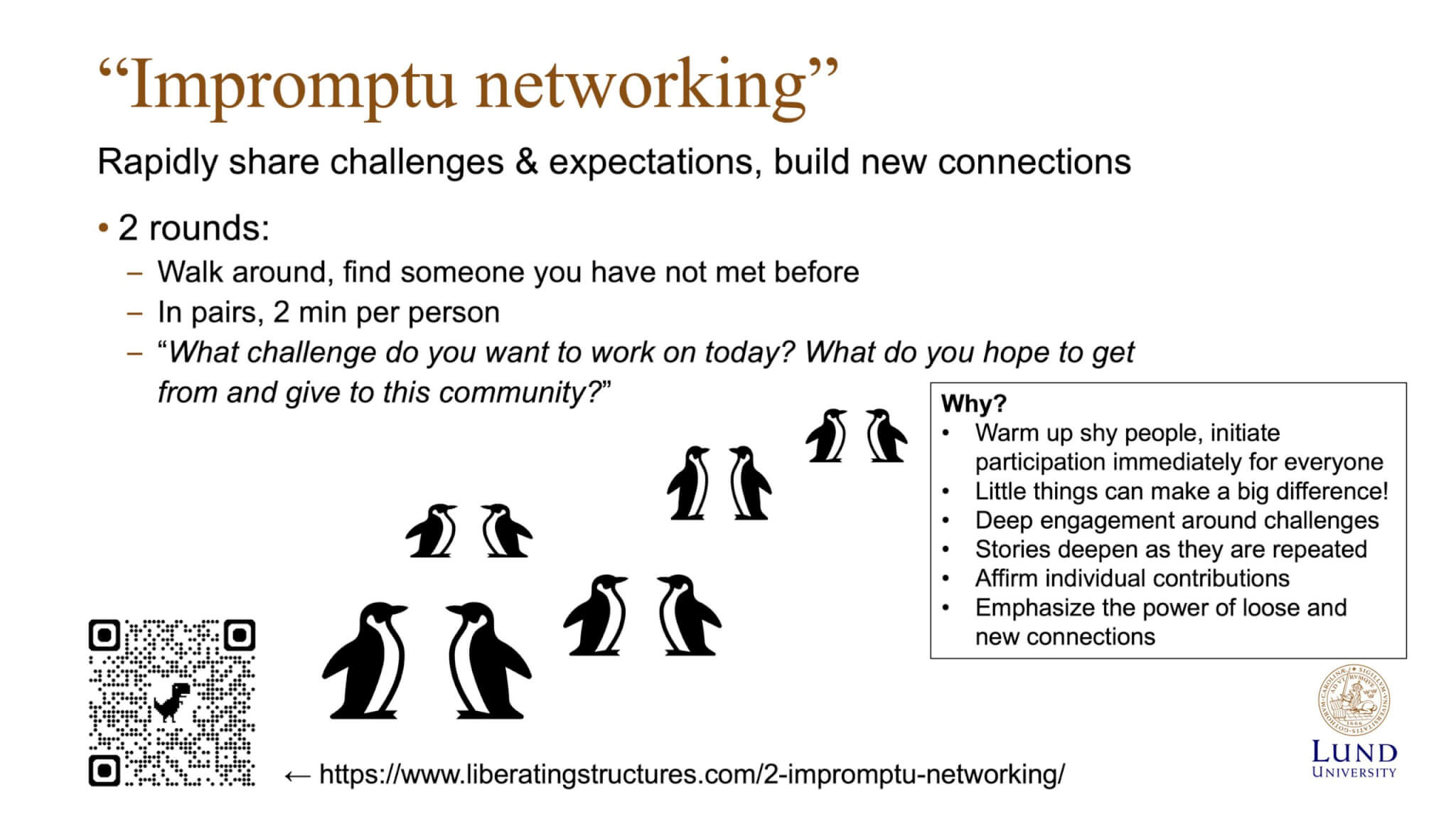
The idea behind this icebreaker method is that participants introduce themselves to a partner based on the questions “What challenge do you want to work on today? What do you hope to get from and give to this community?” I really like using these questions because it is always good to set intentions for any meeting, both what would ideally be the outcome (and then hopefully also make sure that people feel empowered to help steer meetings in the right direction!), but also how one wants to contribute. Especially with new teachers, or in settings where they assume they’ll just sit and passively consume it’s always good to remind them that they are welcome to contribute, too, and also that they do have something to contribute — their unique experiences, perspectives, questions. Also if we do this in several rounds (today we did two), people gain confidence in how they talk about their goals but also in what they are willing to say they can contribute.
And in general, it is always useful to have an icebreaker, and in the context of sustainability also to show the importance of short personal interactions that can form into connections.
Next, we took a minute to write down anything that seemed like participants might want to remember it, for example who they met and what those other people do, anything the other person said that made participants think, anything participants said (or thought) themselves that surprised them or that they want to remember, and their intentions for the day.
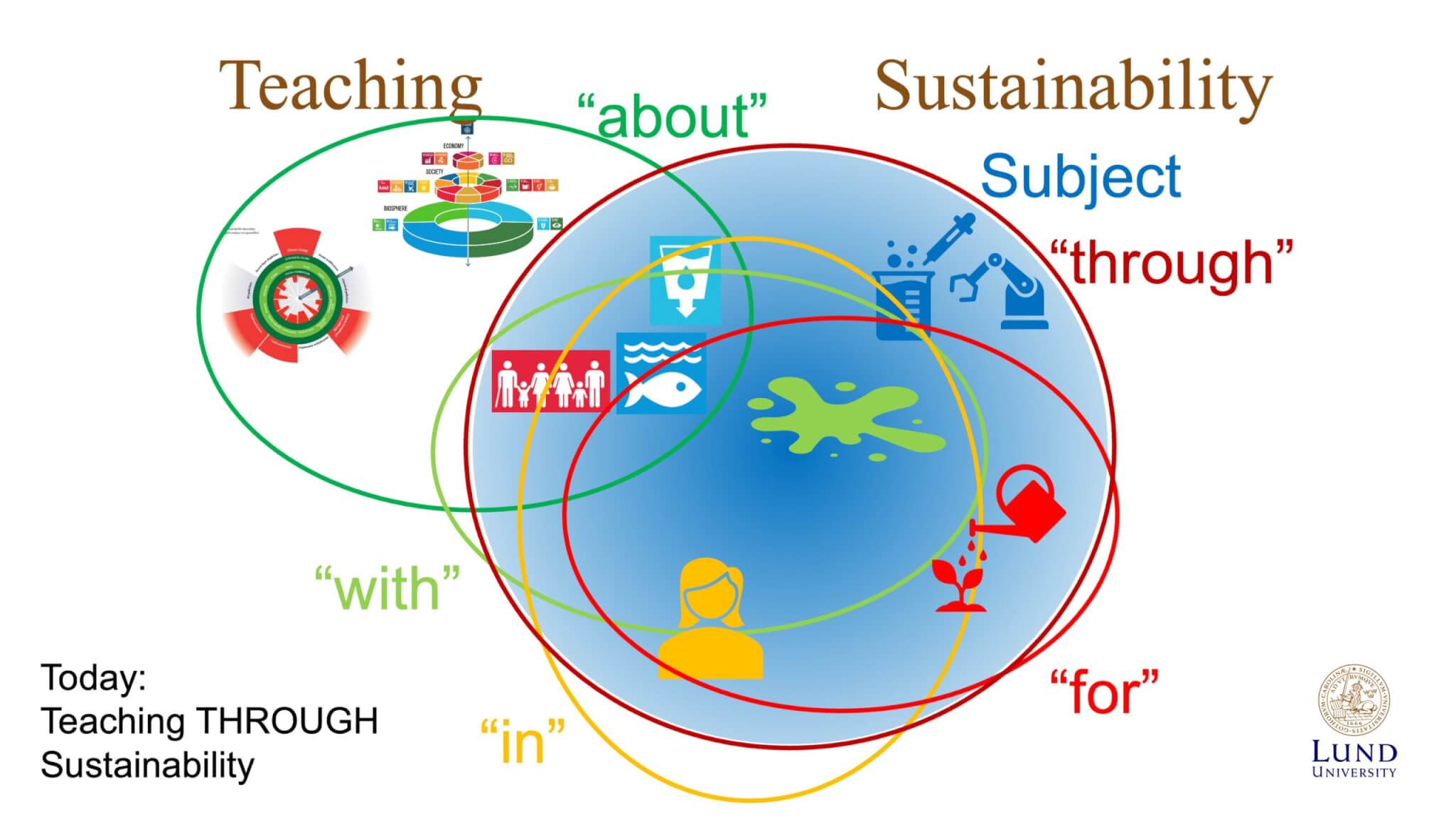
Then, I gave a quick introduction to our “Teaching about, with, in, through, for Sustainability” framework, and how we can teach sustainability in any course, no matter the subject and how full it already is. For that, I introduced 5 perspectives on teaching sustainability. They can all be used individually. If you are starting out on your sustainability journey, you might pick the perspective that speaks to you the most, or the one that contributes something that you feel is most missing. You can also combine the perspectives; start with one or two and add more as you become more confident in teaching sustainability. I will clarify what I mean by showing you an example.
Let’s imagine we are teaching a course where some technical food production process is discussed and optimised (the blue circle), a course that is not ON sustainability (yet). That is what the course has always been about and what fits with the courses that build on it, into the available time, etc. I will now add overlapping circles to build a Venn diagram to show some things that one could consider teaching in this context but that fall outside what we want to do with this course, and in the overlapping area things that we want to bring into the course.
If we now think about teaching about sustainability (dark green in the picture above), that means teaching general sustainability concepts and challenges like for example the physics of climate change, or about planetary boundaries, or about Agenda 2030 and SDGs. A lot of that might be outside of the scope of the course, and that’s ok (although we need to make sure that it is included somewhere in a program! And at the same time we need to make sure that it isn’t repeated in every course since for many teachers, talking about SDGs is the easiest way to bring in sustainability, and many students might know all about the Agenda 2030 from their time in high school already. Then “sustainability” becomes a very shallow and boring buzzword, which of course we don’t want). But maybe there are aspects that are relevant? Here visualised as the SDG “clean water”, which might be related and thus could be taken up in this context.
If we now also want to add a second perspective and teach with sustainability (light green in the picture above), including examples of sustainability applications within the discipline, we could imagine discussing what happens if something within the production process goes wrong, if there is for example a spill of toxic waste from the factory. This might now also influence another SDG, “life under water”.
Teaching with sustainability is basically making sure that examples we use in teaching are both clarifying the content we want to teach AND are relevant for sustainability (and that we highlight that relevance explicitly). That works in any subject: The gap text in a foreign language can be the text that we have always used, or one that discusses biodiversity loss, or provides resources against climate anxiety. The data set we use in statistics class can be a synthetic one, a random authentic one, or one that is relevant to sustainability and where we discuss the relevance. In archeology, we can be excited about all the artifacts currently being released by the permafrost, but also discuss that that is the symptom of a really big problem.
A lot of the time, when we think about sustainability, we think about environmental sustainability. Maybe we can also challenge ourselves to consider other aspects, for example society. In the example above, we might discuss how placing a factory in certain regions in the world makes production cheap on the one hand, but on the other hand means that the laws and regulations are different so that workers might not be paid adequately or work way too long shifts. Now, the SDG “no poverty” might also become relevant, because one way of ensuring that spills are detected and acted upon quickly might be to make sure that working conditions are improved.
Discussing this can then also be teaching in sustainability, positioning the discipline as part of a sustainable world, role-modelling and making it explicit that it is part of our professional identity and responsibility to care about sustainability and to consider the bigger picture. Here I find it really important to remember that to our students, we are the face of the subject, and their model for what a professional in that subject acts. So even if we aren’t experts on sustainability, we need to show that we still consider it our responsibility to talk about it, to struggle with students to find a sustainable direction in how we show up in the world.
We can also teach through sustainability, using sustainability as a framework for teaching. The idea here is that if we woke up tomorrow and magically all the environmental problems had disappeared, we would still not be in a sustainable world. Most of the injustices of the world would still be there, and we would still not know how to live together with people who have fundamentally different values from us, or speak languages we don’t understand, or have the power to make decisions we don’t agree with. So that is where we can practice in the classroom — no matter what subject we teach — to live together in a sustainable way. We can practice partnership and democracy through how we teach. And we will come back to that shortly.
Lastly, teaching for sustainability means inspiring action for sustainable development. There is a lot of literature on that, for example there are established frameworks for key competencies in sustainability, or for sustainability commitment. But in a nutshell, if we teach for sustainability, we need to remember that knowing what and how is not enough, students also need to have the will and the drive to do.
But back to practicing democracy in the classroom!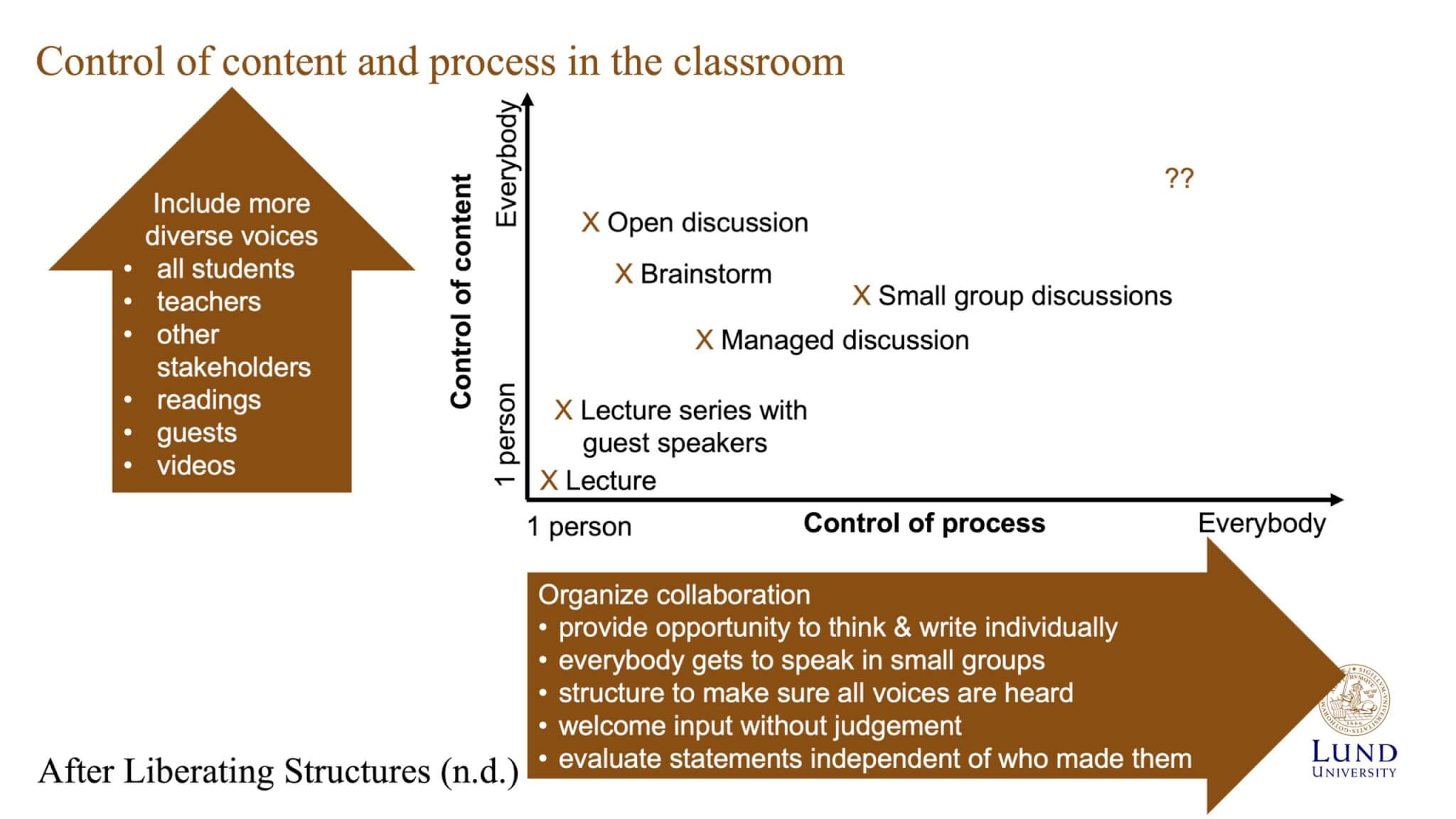
One approach that I find really helpful there is to think about who controls content and process. Often, a teacher has full control of both. They might try to actively involve students in their learning, for example through multiple-choice questions or minute papers, but the control rests with them. They might give up control a little and invite colleagues or external experts to speak in their course, but then it is likely still the main teacher or seminar organizer who controls the process, and at most a handful of people who control the content (and they were invited by the organizer). There are then of course more open models like brainstorming or discussions, but we are not very used to sharing control (or responsibility!) with students.
In general, if we want to move to more diverse voices, we can of course look at which perspectives we invite in guest speakers or in reading we assign, for example is everybody from the Global North?
And if we want to move towards sharing control of the process, this is basically about how we organize collaboration. Here it is important to give students the opportunity to think and write individually, then to make sure that everybody gets to speak in small groups, to structure larger group discussions to make sure all voices are heard, to make sure we welcome input without judgement, and to evaluate statements independent of who made them. And Liberating Structures are really a great collection of methods that can help us go in that direction!
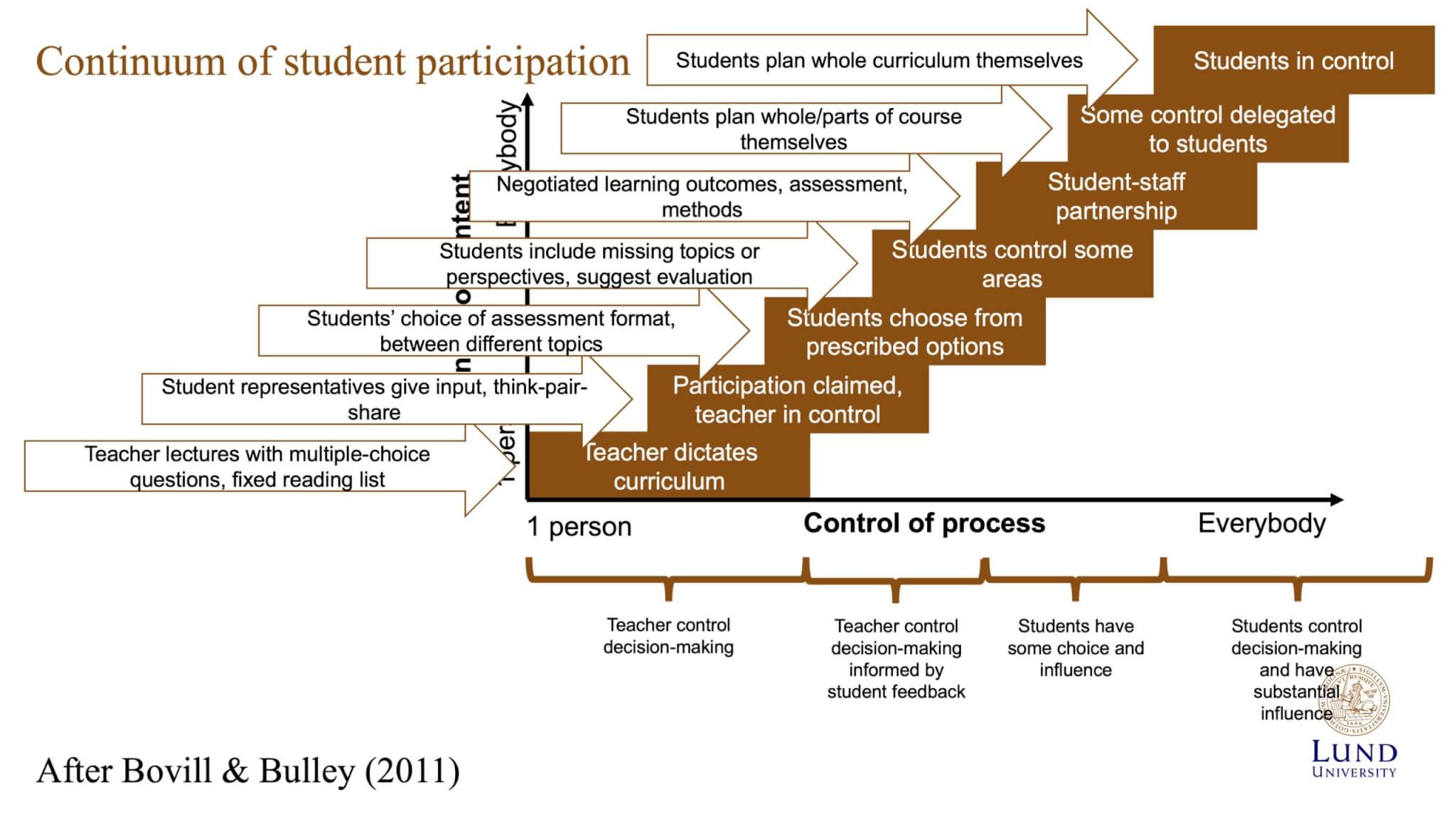
A classical way to talk about student participation is a continuum of student engagement (which I am showing here as discrete steps), where on the one end we have a teacher that “informs” students. On the other end of the spectrum, we could give students full control over what happens and let them plan a whole curriculum themselves.
And in between, there are many other steps:
- In addition to a lecture, we could ask student representatives for feedback or suggestions, or we could invite students to participate more actively through methods like think-pair-share.
- We can also provide several options, for example on different topics to focus on, or different assessment formats like video or podcast or text, and let students choose between prescribed options.
- We can even consider to give students control over some select areas: We could free up one class where students suggest a topic or perspective that they think is relevant in the context of the course. Or we could let them evaluate the course based on the criteria that they think are important.
- We can invite students into partnership and negotiate learning outcomes, or methods, or assessment, or all of those, with them
- And we can delegate some control to students and make them responsible for parts of a course, or a whole course, and just support them where needed and wanted.
Even though images of ladders and staircases always seem to imply that we are supposed to climb higher and higher, I don’t want to imply that that is the case here. Teaching always depends on context, and there is a time and place for all of these options! Even though I would argue that student-staff partnership is a good option to practice democratic processes in the classroom, there are also other ways to do that, and also to scaffold student responsibility by first giving choice between prescribed options, then giving students control of some areas, then inviting them into full partnership. Also we might want to start slow because we as teachers aren’t ready to give up control like that because we might be worried about what might happen if we do. So starting wherever you are comfortable and then maybe seeing if we can stretch a bit in the direction of partnership is a good approach!
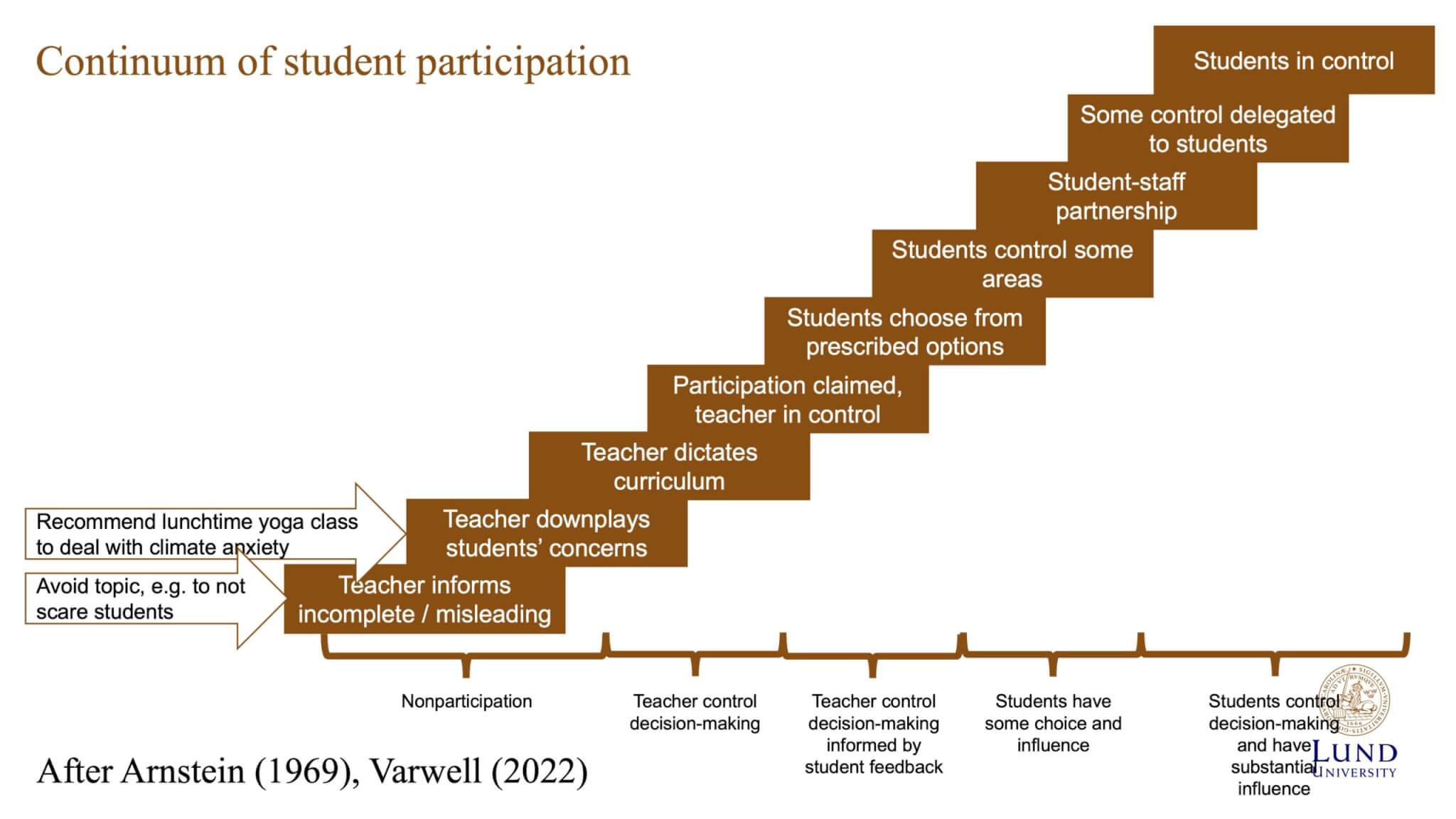
Interestingly, the ladder of student participation originally came from a ladder of citizen participation, published in 1969, and that ladder had two more steps that ideally would not exist in teaching and learning (nor in citizen participation, for that matter), so they have been dropped when we talk about student participation. Those steps are that students are not taken seriously, and the teacher conveying incomplete or misleading information.
Unfortunately, both do exist in teaching, and maybe especially when it comes to teaching sustainability:
- Teachers might react to students articulating concerns for their future by recommending that they take lunchtime yoga classes to deal with climate anxiety, when it is very clear in the literature that while mental health care is important, and an important part of dealing with climate anxiety (and I do not want to diminish that!), it is very important that students also develop the competencies and self-efficacy to become active and fight the root of the problem, not just work on the symptoms
- And about the incomplete or misleading information: teachers might avoid talking about the climate crisis, or any of the constituent crises of the ongoing polycrisis, and thus maybe not intentionally, but effectively mislead students. And there are many reasons why teachers might choose to not talk about difficult topics: Not feeling prepared to deal with emotions, not being the expert, not having time in the course plan…
But it is important that we do it anyway!
What we as teachers perceive as student nonparticipation might not really be that they don’t care, it might be that they care very much and we just don’t get to see that in our class. A colleague mentioned today (and I have their permission to share the story!) how their students staged an intervention when they felt that the teacher wasn’t teaching what they wanted to learn: When the teacher came back after a break, the students collectively did yoga and ignored the teacher! So what looks like disengagement and non-participation does not necessarily mean that the students don’t care and don’t want to learn.
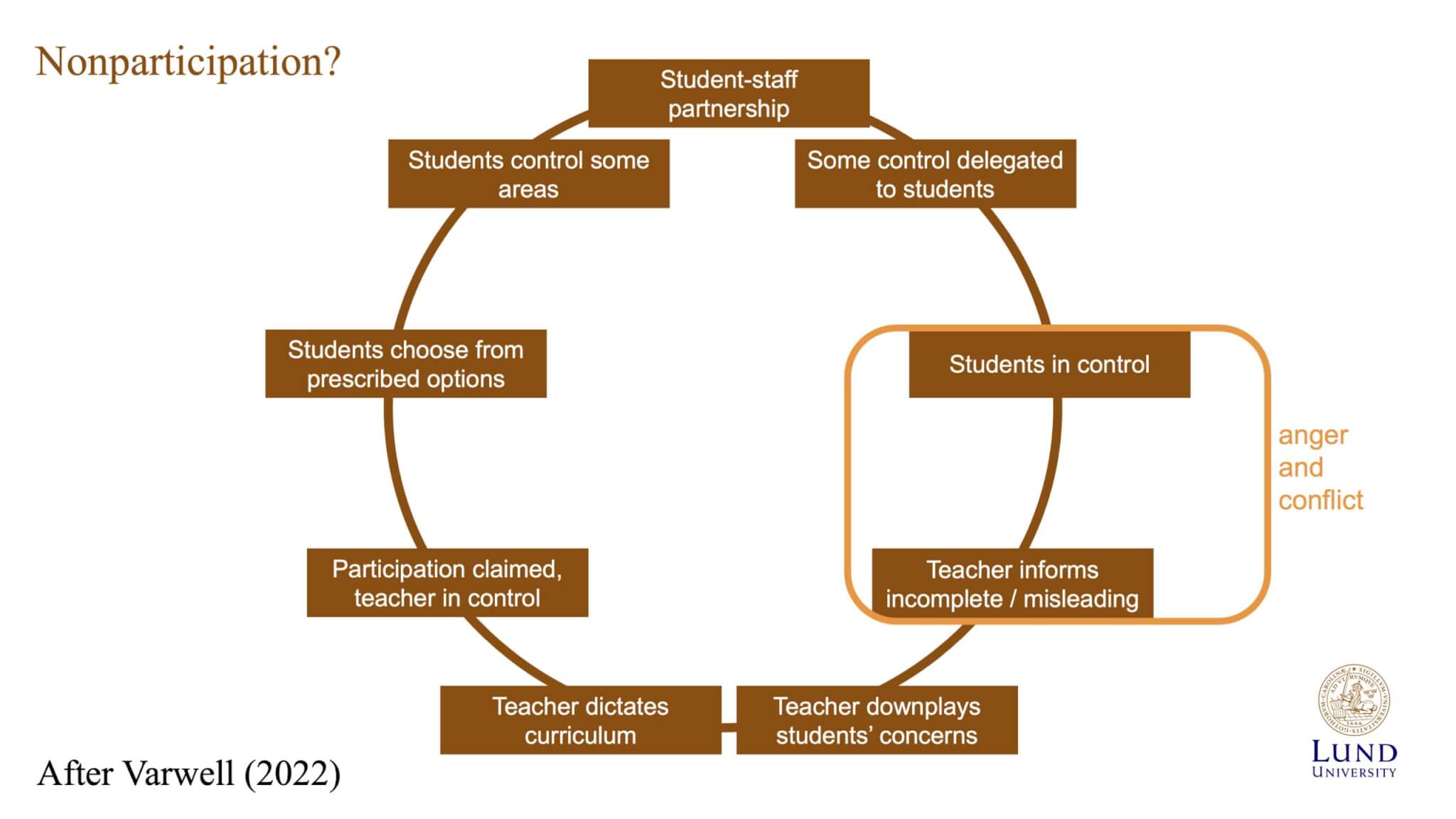
One way to understand what happened there is to look at the continuum in a different way: closing the loop between students in control on the top end and teacher misinforming at the bottom. If we display the continuum of student participation like this, we suddenly have a connection between the students that we perceived as completely disengaged and non-participating, and students that take control. Students that feel that their teachers aren’t taking their concerns seriously or are not even teaching them what is crucial for them to learn might take action themselves – for example through a school strike, or through any number of other activities, like the yoga intervention in my colleague’s case. While it is great in general when students do take initiative and responsibility, it is not good if they do that because they feel that we have failed them, that they cannot trust us, that they are on their own. We need to then bring them back into conversations with us.
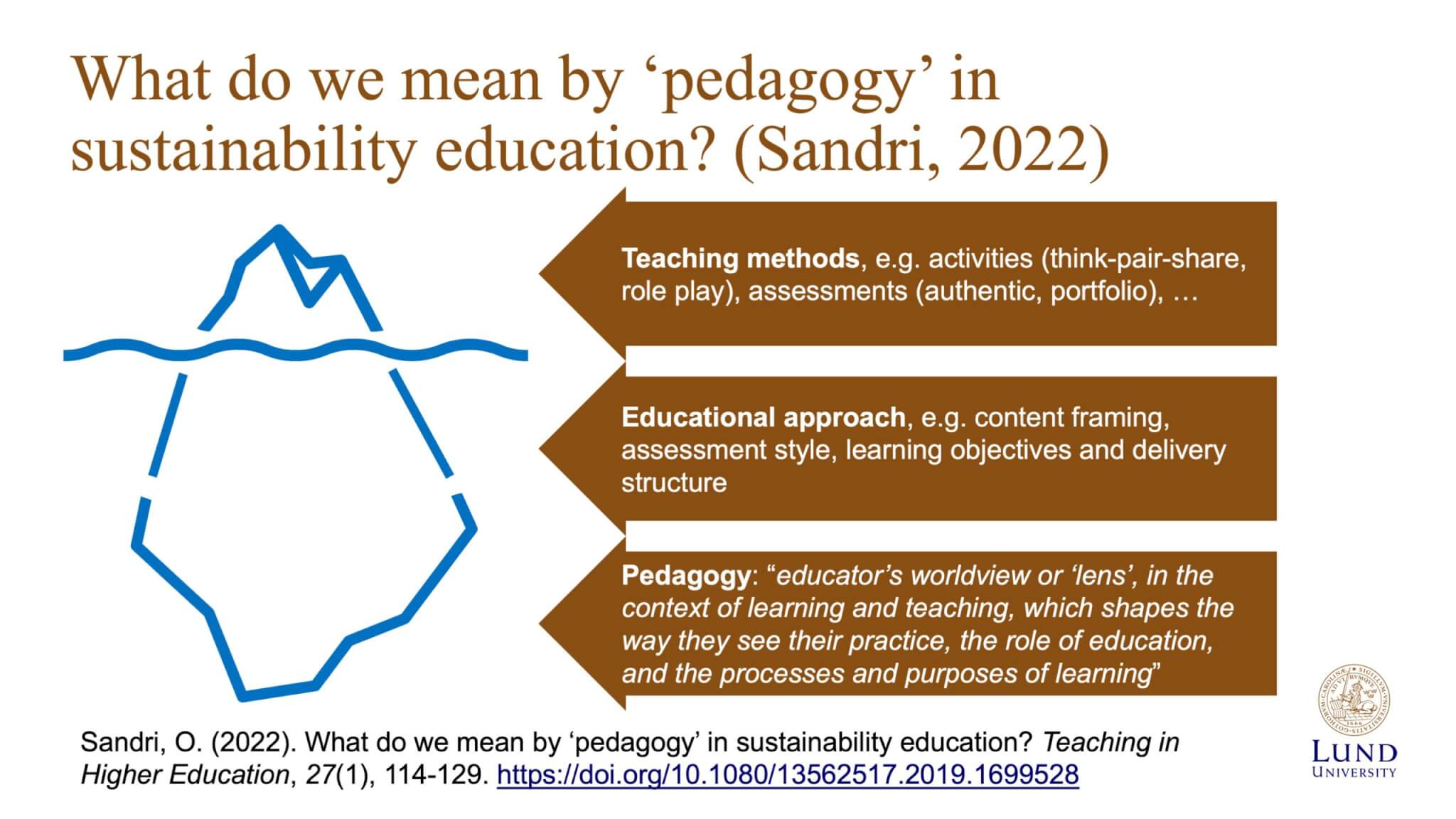
Next, we talked about what “pedagogy” in the context of sustainability education actually means. Often, we hear or read that we need to use all kinds of pedagogies, or methods, but the connection, why one follows from the other and for what purpose, is often not clear. And while I think it is great to know the technical terms for pedagogies because it makes it easier to talk with other people who know the terms, and it is easier to find literature etc, what is even more important is to articluate what matters to us in our teaching. I came up with a couple of examples for how people can think about this:
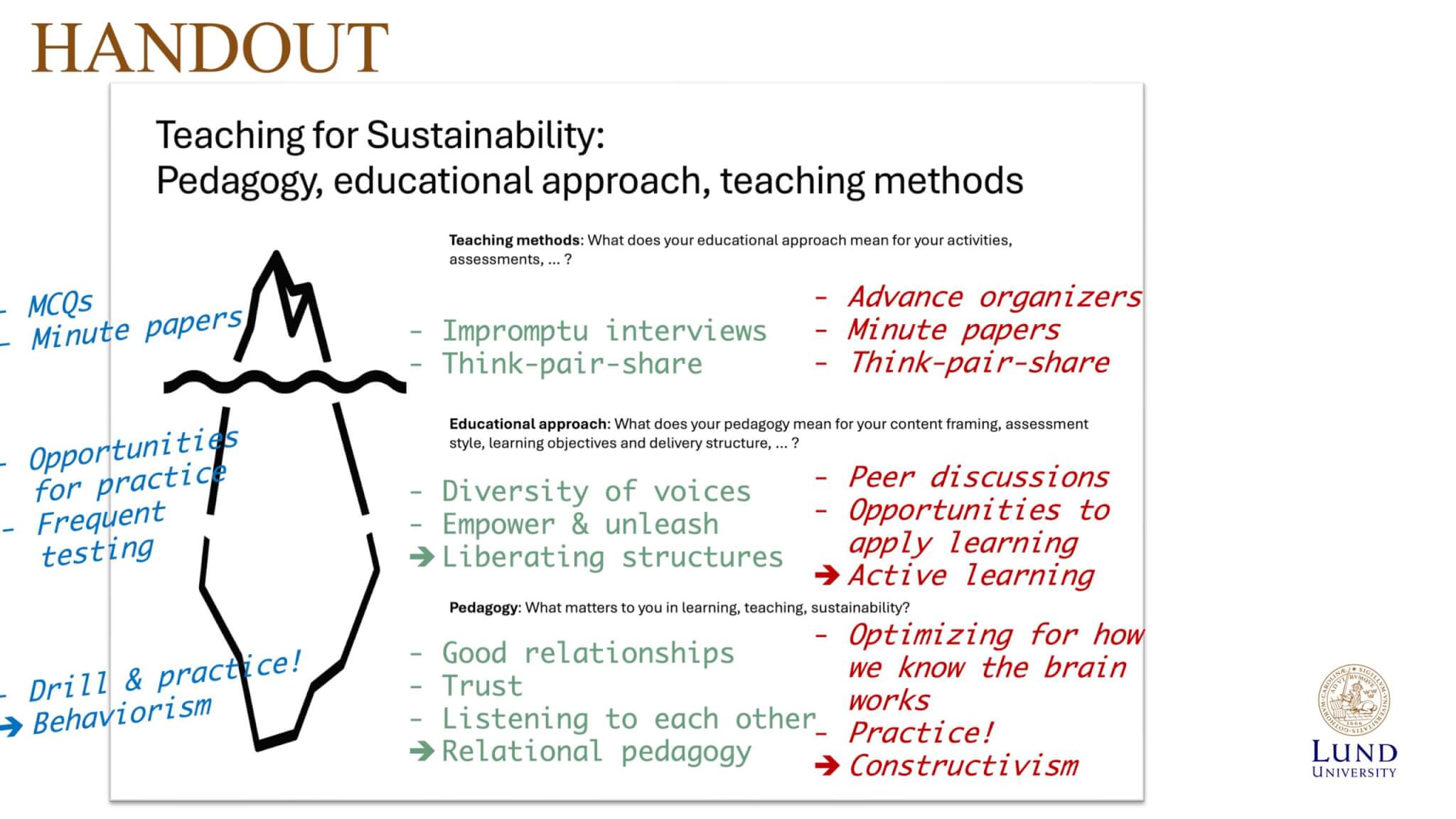
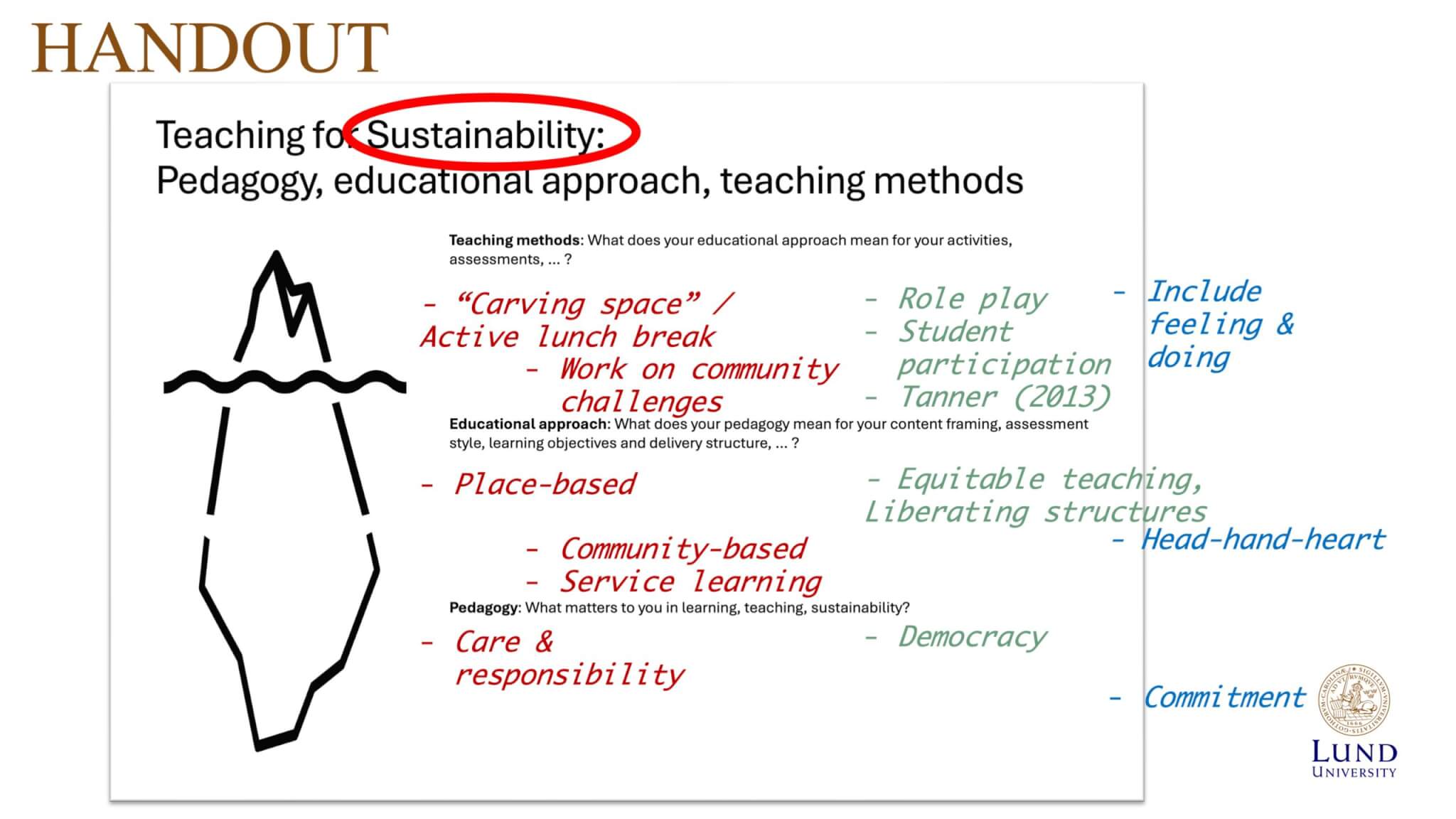
Lastly, I highlighted the head-hand-heart framework for sustainability commitment, and also showed how I have used it in my own work. Since I last blogged about it, I have added more hand and heart elements to my course, for example drawing in the active hope exercise. I always think this is a super useful framework!

Then, we went into a modified form of the Troika Consultation (without the problem-giver turning their back to the others, and without touching knees. I have ALWAYS hated touching knees!!), another one of the Liberating Structure methods, because the participants felt that talking through their questions together would be the best use of our time together.
There were a lot of interesting points that came up during those discussions, for example about connecting disciplinary content with real-life experiences: Of course, the “active lunch break” works great for that (see slides below), and a shout-out to the “carving space” activity by Holmqvist & Millenberg (2024)! We talked about this activity both with regards to noticing policies in the real world (which can be as obvious and easy to find as parking signs or bus stops) and with energy-saving constructions (which can both be noticed directly, or their absence).
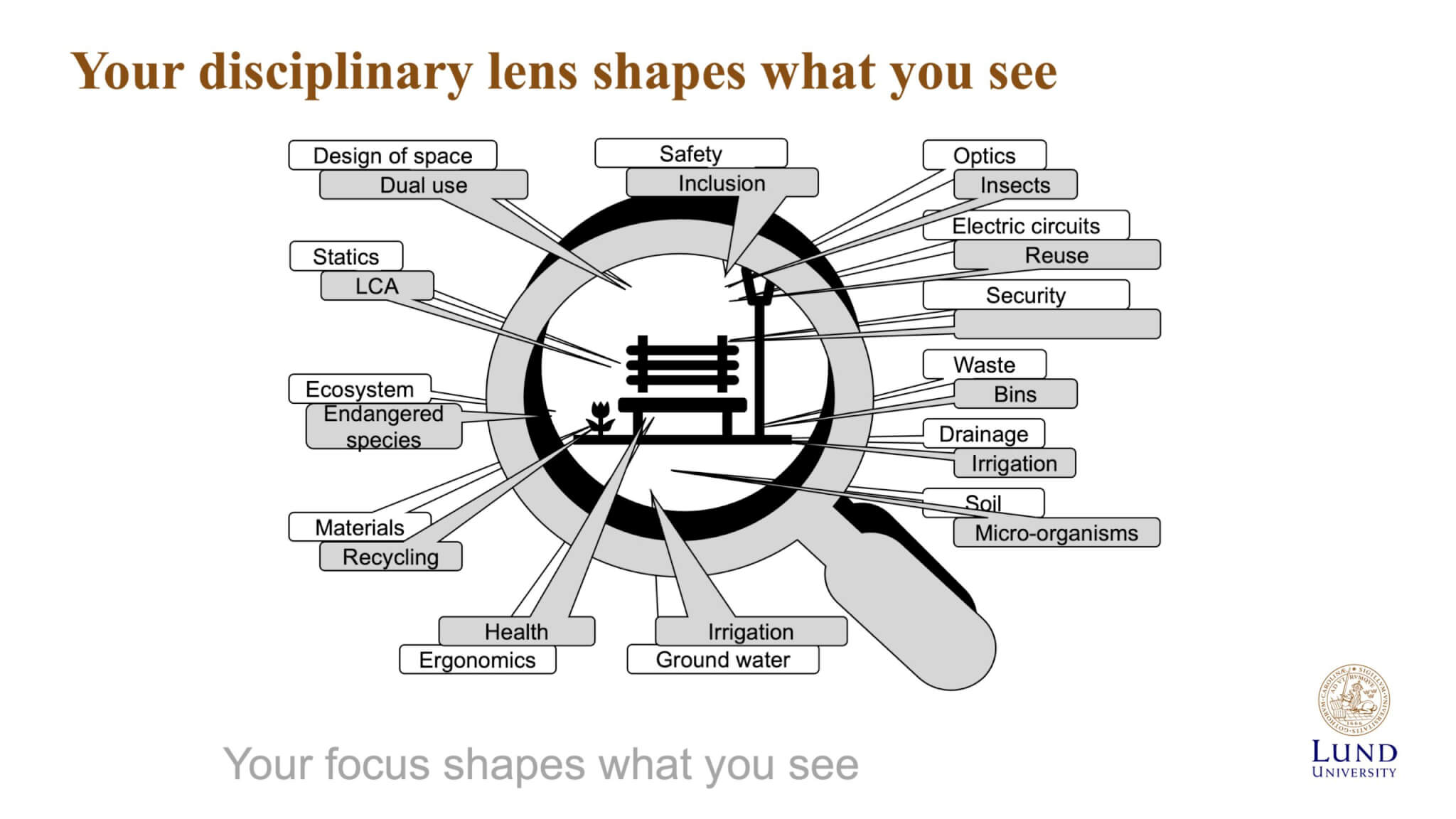

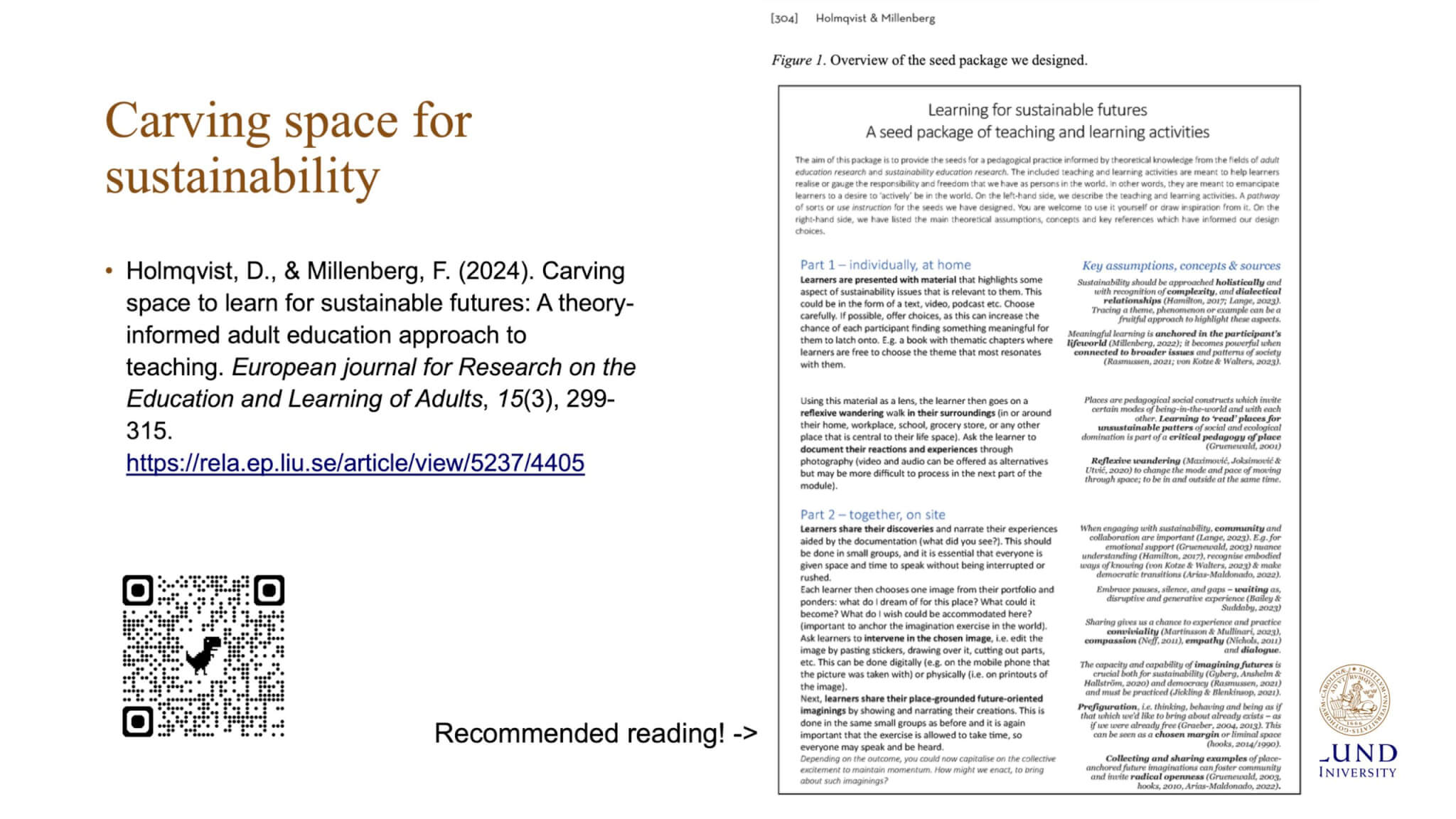
Another way to make the connection could be to capitalize on a very international group of participants and asking them to find examples in the media in their home country and local language there. These days, it is not at all difficult for the rest of the class to auto-translate those articles into English or any other language, and it would be great to see what kind of issues (related to the course’s main topic) are discussed in different parts of the world and how. I think that is a great idea to really make the diversity of the group a feature that is enriching for everyone!
In that context, we also talked about how participation can be scaffolded for the teacher, too, not only the student, since also the teacher needs to gain experience and confidence sharing responsibility and giving up control: Depending on whether they are comfortable thinking on their feet and spontaneously responding to whatever students might bring or not, an alternative might be for students to submit the articles in advance to allow the teacher some time to think about how to connect or integrate them with what else is planned in that session.
We also talked about student attendance in a course with both mandatory and non-mandatory sessions, where the experience is that everything that isn’t mandatory is really not well attended (maybe not surprisingly, when the implicit messaging is that some sessions are so much more important than others). The teacher went for only a few mandatory sessions to give the students choice and freedom to decide where they want to focus their energy, but is now a bit disappointed that students don’t show up when topics are not directly related to the topic they are working on in the essay that students do in place of an exam (but on the plus side: students now report to be a lot less stressed than in previous years). The teacher could go back to all-mandatory or an exam (and maybe students would prefer the “pressure” of the exam to attend? I could imagine that based on the findings in Cullen & Oppenheimer (2024)), but doesn’t want that. But one option we discussed might be to have mandatory tasks based on what they are learning in the voluntary sessions, and an exam where students are tested on only the sessions that they did not attend.
And this is where I should really have listened to my own advice and taken notes… But I did not, so the last point I remember is talking about the difficulty of organizing group work in hybrid teaching. Being on the laptop in an in-person group in a room where there are several other conversations going on is not fun, so it’s best to avoid that… And even worse, having the online people on a huge projection on the wall! The easiest solution might be to both put people in small groups in person in the room and in breakout groups online, but to not try to mix those two groups in a synchronous session (provided there are enough people both online and in-person to make that work). If we also want to mix the groups, it is easiest to do that asynchronously and then online for everybody.
My reflections about the session: It is always the most valuable for participants to talk with other teachers in the same situation! And we had great discussions today, I am glad that the whole workshop was set up to give that space. But it is also a challenge: Teachers tell us over and over again that they want to have workshops on how to teach for sustainability, but in the end we then have really low attendance, especially for sessions like today that don’t give teachers any credit or certification or anything. Today, we also had only highly experienced teachers showing up, all of which have worked with me on sustainability questions before, so on the one hand that was great for the discussion quality, but on the other hand the idea with the series was to give teachers a low-threshold introduction to teaching sustainability. Why don’t those teachers show up? Does the way we advertise sound like you need to know too much already, are we using insider language or something that seems like they wouldn’t fit? I really don’t know. Hopefully, we will be able to reach those teachers with our MOOC!


