Notes from Gerald Decelles III’s trial lecture & PhD defense
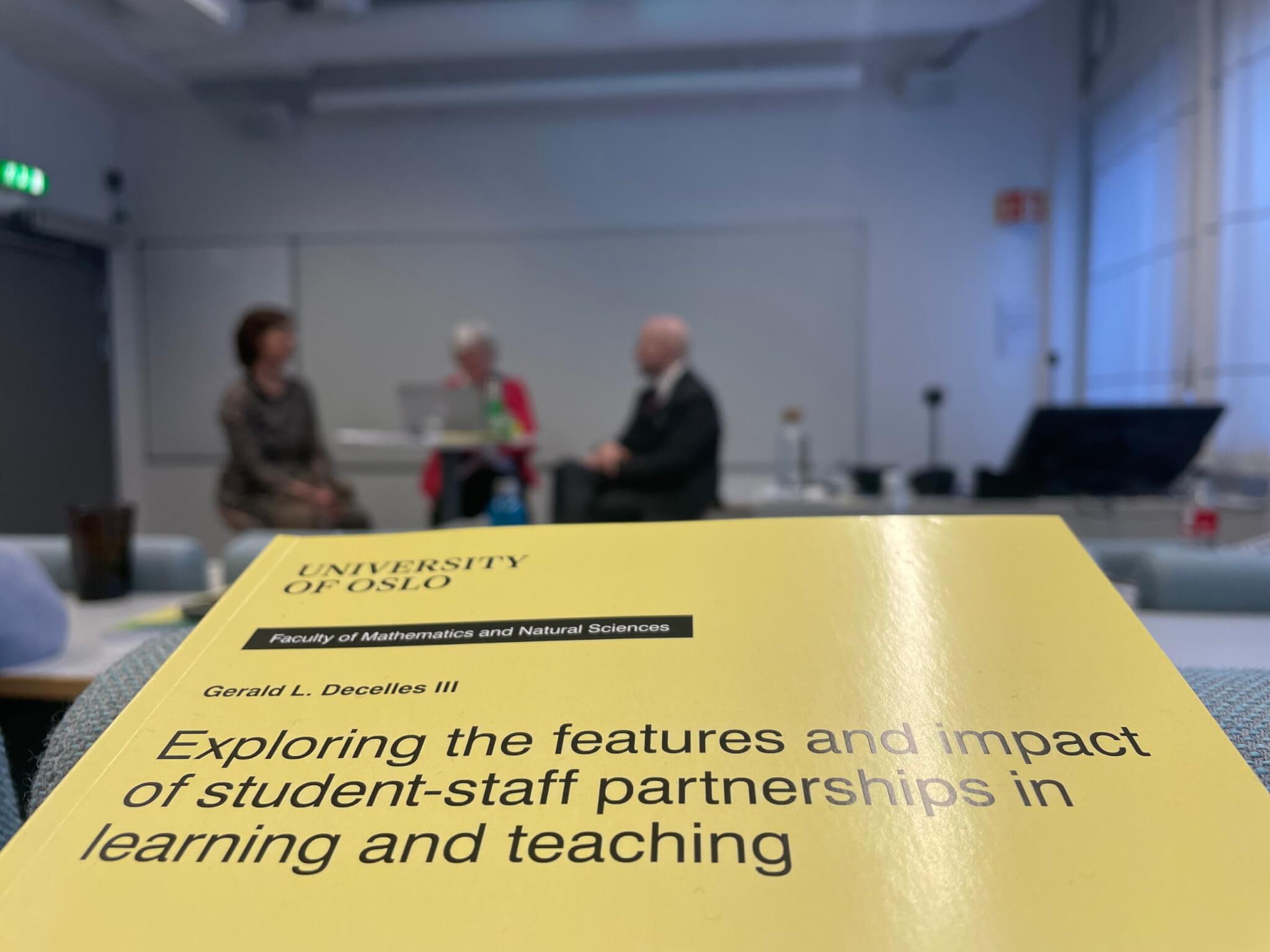
Last week, I had a great day listening first to the trial lecture and then the defense of Gerald Decelles III’s PhD thesis, and it was so inspiring! Both his trial lecture and defense were such excellent presentations that I have to compile my notes into a blog post to process my thoughts. In the following, I combine both also with reading his PhD thesis (Decelles III, 2026; which you see on the image above, with Gerry and the opponents in the background).
Gerry was given the topic “Developing engaging assessment in STEM education” for his trial lecture and started out by introducing the different components of this topic: “STEM“, “engagement“, and “assessment“.
“STEM”
Did you know that STEM (Science, Techonology, Engineering, Mathematics) was actually called SMET until 2001? I did not. That was the time when the TIMMS and PISA reports showed the US falling behind other countries in the STEM subjects, of the “no child left behind” act, of 9/11, and when a strong STEM education was seen as important in the defence strategy of the US. Gerry told us about his memories of that time when he, as all teachers in that context, wasn’t involved in developing learning goals or the standardized tests that would be used to evaluate student learning (and also the teachers’ teaching), and about the frustrations with the resulting “teaching to the test” that educators felt. Also, did you know that even though we (or at least I!) think about specific disciplines, like maths or geosciences, as being STEM disciplines, STEM was meant to be interdisciplinary? So a lot to unpack behind that little word!
“Assessment”
Next, Gerry talked about assessment, different functions and forms (and I have written too much about that before to repeat here now). But he quoted Biggs (1996)’s story about learners who amass treasure, not just diamonds, to motivate that we should aim for divergent assessment: Let the students show what they can do!
“Engaging”
Next, Gerry asked very relevant questions. If we talk about engaging assessment, what do we mean exactly? Engaging for whom? The administrators? The teachers? The students? Assuming that we meant the students in the first place, what would be engaging to students? Something that is not too taxing? Something that will be useful in the “real world” once they leave university? (Note: It is a bit problematic to separate the university from the real world, but I don’t think that is what he actually meant here)
“Engaging assessment”
So then putting the last two together: engaging students through authentic assessment. There are more dimensions to “authenticity” and realism than being “like work”. Ajjawi et al. (2023) distinguish between psychological authenticity (which is in the eye of the beholder, as Gerry points out), ontological fidelity (i.e. how the learner wants to be in the world), and as a complex social practice (so if we make things too easy, students might not actually learn what they want most to learn!), and it is impossible to do all three at once.
So what if we were to co-create assessment, or, as Gerry says, “blur the lines between what it means to be a teacher and a student“? There are many reasons why one should consider it (and Gerry had references for all of those, but I wasn’t quick enough in my notes…):
- students should be active in their learning, and learning should include assessment
- co-creation has benefits for students and staff
- designing assessment tasks IS learning
- co-creation can lead to better relationships between students and teachers
- co-creating assessment can help expose the hidden curriculum
So how should we do that? Through partnership.
Partnership
One thing that I really enjoyed about his thesis is that Gerry uses the term “partnership“, where “partnership is conceptualized and defined from the point of view of the partners“. So often we have tried to talk about students as partners (but that feels off since we only mention one side of the partnership), student-staff partnerships (and then pointed out that staff includes teachers and other staff), and many other versions, when a really good solution is so simple — partnership!
Gerry presented the Lundy model of critical areas for conceptualizing student voice:
- space to express viewpoints
- voice to be able to articulate thoughts
- audience that listens to the students
- influence so that what students say is acted upon appropriately
Gerry also points out that partnerships are complex and that there is no “one size fits all” way to do them. There is literature on how partnerships can actually undermine trust between teachers and students, reinforce power-inequalities, and be stressful and anxiety-inducing!
And it is very difficult to research why some students (and teachers) don’t engage in partnership, since they aren’t there to ask… Why do they wish to be outside? This is very important to understand (but of course needs to be accepted).
One article that Gerry referred to is Kaur & Noman (2020)’s “Investigating students’ experiences of Students as Partners (SaP) for basic need fulfilment: A self-determination theory perspective“. They looked at six themes: Agency and choice (to capture autonomy), confidence and challenging (for competence), and environment and interaction (for relatedness). More than 3:4 students reported experiencing agency in having the opportunity to participate and contribute, almost 3:4 students reported on a positive classroom environment that would support relatedness, and almost 2:3 students reported that they felt they had choice. Almost 1:2 students highlighted meaningful interactions with faculty. While this is based on limited data in two context, the authors conclude that “[…] SaP principles and practices have the potential to fulfil SDT’s three basic psychological for students’ motivation; this explains the underlying mechanism that links SaP and engagement. In other words, during partnerships students can sense that they have options in shaping their learning in several ways; they also realise that are they capable of contributing in a meaningful way and their perspectives and that their presence in teaching and learning process is valued. Students and faculty in this process can form connections, which in turn, improves their motivation and persistence in given tasks.”
But in order to work in partnership, it is incredibly important to build trust. Cavanagh et al. (2018) investigate “Trust, growth mindset, and student commitment to active learning in a college science course“. In their survey of 245 undergraduate science students on trust (“defined as perceptions of their instructor’s understanding, acceptance, and care“), they find that “student trust of instructor and students’ views of their own intelligence are both associated with student commitment to, and engagement in, active learning. Student-reported trust of the instructor corresponded to final grade, while students’ views of their own intelligence did not“. Trust in the instructor was even a stronger predictor of student engagement and final grade than growth mindset, even though “encouraging a growth mindset” was one of the four trust moves the instructor in the course used (the others being transparency about why they were supposed to do active learning, showing empirical evidence to support that choice, and constructive alignment).
But now, on to negotiation. How far are we willing to go in co-creation? And how far are students willing to go? Students are socialized in the system we are all in, and might tell us what they think we want to hear, or might not even be able to imagine other options than what they have experienced!
In his thesis, Gerry explored partnership in three studies.
“The Same, But Different: Teacher and student experiences of partnership” (Decelles III et al., 2025)
In Decelles III et al. (2025), he and his co-authors investigate teacher and student experiences of partnership. They find several themes that support the existing findings also in a Norwegian context:
- the value of relationships: For teachers in becoming allys with students when trying out new things in their teaching, for students about finding mentor- and sponsorship
- voice, agency, and power: For students it’s important to be heard and then action resulting from that, and feeling ownership; for teachers it’s important to see student engagement
- importance of positive past experiences
- multiple understandings: partnership is often perceived more as “helpful for both staff and students” rather than “as a means for a critical rethinking of student and teacher roles and relations“
They also identify an aspect of partnerships that is so far underreported: the uncertainty it brings to teaching and learning. For teachers, partnership reduces uncertainty since they have better relationships with students, for students partnership increases uncertainty since their ideas of how learning at university works are being challenged.
“Student compensation and motivation in student-staff partnerships” (Decelles III et al., 2025)
In the second paper (Decelles III et al., 2025), Gerry and co-authors investigate the experience of compensation in partnerships, and how it connects to motivation. Typically, in Self–Determination Theory, the prevailing wisdom is that verbal rewards are mostly positive for motivation (mostly, because it depends on the relationship between giver and receiver), that compensation or other rewards that don’t control behavior don’t reduce intrinsic motivation, but that performance bonuses or payment upon completion of a task are perceived as controlling and undermining autonomy (but: can strengthen feeling of competence!). So what happens when you pay students for partnership? Gerry et al. find several relevant factors: students personal finances, time as an influential factor, and partnership as motivator. Overall, they find that compensation acts as enabler that can lead to more equitable partnership opportunities.
In his thesis, Gerry refers to the paper by Bardach & Murayama (2025) on transformation of extrinsic to intrinsic motivation (which came only out after his paper was submitted) and that he says “challenges the idea that partnership is only accessible for those who are intrinsically motivated“, since we could bite students with extrinsic rewards and let them experience the joy of partnership so they become intrinsically motivated to continue.
The blog “taking orientation online” (which seems to sadly not be running any more) also writes about incentivizing completion of courses and make the point that it very much depends on what incentives are (students love automatic grade improvements as incentives! And not all vouchers are appreciated in the same way, even if they are for the same amount of money, because some are a lot more useful than others…).
“Challenging the assessment narrative: Addressing assessment anxiety through the collaborative process of co-creation” (Decelles III & Bovill, 2026)
In the third paper, Decelles III & Bovill (2026), “Challenging the assessment narrative: Addressing assessment anxiety through the collaborative process of co-creation“, they investigate the question of co-creation of assessment influences assessment anxiety. They find that that depends on
- the type of assessment
- knowing the assessor
- co-creating helps agency
- co-creation helps anxiety
This can help change the narrative from what the student can do against their anxiety to what the student and teacher can do together!
Relevance of the work
Gerry’s work is important for several reasons. While he finds a fairly pragmatic approach of both teachers and students to partnership, there is the potential for much more. Gerry writes in the conclusions of his thesis: “It is my hope that this PhD research helps to advance partnership research and grow its practice. At its core, partnership is a democratic approach to education that is about embracing the diversity of opinions, the equity of participants, and the inclusion of all voices. At a time when this is in short supply in the world, partnership is needed now more than ever.” And having research showing that (and how) partnership can work will hopefully make it easier for other teachers and students to try partnership, and to develop it towards that goal.
Cavanagh, A. J., Chen, X., Bathgate, M., Frederick, J., Hanauer, D. I., & Graham, M. J. (2018). Trust, growth mindset, and student commitment to active learning in a college science course. CBE—Life Sciences Education, 17(1), ar10.
Decelles III, G. L. (2026). Exploring the features and impact of student-staff partnerships in learning and teaching. PhD thesis. Series of dissertations submitted to the Faculty of Mathematics and Natural Sciences, University of Oslo, No 2605. ISSN 1501-7710
Decelles III, G., Bovill, C., & Lundmark, A. M. (2025). The Same, But Different: Teacher and student experiences of partnership. Student Engagement in Higher Education Journal, 7(2), 133-153.
Decelles III, G., & Bovill, C. (2026). Challenging the assessment narrative: Addressing assessment anxiety through the collaborative process of co-creation. International Journal for Students as Partners, 10(1).
Decelles III, G. L., Bovill, C., & Lundmark, A. M. (2025). Student compensation and motivation in student-staff partnerships. Accepted at Journal of Geography in Higher Education
Kaur, A., & Noman, M. (2020). Investigating students’ experiences of Students as Partners (SaP) for basic need fulfilment: A self-determination theory perspective. Journal of University Teaching and Learning Practice, 17(1), 1-15.


