Asynchronous parties and critical ignoring
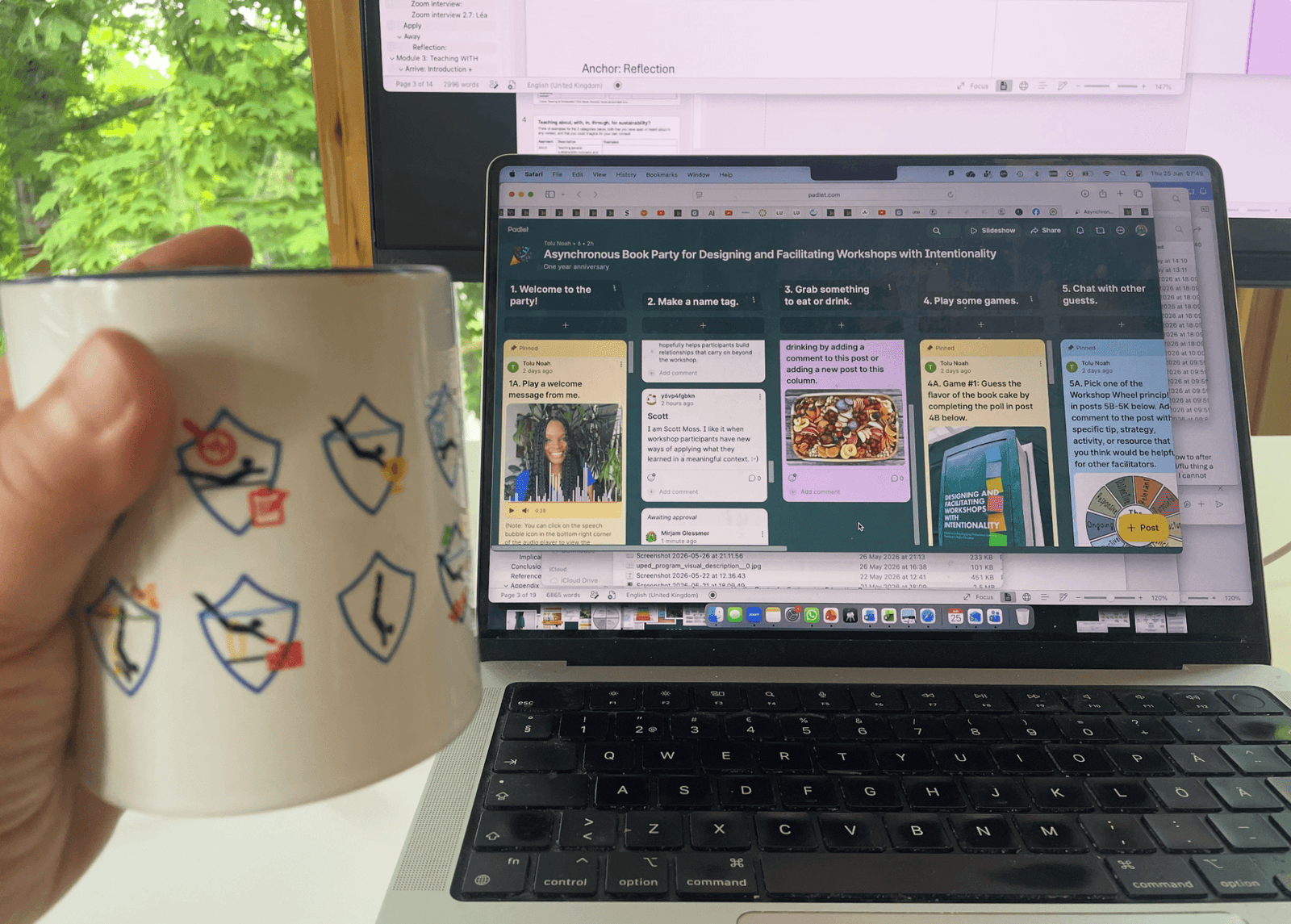
I loved the book “Designing and Facilitating Workshops with Intentionality” by Tolu Noah (2025) so much when I read it last summer! I have very fond memories of sitting in my parents’ garden with the book, working through it by applying everything to a course I was preparing, so when I saw the invitation to an asynchronous book party to celebrate the one year anniversary of the book launch, I knew I had to participate!
Turns out I am super glad I did! The book party is a padlet with lots of invitations to celebrate with Tolu, first to watch a welcome message, then to create a “name tag” where you introduce yourself and your favourite thing about workshops, an invitation to share what we are drinking or snacking on while celebrating, games like guessing the flavour of the cake (and you can check if you guessed correctly — I did!) or a word search related to the topic of the book, a “chat with other guests” prompt to share how we are using principles from the book in our work, a photo wall with milestones of writing and publishing the book, and much more. And I think this is such a great idea! For many reasons: It is a way for me to show Tolu how much I appreciate the book and what impact it has had on my teaching (and I have lots of blog posts mentioning it!), for her to see what people appreciate specifically and what they make of it, but also just a great community building tool to recognize some names and check out some new people, and to learn from all of them. I already connected and wrote with someone on LinkedIn who I met at the party, and I looked up a concept (the 5E Experience Design model) that Tolu mentioned in response to something I wrote, so now I am reading about this!
The 5E Experience Design model (according to a bunch of websites I first found on google! I then also found an article by Tanner (2010) — and that is the Tanner of the awesome article Tanner (2013) on equitable teaching strategies! but here the Es are different, so that’s for another day) highlights that there are these “5 E”s to consider when planning a workshop or similar:
- Excitement. How do future participants learn about the workshop, and how do we prepare them so they are excited, intrigued, whatever we hope they will be? This can be about the actual invitation itself, but maybe also about the advertising of the opportunity (social media? university newsletter? website?), or about materials we send out to registered participants to prepare for the event. Do we send them a puzzle so they have a little win even before everything starts?
- Entry. How do we design the transition coming into the workshop so participants feel welcome and know what to expect? How can we make them feel seen as people?
- Engagement. This is the part we typically think about when planning a workshop. How do we invite people to engage?
- Exit. How do we close the workshop in a way that participants will actually be able to transfer learnings back into their everyday lives?
- Extension. Can we follow up on what happened in the workshop so that it has an impact even after it is technically over? This could of course be something we send out (maybe a summary or a group photo?), or a follow-up meeting or call, or something we already plant during the workshop that somehow comes into effect later.
So — super useful model to think through the whole experience!
But why did I think it was worth my while to go to Tolu’s party and engage there, google the model she recommended, and check out if the author of an article is the same one of another article? Why do I have 3 more “5E” articles open in tabs on my computer, but am not reading them right now? Why did I choose those and not any other of the approximately 130k hits that google scholar shows for “5E Experience design model higher education”?
We live in a world with way too much information, and both the volume and quality are getting worse every day. But even for peer-reviewed publications that would probably be directly relevant for my work, there is simply more stuff coming out every day than I can possibly read. For a long time, I have tried very hard to be on top of everything, to read also articles where I feel that the quality isn’t actually what it should be, or the question they are trying to answer isn’t super relevant for me right now. But it is simply impossible.
Then I came across a post on “critical ignoring” by Austin (2026) that I found very helpful. In a world of information overload, they develop how critical ignoring is a triage-oriented, fast, pattern-based skill where — in contrast to critical thinking — the question is whether attention should be granted at all, not paying attention only to then find out that something is not worth your while. So they suggest asking ourselves questions like “Who produced this—and why What incentives shaped it? Is engagement the point? Would analysis clarify anything, or merely amplify noise?” and only engage with the input — and use critical thinking — once information has passed all those questions. We can think critically if we trust the author, or trust the person who recommends things, or the system that has quality-checked the work, or if we have for some other reason decided to engage after critical ignoring. We should practice critical ignoring when confronted with algorithms presenting stuff to us, AI generated content, if there are no trusted gate-keepers, if there is too much information to deal with all of it. And I find it so helpful to think about information and attention this way! Of course then we cannot just ignore everything, we need to stay critical and ask ourselves, for example, “am I skipping this because I’m tired, or because it’s low-value noise?” or “what about this headline or source raised red flags?“. But being more intentional about what we pay attention to can only be a good thing, especially if it means being more available for things that matter to my colleagues and people that I love to learn from. And any invitation from Tolu, or recommendations by her, will definitely make it through the critical ignoring filter and get my full attention!
Tanner, K. D. (2010). Order matters: using the 5E model to align teaching with how people learn. CBE—Life Sciences Education, 9(3), 159-164.


Listening to podcasts and wondering if I should start another scicomm project… - Adventures in Oceanography and Teaching says:
[…] completely misinterpreting or misinterpreted don’t exist? Maybe I really need to think about critical ignoring […]
Anne says:
Thank you for the ‘critical ignoring’, the curated reading and thoughtfully, contemplative experience that you generously share.