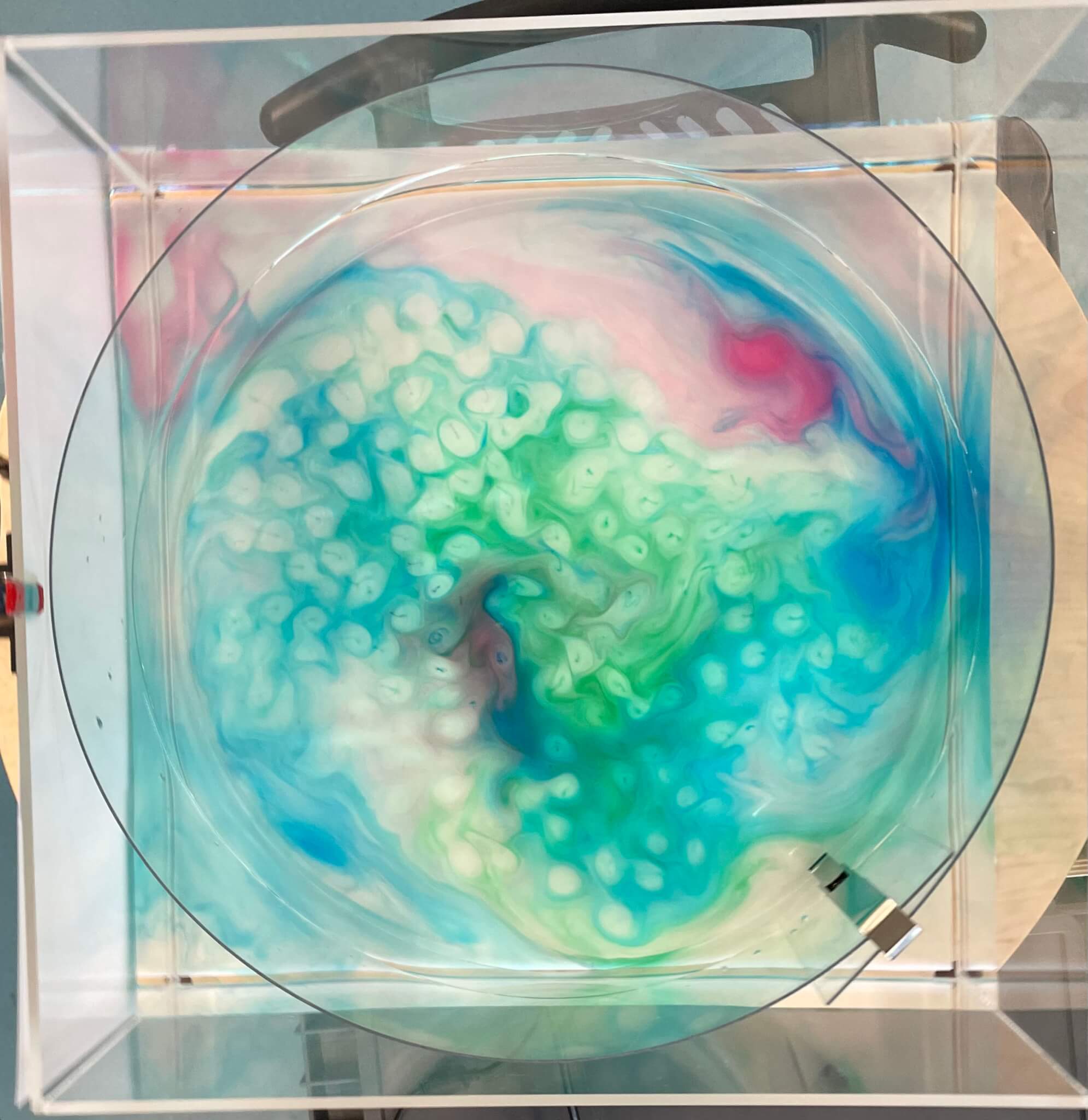
BABY I’M BACK! What are these weird cells in the rotating tank?
My friend Torge (who I had a super exciting rotating tank experiment project with, “Dry Theory 2 Juicy Reality“, check it out!), sent me the picture above and asked whether I had any idea what was happening there. I had not. But I had to find out! (Sorry to everybody else who wanted something from me today, this was clearly much more important and exciting…)
Torge and his intern Jim Sohr set up a rotating tank (cold water, cold room), stirred a bit, and added dye to observe Taylor curtains and how turbulence in a rotating tank is 2D (similarly to what we did here). But then after 10ish minutes, mini “tornados” form with a rotating dye thread in the middle (just a dye dot as seen from above) and a clear, circular area around them. What is happening?
Torge sent me a link to a post by Debbie Schwartz at Tandon Lab, who observed similar pattern (but minus the dye threads, as far as I can see) and identified them as convection cells. But convection seems unlikely for cold water in a cold room if there aren’t other processes at play.
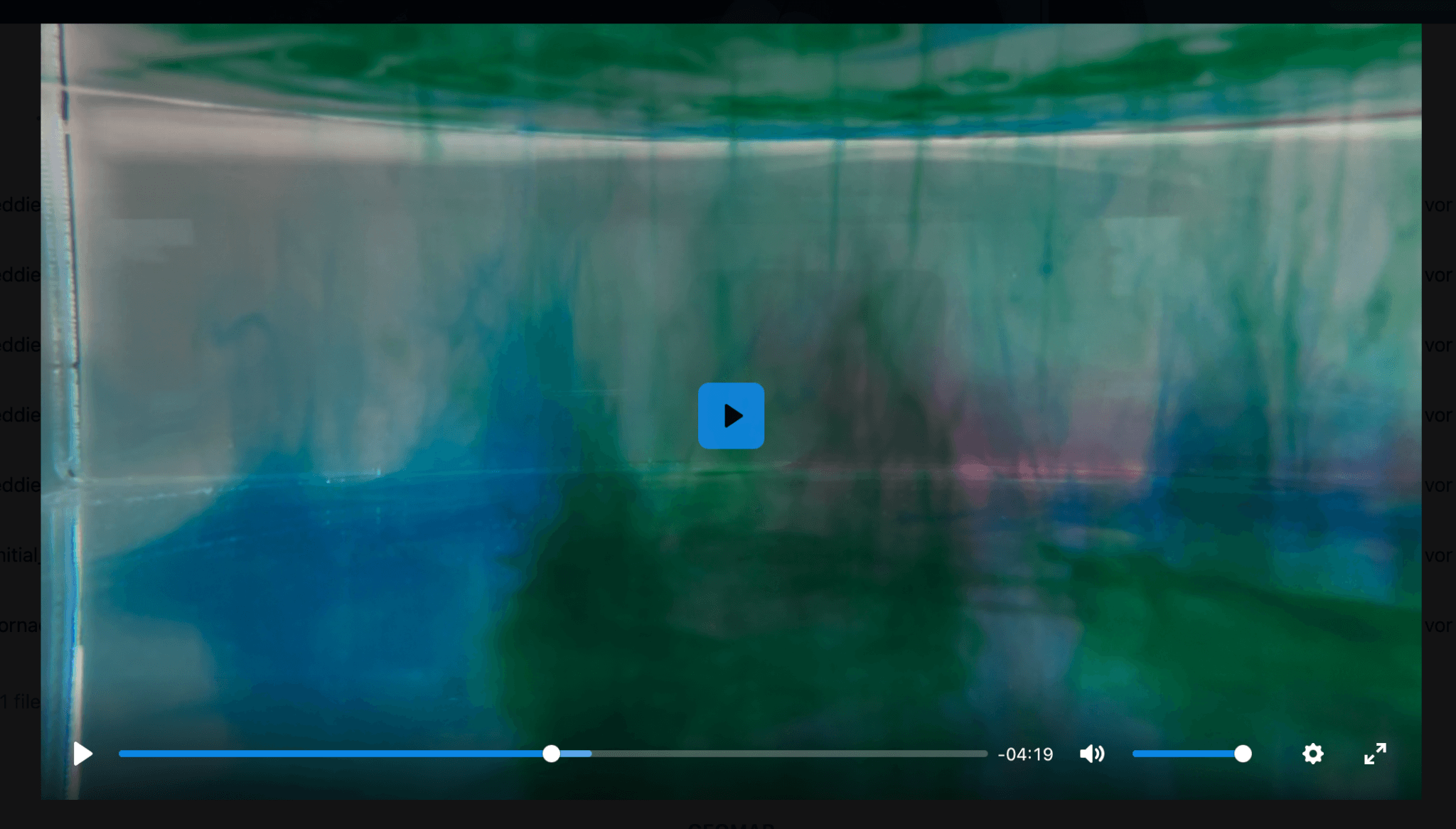
But let’s look at the tank in side view to get an idea where the dye is located in the water column. We see that most of the dye sits either in the rotating columns or at the bottom (and don’t be fooled by the reflection in the surface, that looks like a lot more dye up there than it is, I am speaking from experience…). But there is some dye in the surface, possibly even a dye film? In any case, watching the movie, we see that the dye threads grow downwards from the top, so there must have been some up there (and Jim confirmed the dye film theory in a comment on a draft of this post. Good!).
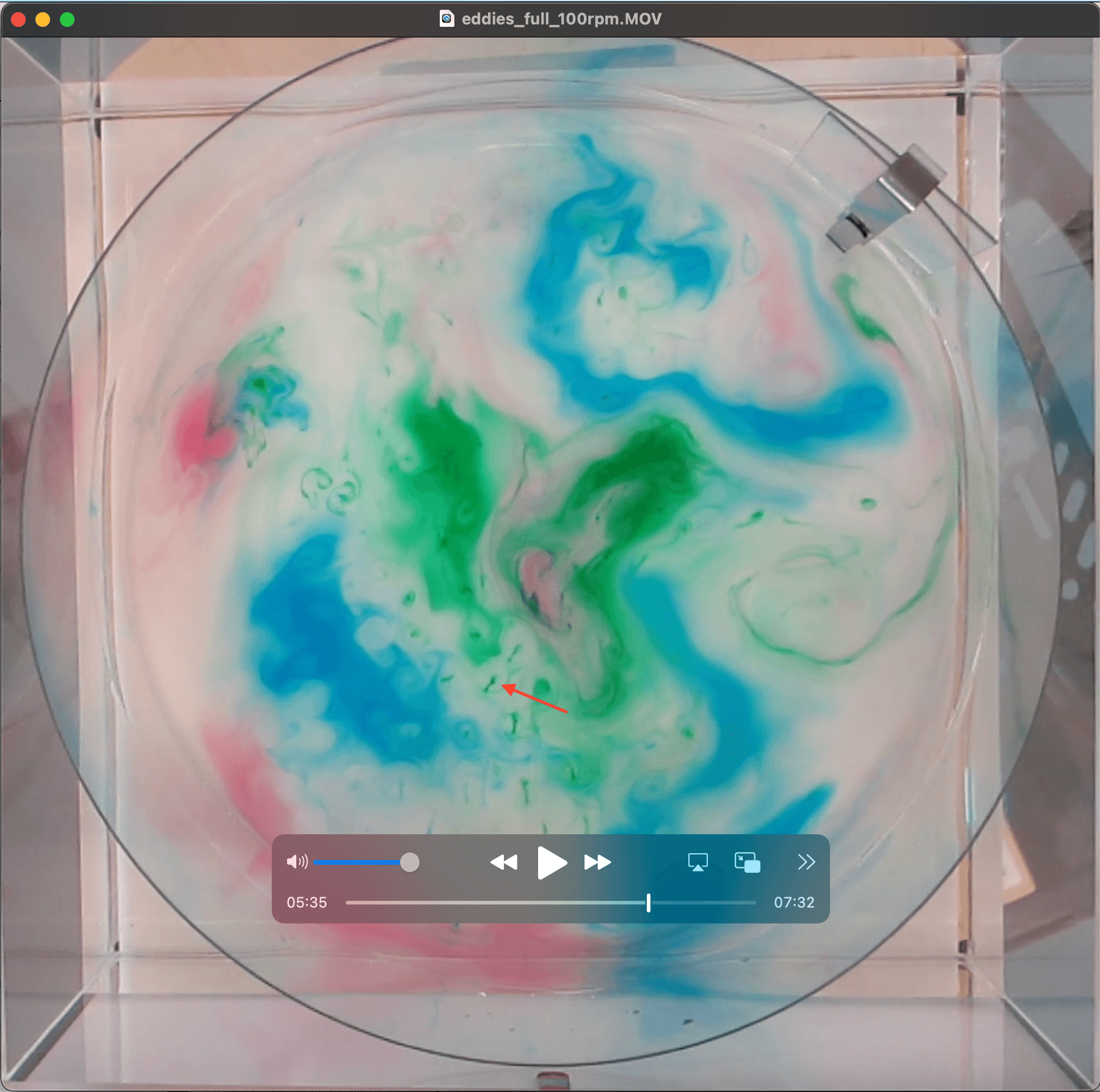
If we look at the mini tornados developing over time in a top view, we see how they form. Let’s follow one of the first clear dots that forms (marked with the red arrow in the following pics).
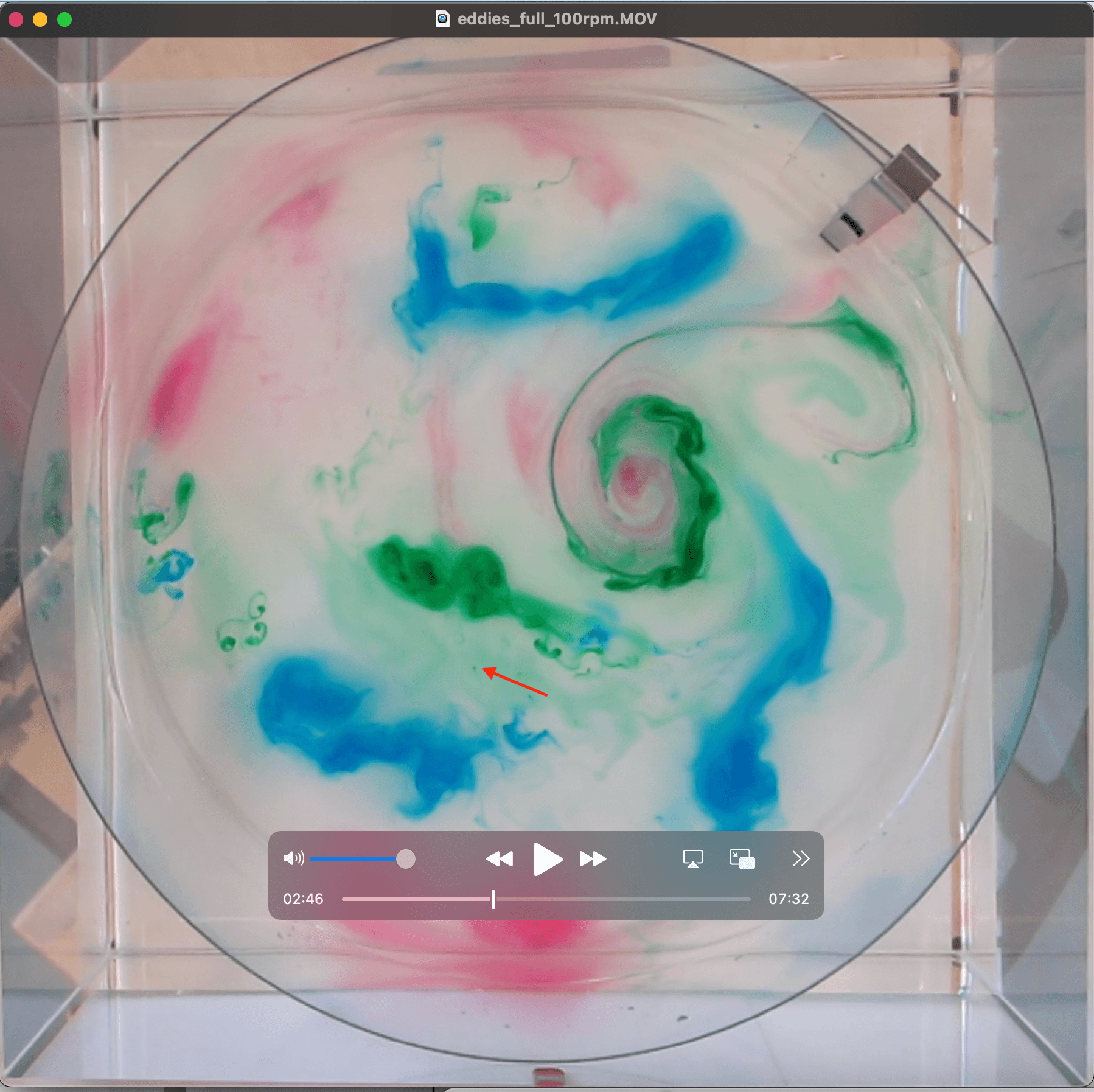
As the dot (and others) become stronger, they concentrate dye in them and seem to pull it from their surroundings.
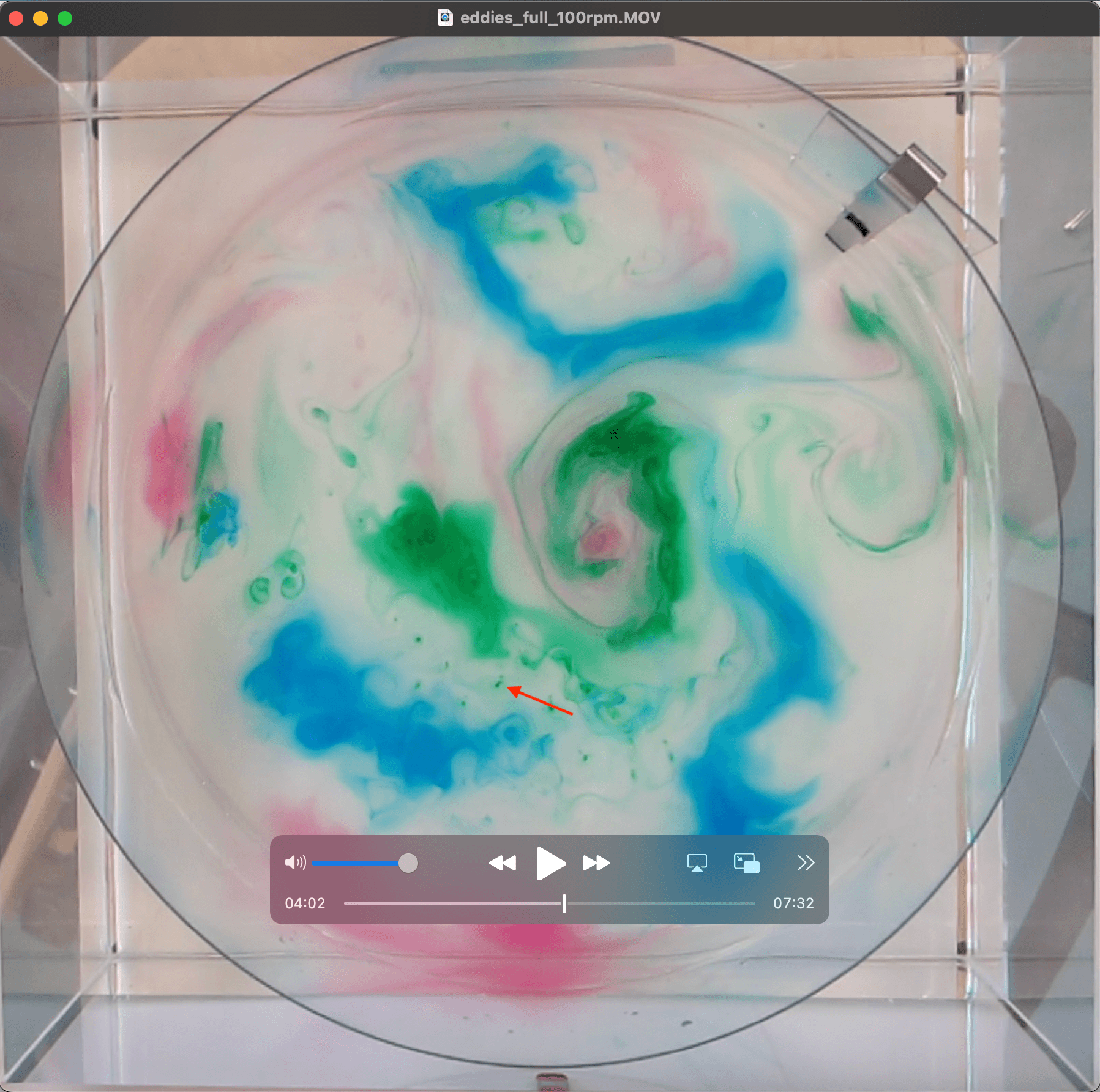
If we assume that there is a dye surface film, that could be one explanation of where that is going: down the dye tornado drain.
So my theory for now: Either the surface is cooled and thus gets denser (especially seeing that there is more dye in the very surface than right below [and Jim, in a comment on the draft, mentioned that the dye was room temperature (and I’m assuming office room temperature, not cold lab room temperature), so then it would be cooled by both air and water]), or there is evaporation (and Torge says that they were in a relatively dry lab with the AC running) and it thus gets denser than the non-dyed water below. In any case, the surface must get denser, so the dye fingers develop.
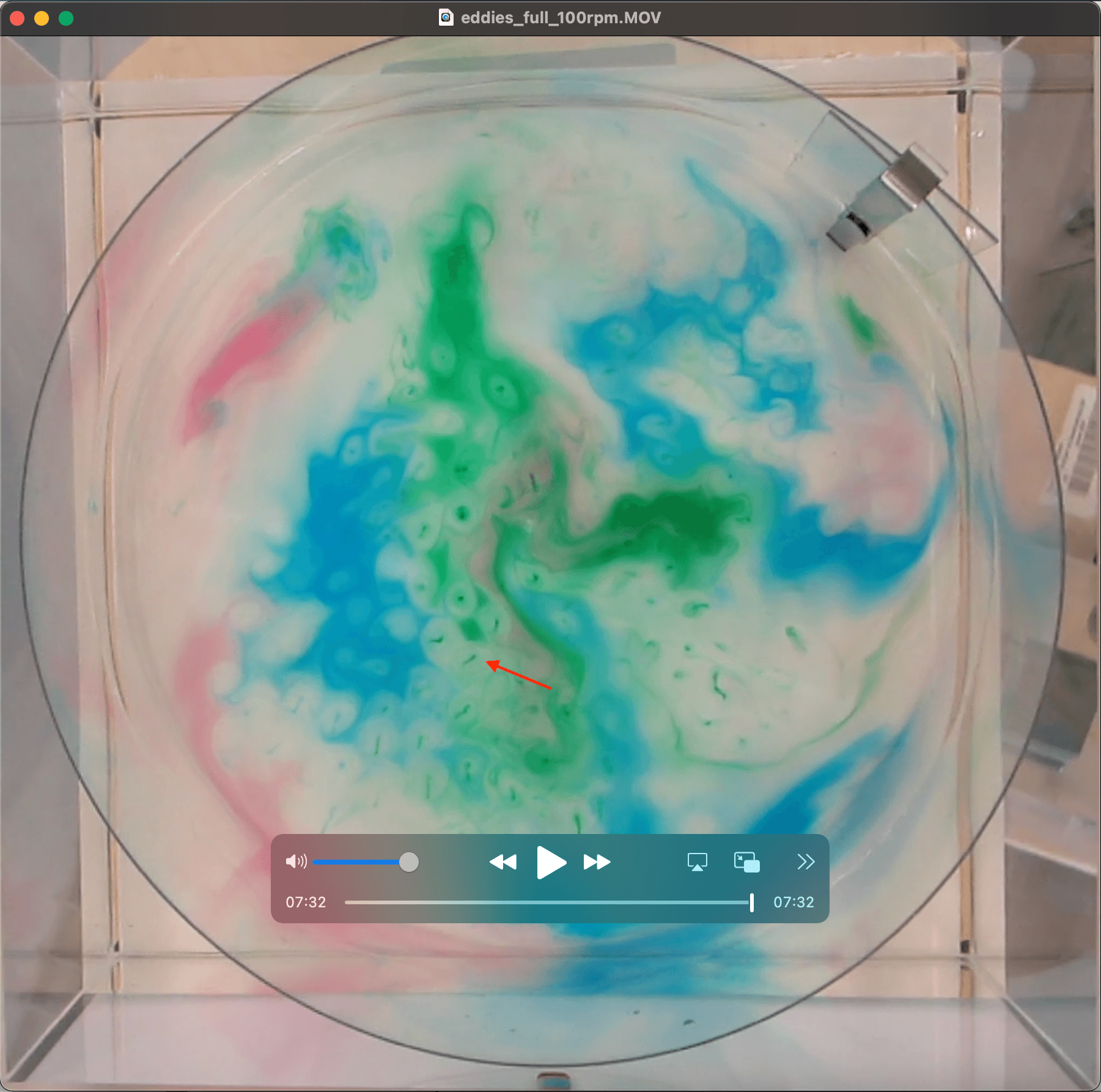
What is also interesting is that while we have the dye tornado in the dot (and sometimes we see a tail, which is just the projection of the tornado that isn’t fully vertical) and a clear area around it, the rim of the clear areas are sometimes more concentrated (see below — same image as above, but now the red arrows mark columns where there is a concentration of dye outside the clear footprint), whether there is a dye thread in the center or not.
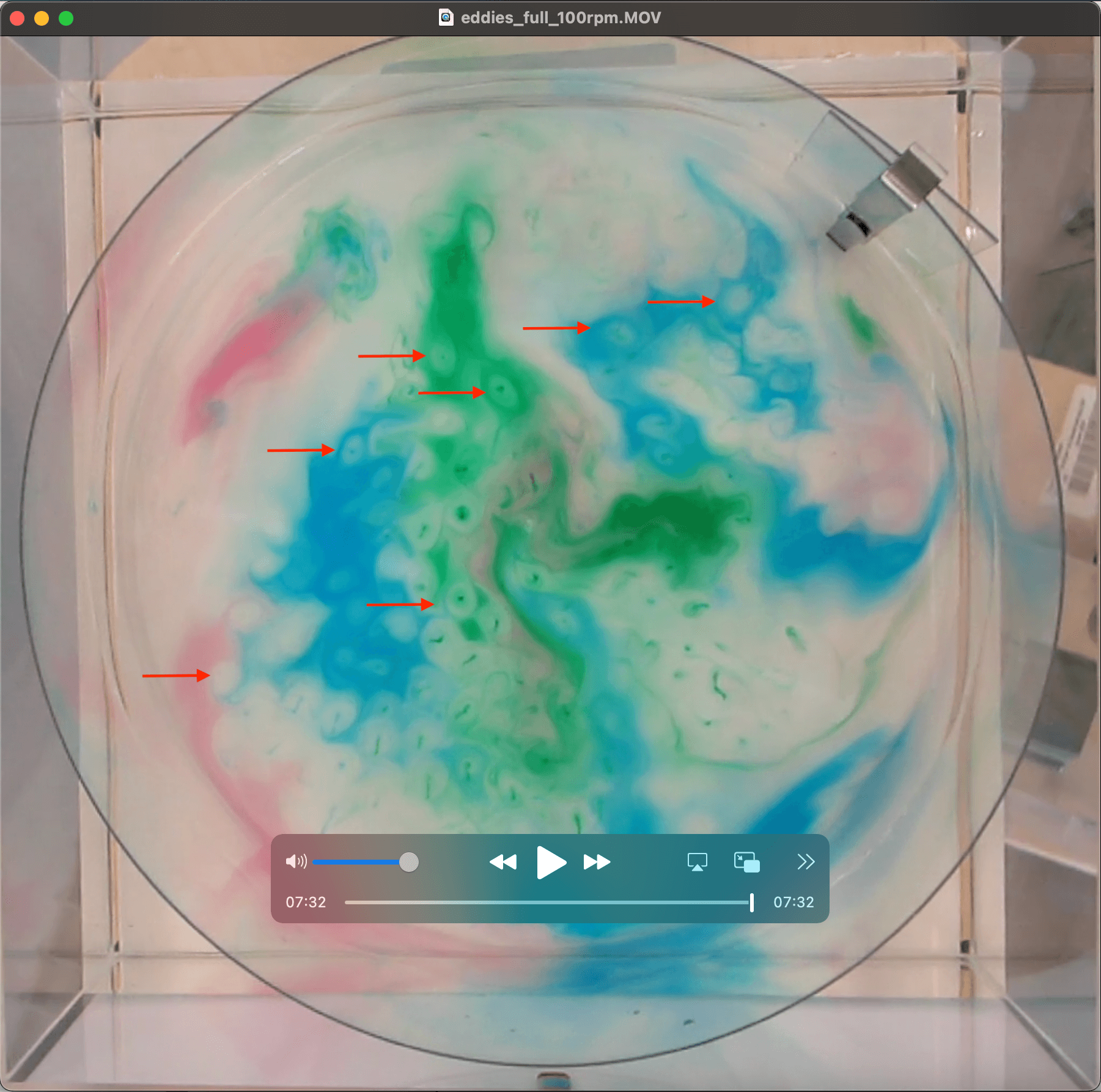
So where does that come from? Maybe this is where the divergence of sinking water at the foot of the “tornado” moves dyed bottom water out of the way, thus “bunching up” the dye layer and concentrating dye when seen from above?
One question that is still open is if this is Rayleigh-Benard convection. The experiments I can find online show much more regularly packed cells, but then I think they only become really regularly packed when they are fully developed and the forcing is so strong that they need to find the most efficient packing to actually deal with the heat flux. If they aren’t close to each other yet, why should they be in a regular pattern? Maybe if our forcing was stronger or the experiment had run for longer we would also get a regular grid. I would love to see how this experiments develops when it is kept running for longer!
What do you think? More theories? Other things to think about? I had NO IDEA how much I miss this, thanks for inviting me to play, Torge and Jim!!


