Playing with the Community of Inquiry framework
In an old blog post, I wrote about the importance of facilitation/teaching presence in the context of the pandemic and people teaching on video calls from their homes. In there, I refer to one article that refers to lots of older sources, and I think now I finally read one of those…
Garrison et al. (2010) describe their work developing the Community Inquiry framework and the first decade of it being out in the world (back when computer conferencing was new and nobody really knew how it would be usable for education).
Intuitively, this framework makes so much sense to me! This is my interpretation:
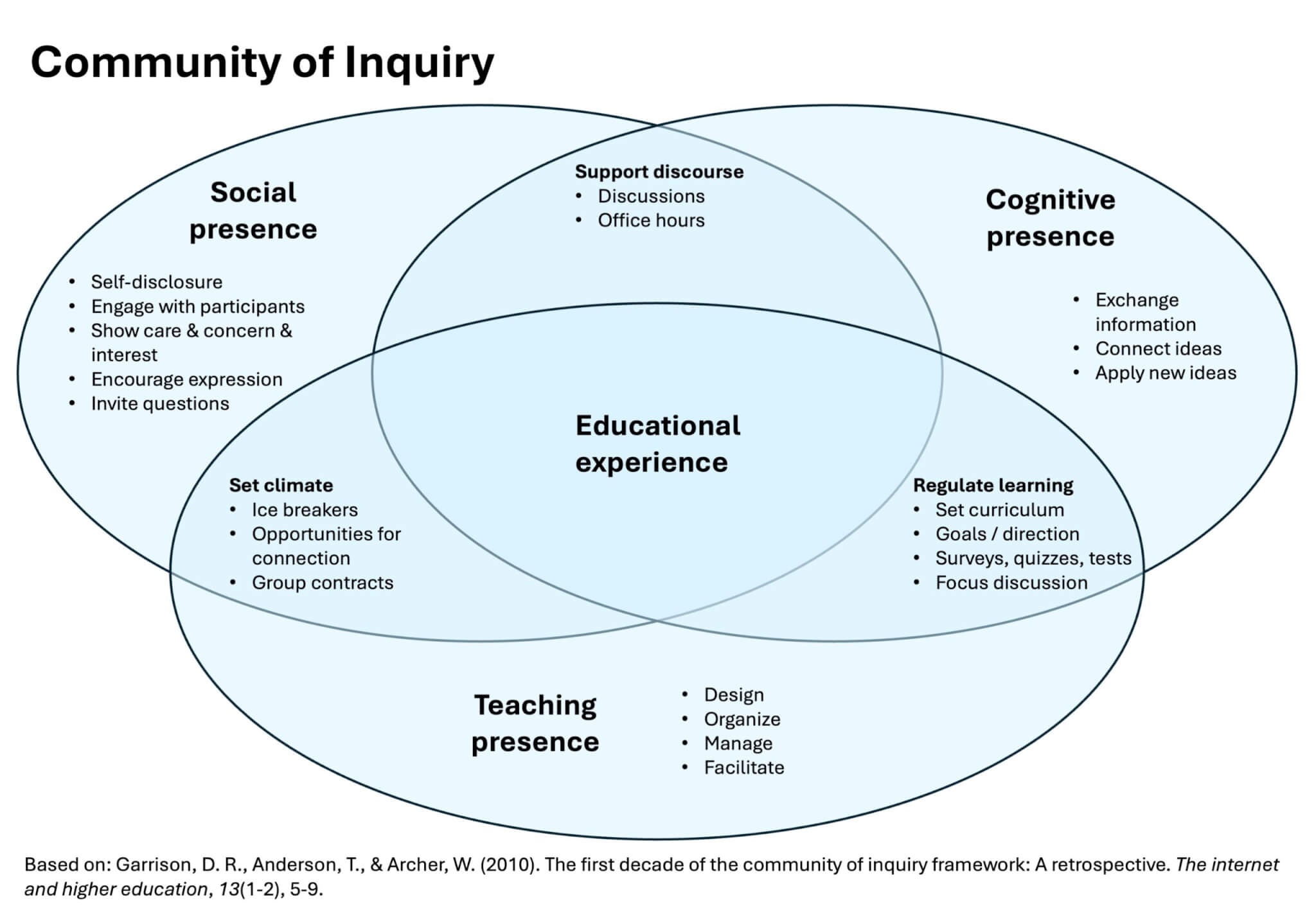
There are three overlapping “presences” that are relevant in teaching: cognitive, teaching, and social presence. In the Venn diagram in the featured image as well as below I describe how I understand them and what happens where they overlap.
Cognitive presence is about the disciplinary knowledge, skills and engagement: exchanging information, connecting ideas, and applying new ideas. Teaching presence is about structuring learning opportunities: first designing them and organizing them in a way that students can find their way around (remember, this model was initially about asynchronous online learning! But this is also relevant for other forms of learning), and then managing and facilitating learning through structures. Social presence is about creating relationships with students: self-disclosure, engagement with participants, showing care, concern, and interest, encouraging expression, and inviting questions. So far, so good; clearly all three are important for learning.
Where two of them overlap, it gets more interesting: Where cognitive and teaching presence come together is where learning is regulated, for example through setting the curriculum, providing directions and goals, setting surveys, quizzes, and tests, and focusing discussions. Social and teaching presence together are about setting the climate for learning: including ice breakers, providing opportunities for connection, maybe negotiating and documenting group contracts. Lastly, social and cognitive presence together are about supporting discourse: offering office hours or other meeting opportunities, facilitating discussions. And then in teaching, in the educational experience, ideally all of this comes together!
I find it really useful to think through those different presences and how they would show up (or more importantly, be purposefully implemented) in my teaching. In the old blog post I was focused on social presence because that was the one that seemed to be most affected by the sudden move online, but also thinking about structuring learning and designing education and cognitively engaging in content as separate for a while is quite useful. Of course, they come together in the actual educational experience (as indicated by the overlap in the Venn diagram), but reflecting on what it is I do to structure learning vs what it means to cognitively engage with the content and socially with the students is useful. And then resulting from that, how learning can be structured for cognitive engagement, or social engagement, and ultimately both.
One thing that I didn’t really understand from reading the article (and reading around on the internet a bit) is whose presence they are talking about. As described above, I find it helpful to consider what it means for the teacher’s presence. It is also useful to consider it from a student perspective — they of course also need to be cognitively engaged, structure their learning, and deal with other people. It is very unclear to me how they think about that in the model.
Relatedly, I was thinking about how the model of Communities of Inquiry relates to Communities of Practice. Maybe that Communities of Inquiry are about educational environments, whereas Communities of Practice are about learning environments. The first one is created by a teacher (see also my focus) for the learners (and of course that is the case in many asynchronous online learning environments), the second one is co-created by a community of learners (but can also be designed and developed). I wonder how one would get the co-creation aspect into a Community of Inquiry framework. Possibly by presenting a graphic like mine above, discussing how we need to create all three presences simultaneously, and then negotiating what that will look like?
It will be fun to play some more with this framework!
Garrison, D. R., Anderson, T., & Archer, W. (2010). The first decade of the community of inquiry framework: A retrospective. The internet and higher education, 13(1-2), 5-9. doi:10.1016/j.iheduc.2009.10.003


