
Experiencing “the power of asynchronous learning” first hand
Several of the advantages of asynchronous learning really came through for me while watching a recording of the Centre for Online and Distance Education’s webinar on “the power of asynchronous learning” (watch on youtube). First — that I even had access to a recording of this seminar and had not just missed it because I wasn’t there live! Second — I really enjoyed the flexibility of watching a recording rather than a live session: I could pause it, go watch northern lights (see featured image!), and continue watching afterwards!
While walking and northern light watching, I thought about asynchronous learning, and how I have recently — in connection with producing our MOOC, but also just generally because I like that format for myself — become more and more interested in exploring online asynchronous learning more deeply, how to build trust and community in that setting. So this came at a great time, the three panelists had such great tips!
One of them, Niya Bond, has interviewed Rachel and me about our work on trust right before Christmas (and that recording will be available soon, exciting times!). And I remember that interview as such a great experience. Niya made me feel calm and welcome and seemed so genuinely curious and excited that it was just a pleasure to talk with her! So watching this recording now felt like getting a glimpse of the “behind the scenes” of how she managed to have that effect on me. She shared three main tips:
“Maximize the micro moments!” This tip is about showing up strategically with a focus on care and human connection. For example by asking for how people want to be addressed, and then using that name consistently; in discussion forums, when giving feedback, … Names are important (and name tents can help in big in-person classes)! Or by sending friendly weekly videos, focusing on encouraging feedback, providing tips & tricks, sharing helpful resources. And by asking open-ended questions. Niya says she uses appreciative inquiry as basis for her work, and she really creates a space online where people feel seen and empowered!
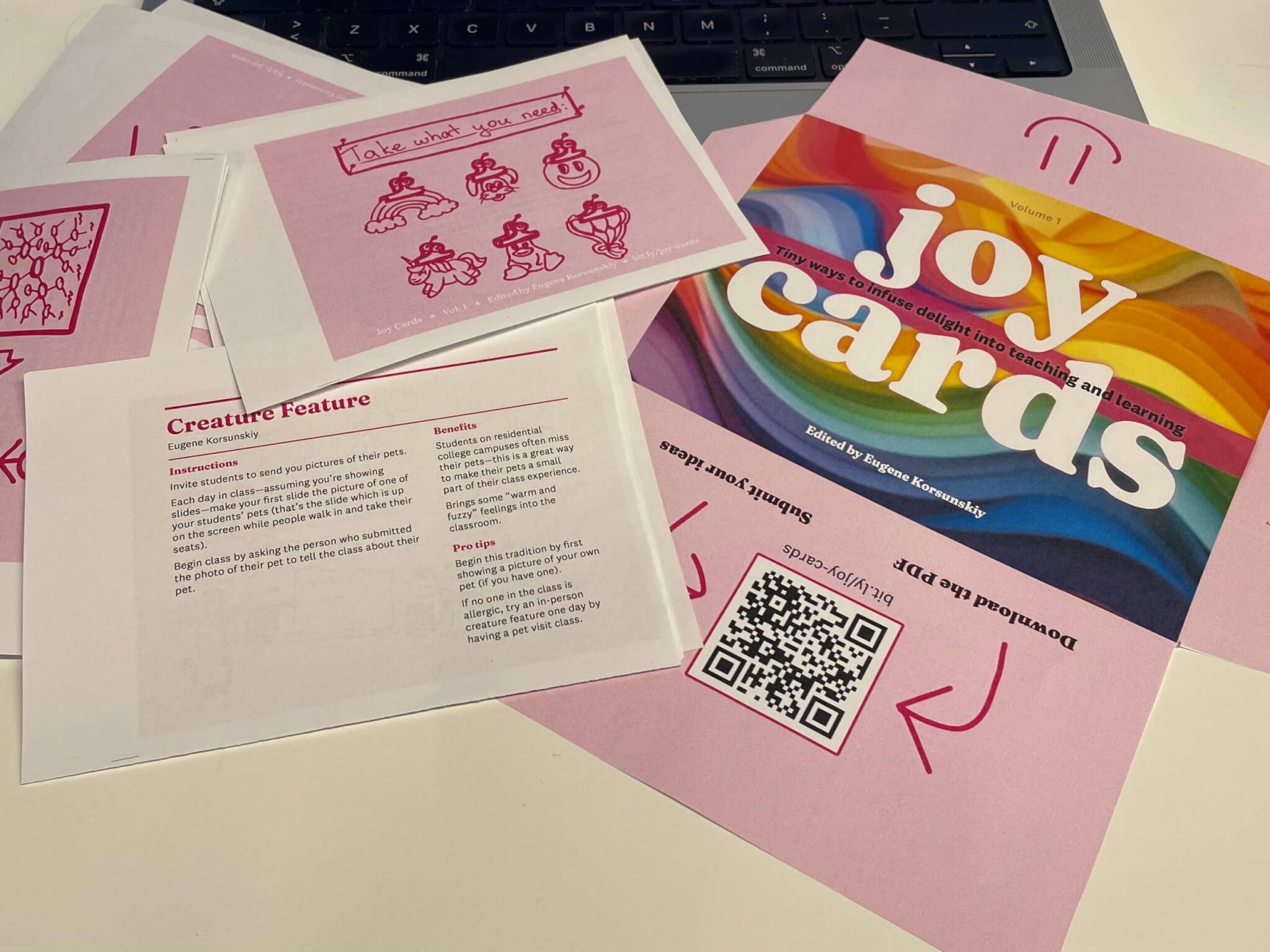
One other example of Niya doing that is this interview on OneHE “Small Ways To Spark Joy In Your Teaching: A Chat With Eugene Korsunskiy”. There, they talk about the super cool collection of “joy cards” with ideas for small and easy ways to introduce more joy into teaching. The one example presented in the interview is “Creature Feature”: Since many students left their pets at their parents’ place when they moved to start uni and now miss them, they can submit pictures to teacher and then each lesson starts with showing one pet and the student gets to talk about how cute and quirky it is for a minute. Such a cool idea! I was texting with Rachel while watching that interview and she pointed out that instead of asking only for pets people have, one could also ask about pets that people would like to have, to make it even more inclusive! (Me: an axolotl! And a big tank of jellyfish) I can really see how something like this would introduce joy into the classroom, and also help build connection!
Also, the joy cards themselves brought so much joy to me when I just printed them, and cut, folded and glued the envelope to store them in. They are pink! One other suggestion on the joy cards is to have lots of sparkly stickers for anyone who wants one to take! And the cards are also a great example for how online asynchronous learning does not just have to be watching stuff on your computer, it can (and should) very much involve doing something with your hands and connecting with the space you are in (even just by having more pink on your desk)!
“Make temporal transparent” (and that is really what I was mostly thinking about during my walk). Asynchronous learning opportunities are accessible anytime anywhere, but always being “on” is not desirable. What is important is to not just consume all the content at once and as soon as it appears, but to instead use it in a way that lets us pause and reflect without having to react immediately (as Niya says: “waiting is still active work”!). Having the opportunity to do that is really one of the main strengths of online asynchronous learning! And it’s the teacher/educator/facilitator’s role to model how to do that. Niya talked about how she makes her own thinking process and time management transparent, for example saying things like “I read your essay on Tuesday, and now on Saturday, I am still thinking about it” (not a direct quote, but something along those lines), and how she models curiosity (type “I was thinking about what you said here and how it fits to this”, “We had a great conversation about x, let’s keep that going and also add in y!”).
“Self care and boundaries are secrets to success” — both for learners and facilitators, very important reminder! This can be communicating that Saturdays are family days so nothing work-related will happen that day, or taking that break to watch northern lights, or so many other things. I feel like self care and boundaries in a world that expects me to be constantly available no matter where I am and what I am doing are really something I need to explore more, both for myself, but also to be able to model and encourage in others.
After this much fan-girling, a quick shout-out to the other two presenters.
Flower Darby (of the small teaching online book! It was so cool to put a face to the name!) also talked about the importance of prioritizing social connection (and how the opportunities typically need to be planned, you cannot rely on them happening naturally!). Opportunities for connection can be as small as tiny acts of self-disclosure, which can already make a big difference (or, as she did, acknowleding that some people will be watching a recording rather than being in the seminar live!). And she showed the method of showing a bunch of different pictures, asking participants to respond to which one represents best how they feel (for example about the upcoming weekend), and to share their why. People who watched live did that in the chat, and Flower highlighted the connections that showed up in the responses: Dog people, cat people, … but also nuances, for example that mountains can mean both adventure or the overwhelming mountain of work that is in front of us. She suggested that learners could rotate and create a slide every week, or submit pictures.
She also suggested using one word associations of how you feel about a topic to activate prior knowledge so that new learning can stick better, even in asynchronous classes in discussion forums. And a really good tip was to provide structures for guided notes for participants!
And the third speaker, Beccy Dresden, had the super relevant tip to actually take courses in the format you will be teaching in yourself to figure out what you like and don’t like, and what works and what does not. S0 important to also look at our teaching “from the other side”!
One last thing I found really interesting is the context of the CODE webinars. You can sign up to participate in real time, or watch the recording on youtube (both for free). If you want, you can sign up and submit a reflection on 5 of the 7 webinars in this year’s series and get a (then paid) certificate, but the date by which you have to sign up is a month after the last webinar, so you have had the chance to watch all of them before deciding on writing a reflection. I think this is such a good way to do things, definitely remembering that for later!


