Journal club on Nagatsu et al. (2020)’s “Philosophy of science for sustainability science”
Late last year, we had a “Transformation Thursday” lunch on philosophy of science, led by a colleague. Now we will follow up on that with a journal club on Nagatsu et al. (2020)’s “Philosophy of science for sustainability science“.
Nagatsu et al. (2020) frame sustainability science (“a field devoted to studying—and ultimately transforming—the way human societies interact with and depend upon the natural environment“) as an atypical science in the sense that it is driven by the desire to solve societal problems (“tensions between balancing the needs of present generations with those of future generations without disrupting the life-support system of the planet“), and that this brings ethical issues to the forefront that might not exist to the same extent in other sciences.
They highlight three areas where philosophy of science can help sustainability science:
- Epistemological issues, which are about where knowledge comes from and how it is applied. How can reliable knowledge be produced that is also practically usable? Discussions around this are for example on methods (e.g. whether randomized control trials should be the gold standard) and on ideals like science being value- and context-free. Or how does one bring together different methods and practices in “integrative problem-solving across university disciplines” (i.e. trans-disciplinarity)? And is that happening based on scholarly considerations or ideology, and does it underestimate the importance of disciplinary knowledge and methods? How do collaboration on truth-seeking and competition for funding play against each other? Or focus on directly applicable results vs long-term theory building? All of these questions are rarely asked when we are deep into the sustainability work, but where taking a break and taking a bigger-picture view is really important!
- Conceptual work, like what do words that we use all the time, like “resilience”, really mean (or, for that matter, “sustainability”)? And how well-defined do concepts need to be to be useful?
- Normativity and values in sustainability science. Sustainability science is done in order to make the world a better place, so clearly there are values involved to know what “better” would look like. But typically science is supposed to be value-free. I would argue that that is impossible anyway, but the authors say that there needs to be some justification of how some values “may legitimately enter into science“, and also make sure that methods and institutions have ways of dealing with biases that might come in via the values.
What I found really interesting when reading this paper is zooming out and looking at the big picture. Especially pondering the influence of policies (institutional, but also funding agencies etc) on what gets researched and what does not, who works together vs not, … This plays out on all levels, but even with decisions like who gets to sit in the same building and uses the same coffee machine, vs on the other end of campus, vs works mostly remotely. What infrastructures are in place for meetings of different groups, and how do they influence what conversations happen and which don’t? Just earlier, I was thinking about the gap in conversations between established academic development courses that have fairly static curricula, and fast and interactive social media on the other, and how to bridge the gap. The decision on whether the gap should be bridged by a blog or a Transformation Thursday, for example, will have such far-reaching effects that are really hard to foresee, and that might get not thought through enough among other considerations, like how feasible or expensive something is to implement. Being reminded to take a step back to look at the big picture is so important! And maybe we need to find a way to ensure that this happens more regularly, and in an informed way. So this upcoming journal club is a good first step in the right direction, and we’ll see what ideas develop in the discussions there!
Nagatsu, M., Davis, T., DesRoches, C. T., Koskinen, I., MacLeod, M., Stojanovic, M., & Thorén, H. (2020). Philosophy of science for sustainability science. Sustainability Science, 15(6), 1807-1817.
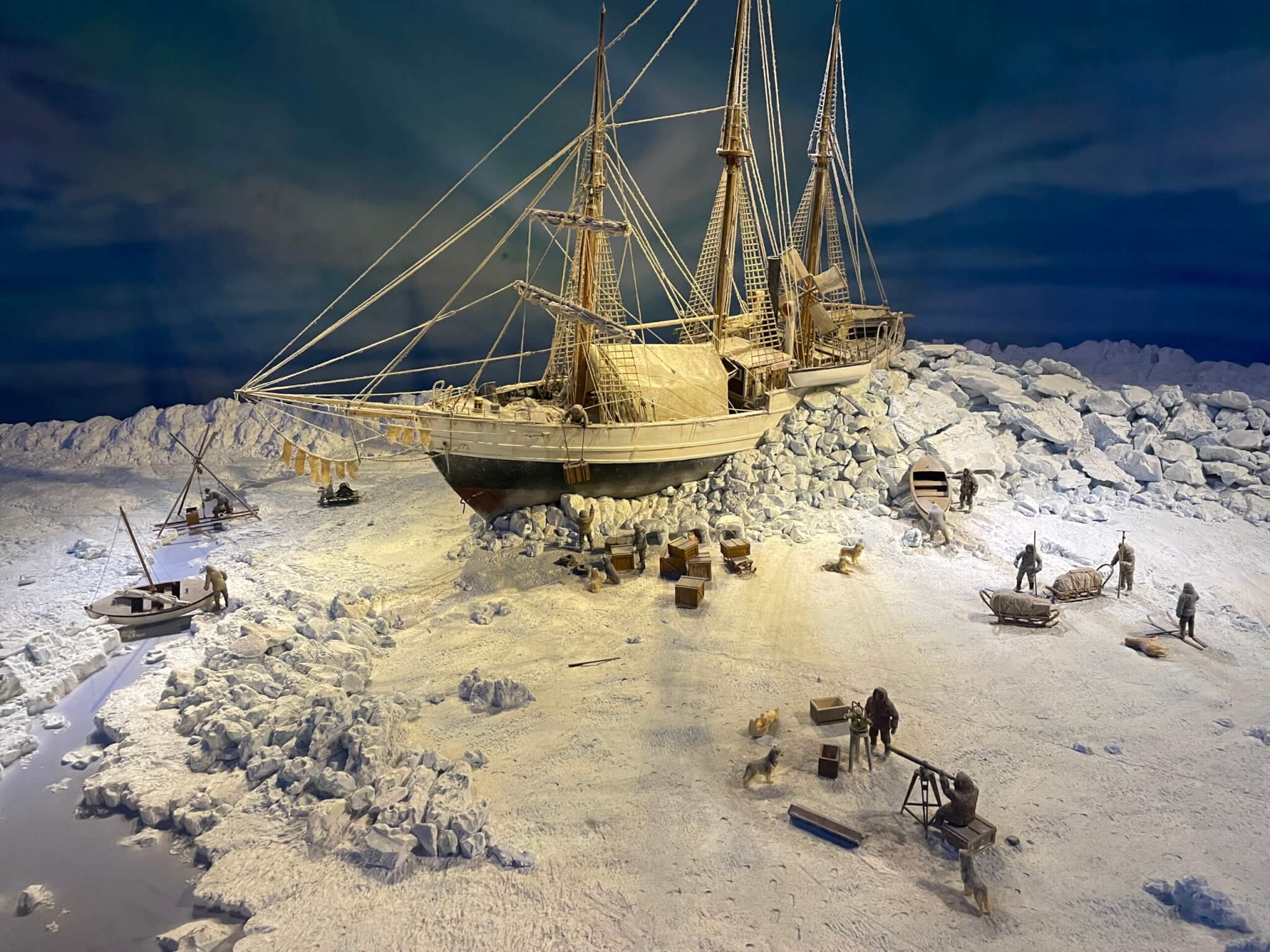
Featured image is a diorama in the Fram museum in Oslo, because I am equal parts impressed by voluntarily freezing a ship into the polar ice for years just to show that a transpolar drift exists and to measure all kinds of stuff while there and all the logistics that were necessary to pull that off, and baffled that people would choose to do this to themselves when they must have known how difficult mentally all of this would be. Also I did not see that one of the doggies had fallen over until Rachel pointed it out.


